Protectionist Visa Policies Reshaping Indian Student Outflows
Source:Indian Express ↗
Why It Matters
Protectionism in developed nations directly impacts India's demographic dividend and human capital migration. Understanding this shift is critical for questions on the diaspora, international relations, and the necessity of domestic education policy reforms like NEP 2020.
Summary
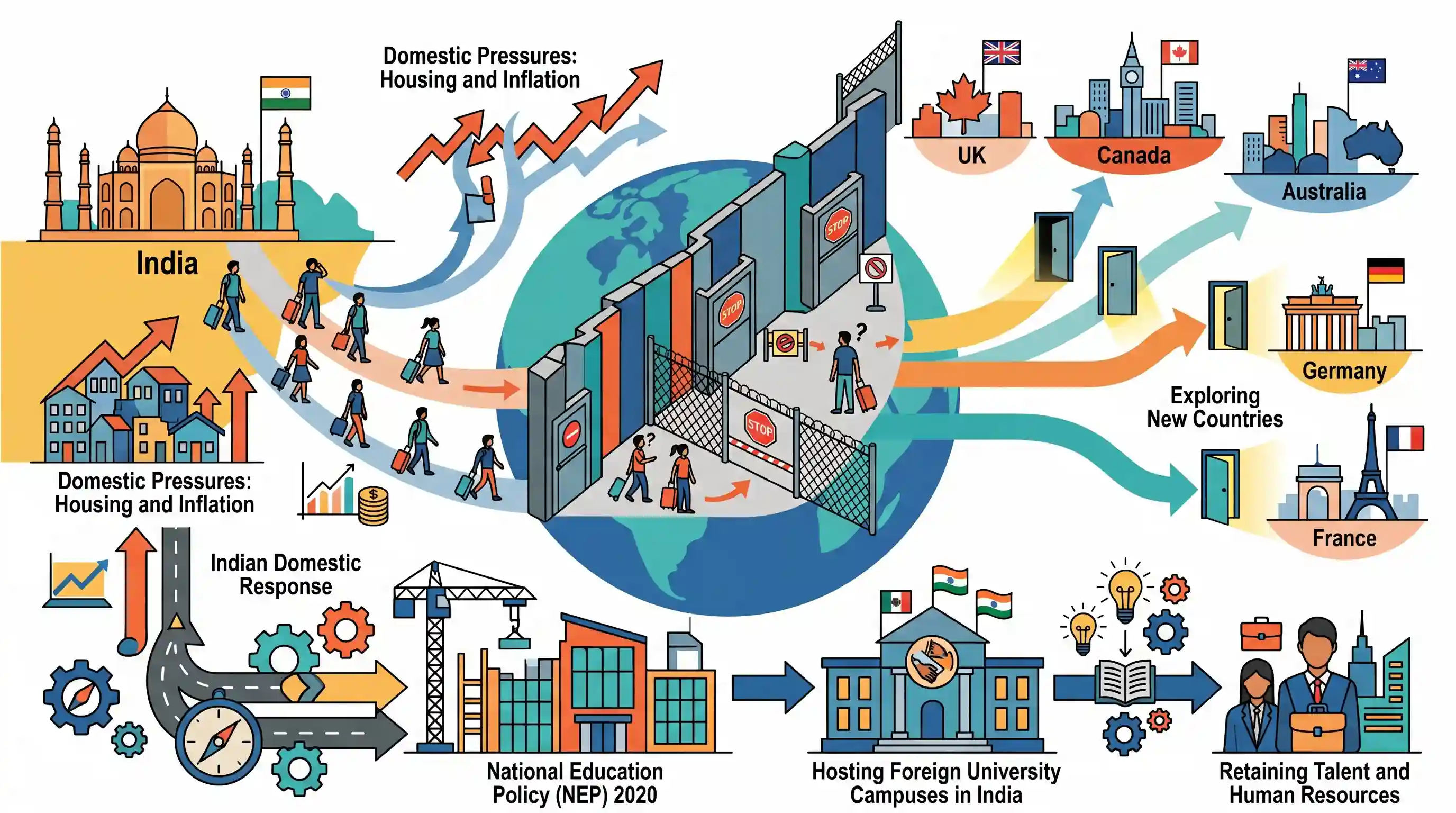
The article analyzes the impact of rising protectionist politics and anti-immigration sentiments in major Western education hubs (such as Canada, the UK, and Australia) on Indian students aspiring to study abroad. Domestic political pressures, including housing crises and economic inflation, have compelled these nations to tighten visa regulations, cap international student intakes, and restrict post-study work rights. This protectionist shift creates uncertainty for Indian students, prompting a need to explore alternative destinations like the EU (Germany, France). For India, this scenario underscores the urgency to upgrade domestic higher education infrastructure and accelerate the implementation of the National Education Policy (NEP) 2020 to host foreign university campuses, thereby retaining talent and mitigating brain drain.
Key Points
- Major international education hubs like Canada, the UK, and Australia are implementing restrictive student visa policies due to domestic political pressures, including housing shortages and anti-immigration sentiments.
- These protectionist measures disrupt the plans of Indian students—who form one of the largest international student cohorts—by limiting post-study work opportunities and increasing visa scrutiny.
- The shift is forcing Indian students to explore alternative, non-traditional study destinations in the European Union (such as Germany and France) and parts of Asia.
- The situation presents a strategic opportunity for India to capitalize on its National Education Policy (NEP) 2020 by inviting foreign universities to establish campuses locally, thereby upgrading domestic higher education.
- Strengthening Indian higher education infrastructure will help retain human capital, mitigate brain drain, and harness the nation's demographic dividend more effectively.
Important Terms
National Education Policy (NEP) 2020

A transformative framework for India's education sector, emphasizing 'internationalization at home' by allowing top foreign universities to establish campuses and encouraging Indian institutions to expand globally.
UPSC context
GS Paper II (Social Justice/Education). Tests understanding of structural reforms to curb brain drain and enhance global competitiveness.
Protectionism
Economic and political strategies, such as visa caps or stricter immigration rules, used by nations to prioritize domestic interests (e.g., housing or jobs) over international labor and student mobility.
UPSC context
GS Paper II (International Relations). Key for analyzing how developed-nation domestic politics affect India's interests and diaspora.
Post-Study Work Visas
Temporary permits allowing international graduates to work in their host country; recent restrictions in major hubs like the UK and Canada have significantly impacted the return on investment for Indian students.
UPSC context
GS Paper II (International Relations). Relevant for discussing bilateral mobility agreements and diaspora welfare.
Foreign Higher Educational Institutions (FHEIs)
Global universities (typically ranked in the top 500) now permitted under 2023 regulations to establish and operate independent, autonomous branch campuses within India.
UPSC context
GS Paper II (Governance/Education). Tests knowledge of regulatory frameworks for liberalizing higher education and reducing forex outflow.
University Grants Commission (UGC)
India's apex statutory body for higher education standards; it is the primary regulator responsible for notifying and overseeing the entry of foreign university campuses in India.
UPSC context
GS Paper II (Statutory/Regulatory Bodies). Central to institutional governance and quality assurance in Indian education.
Prelims Trap
International student mobility falls under Mode 4 (Presence of natural persons) of the WTO GATS framework.
Students travelling abroad for education are classified under Mode 2 (Consumption abroad). Mode 4 applies strictly to the temporary movement of skilled professionals providing services.
Static Concepts Connected
What are the four modes of services supply under the WTO GATS framework?
- Mode 1 (Cross-border): Services cross the border without people moving (e.g., online distance learning, telemedicine).
- Mode 2 (Consumption): The consumer travels to the supplying country to consume the service (e.g., studying abroad, tourism).
- Mode 3 (Commercial presence): A service provider establishes a physical branch in another country (e.g., foreign university campus in India).
- Mode 4 (Natural persons): Individuals travel temporarily to another country to provide a service (e.g., IT consultants, guest lecturers).
What are the UGC conditions for foreign universities setting up campuses in India?
- Eligibility Criteria: Must be ranked in the global top 500 (overall or subject-wise) or be highly reputed in their home jurisdiction.
- Operational Autonomy: They have freedom to decide fee structures and admission criteria, but programs cannot be offered online or via distance learning.
- Fund Repatriation: Cross-border movement of funds, including repatriation of surplus, is permitted under the Foreign Exchange Management Act (FEMA).
Cross-Topic Patterns
Education outflow and Current Account Deficit
The massive expenditure by outbound students acts as a significant outflow in invisibles under the Current Account, structurally widening India's CAD and impacting foreign exchange reserves.
Shifting from GATS Mode 2 to Mode 3
Restrictive visas act as non-tariff barriers to GATS Mode 2 (studying abroad). India’s NEP 2020 counters this by promoting Mode 3 (FDI via foreign campuses setting up locally).

Expect a Mains question linking Western visa protectionism to India's Forex drain and the macroeconomic necessity of NEP 2020 foreign campuses.
Linked PYQs · 4
Linked PYQs · 4
- 2015MainsGS2
The quality of higher education in India requires major improvements to make it internationally competitive. Do you think that the entry of foreign educational institutions would help improve the quality of higher and technical education in the country? Discuss.
- 2012MainsGS2
Discuss the likely negative impact of the protectionist measures proposed by the US on India's software industry.
- 2020MainsGS2
National Education Policy 2020 is in conformity with the Sustainable Development Goal-4 (2030). It intends to restructure and reorient education system in India. Critically examine the statement.
- 2020MainsGS2
Indian diaspora has a decisive role to play in the politics and economy of America and European Countries'. Comment with examples.
