Pakistani Strategic Depth Policy Backfires Amid Afghan Taliban Clashes
Source:The Hindu ↗
Why It Matters
The evolving dynamics between Pakistan and Afghanistan are crucial for India's regional security calculus. Understanding the failure of Pakistan's 'strategic depth' policy and the blowback of state-sponsored terrorism helps UPSC aspirants analyze South Asian geopolitics, counter-terrorism strategies, and India's neighborhood policy.
Summary
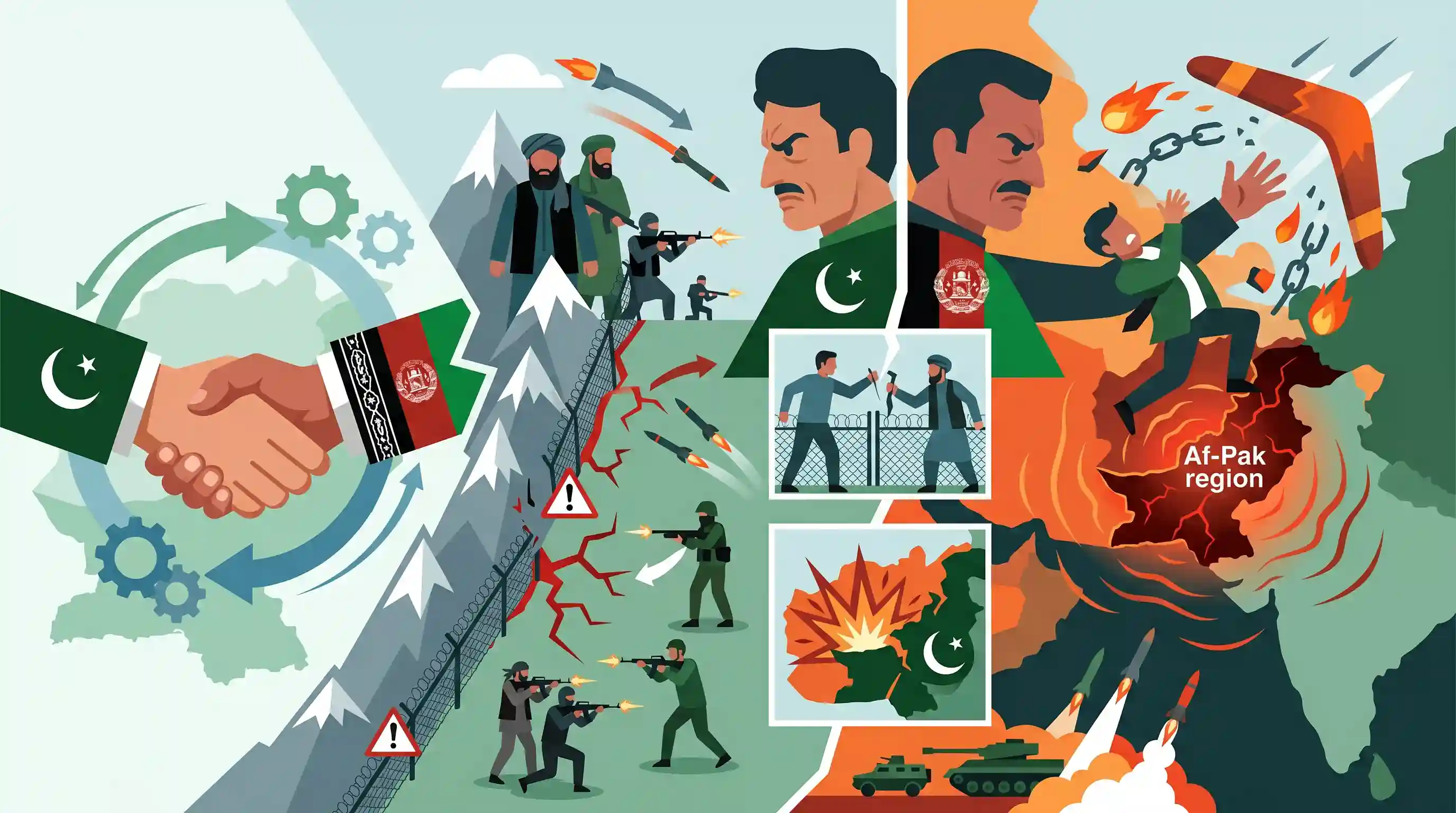
The article analyzes the deterioration of ties between Pakistan and the Afghan Taliban, transforming them from strategic allies into hostile neighbors. Historically, Pakistan supported the Taliban to secure 'strategic depth' and counter Indian influence in Afghanistan. However, since the Taliban's 2021 return to power, disputes over the Durand Line and Afghanistan's harboring of the Tehreek-e-Taliban Pakistan (TTP) have sparked border skirmishes and reciprocal military strikes. This escalating conflict exemplifies the severe blowback of Pakistan's reliance on militant proxies as an instrument of state policy, creating geopolitical volatility in the Af-Pak region with broader security implications for South Asia.
Key Points
- Pakistan historically supported the Afghan Taliban to ensure a pro-Islamabad regime in Kabul and gain strategic depth against India.
- Relations have sharply deteriorated since 2021 due to the Afghan Taliban's refusal to recognize the Durand Line as the official border.
- The Tehreek-e-Taliban Pakistan (TTP) utilizes Afghan soil as a safe haven to mount escalating terrorist attacks against the Pakistani state.
- The current hostility, including reciprocal military strikes, underscores the severe blowback of Pakistan's long-standing policy of using militant proxies for geopolitical leverage.
- The instability in the Af-Pak region presents complex security implications for India, affecting regional counter-terrorism dynamics.
Important Terms
Afghan Taliban

Islamist group that ruled Afghanistan (1996–2001) and regained power in 2021. Historically a Pakistani proxy, it now challenges Islamabad over border disputes and sheltering the TTP.
UPSC context
GS-II: India and its Neighborhood. Critical for understanding regional security, Af-Pak dynamics, and the impact of extremist regimes on India's interests.
Tehreek-e-Taliban Pakistan (TTP)
An umbrella organization of militant factions formed in 2007 seeking to overthrow the Pakistani state. It operates from Afghan sanctuaries, causing severe friction between Kabul and Islamabad.
UPSC context
GS-III: Internal Security. Highlights the role of non-state actors in cross-border terrorism and the "blowback" of using militant proxies for state policy.
Inter-Services Intelligence (ISI)
Pakistan's premier military intelligence agency. It historically nurtured the Taliban to secure "strategic depth" against India but now manages an escalating security crisis with its former protege.
UPSC context
GS-II/III: Security Challenges. Tests knowledge of external state actors' roles in regional instability and proxy warfare.
Durand Line
The 2,640-km colonial-era boundary established in 1893 between British India and Afghanistan. Pakistan recognizes it as an international border, while consecutive Afghan governments reject its legitimacy.
UPSC context
GS-II: International Relations (Borders). Important for understanding Af-Pak border disputes, Pashtun identity, and regional connectivity challenges for India.
Strategic Depth
A Pakistani military doctrine seeking a friendly Afghan government to provide a secure rear and spatial buffer in the event of a conventional war with India.
UPSC context
GS-II: India and its Neighborhood. Explains Pakistan's historical Afghanistan policy and its attempts to minimize Indian influence in Kabul.
Prelims Trap
The Durand Line is a mutually recognized international boundary between Pakistan and Afghanistan.
No Afghan government, including the Taliban, has ever formally recognized the 1893 Durand Line as an international border, making it a perpetually contested de facto boundary.
Static Concepts Connected
What are the key British-era boundary lines in the Indian subcontinent?
- Durand Line: Demarcated in 1893 by Sir Mortimer Durand, dividing ethnic Pashtun territories between British India and Afghanistan; currently borders Pakistan and Afghanistan.
- Radcliffe Line: Published in 1947 as the boundary demarcation line between India and Pakistan (including present-day Bangladesh) following partition.
- McMahon Line: Proposed in 1914 at the Simla Convention as the boundary between Tibet and British India; recognized by India but disputed by China.
What is Pakistan's 'Strategic Depth' doctrine?
- Core Objective: To secure a pliant, friendly government in Afghanistan to provide a rear base for Pakistani military forces in the event of a conventional war with India.
- Execution Strategy: Relying on proxy non-state actors (like the Afghan Taliban) as instruments of state policy to prevent Indian influence in Kabul.
- Blowback Result: The strategy collapsed as the empowered Taliban asserted independence, sheltering anti-Pakistan militants (TTP) and triggering open cross-border hostility.
Cross-Topic Patterns
State-sponsored terror and Blowback
Pakistan's TTP crisis perfectly illustrates 'blowback', providing a textbook case study for GS-III Internal Security answers on the inherent risks of employing non-state actors as state policy.
India's Pragmatic Afghan Engagement
The Pak-Taliban rift offers India strategic space. Despite not recognizing the Taliban regime, India deploys technical teams and humanitarian aid, reflecting a shift to pragmatic geopolitics.

Expect a 2026 Mains question linking the collapse of Pakistan's 'Strategic Depth' policy to India's evolving pragmatic Afghan engagement.
Linked PYQs · 3
Linked PYQs · 3
- 2016MainsGS2
Increasing cross-border terrorist attacks in India and growing interference in the internal affairs of several member-states by Pakistan are not conducive for the future of SAARC (South Asian Association for Regional Cooperation)." Explain with suitable examples.
- 2025MainsGS3
Terrorism is a global scourge. How has it manifested in India? Elaborate with contemporary examples. What are the counter measures adopted by the State? Explain.
- 2017MainsGS3
The scourge of terrorism is a grave challenge to national security. What solutions do you suggest to curb this growing menace? What are the major sources of terrorist funding?
