Private Institutions Dominate Growth in India AYUSH Education Sector
Source:The Hindu ↗
ఇది ఎందుకు ముఖ్యం
The quality of AYUSH medical education directly impacts India's public health safety and the workforce quality of grassroots-level healthcare. As India advances its national goal of 'Integrative Medicine' to achieve Universal Health Coverage (UHC), unchecked commercialization and substandard training in private AYUSH colleges create poorly-trained practitioners. This compromises clinical safety, leads to unsafe allopathic cross-practice, and erodes the global credibility of India's traditional medicine systems.
సారాంశం
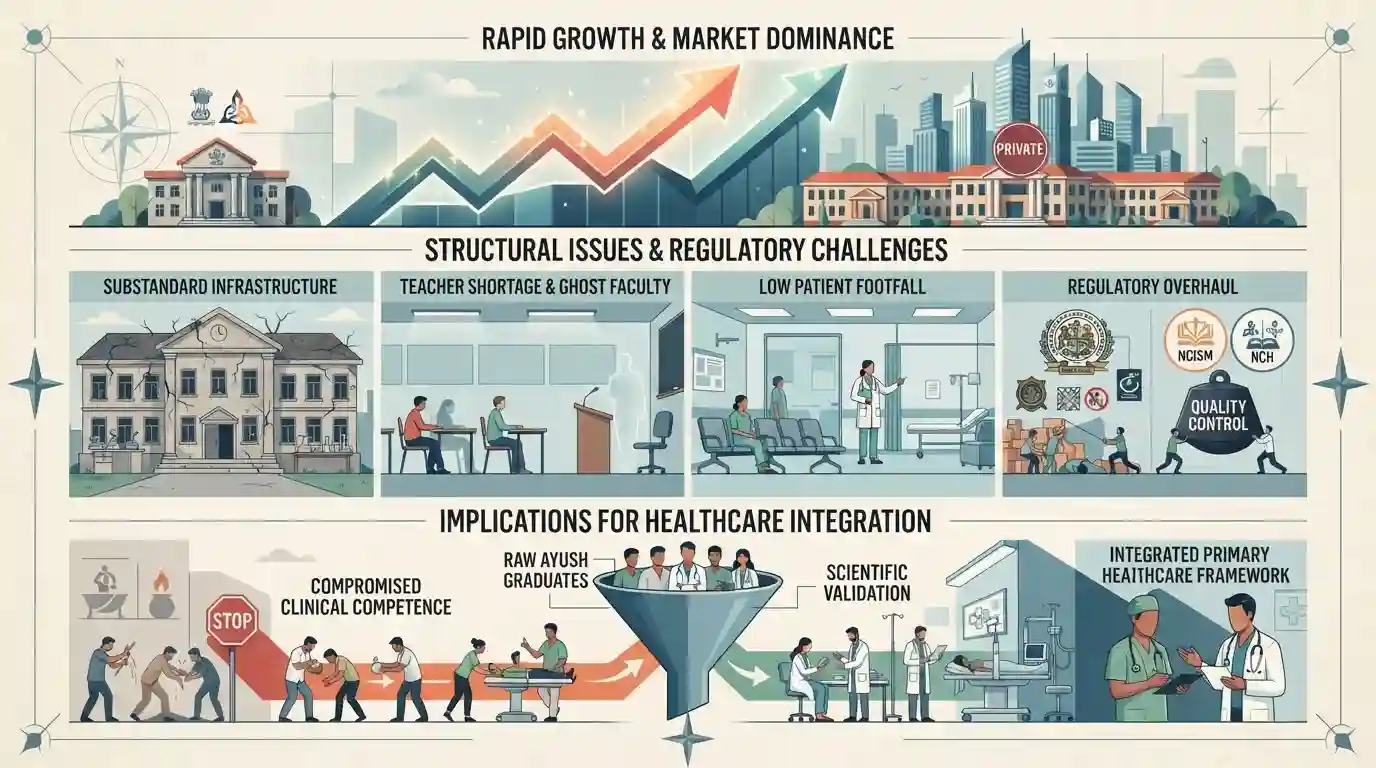
The article discusses the rapid growth and eventual dominance of private (non-government) colleges in India’s AYUSH education sector. It highlights that while there is an educational boom driven by government push and public interest, the market is overwhelmingly controlled by private trusts. This has resulted in several structural issues, including substandard infrastructure, a severe shortage of qualified teachers, the prevalent use of 'ghost faculty,' and extremely low patient footfall in attached training hospitals. Despite regulatory overhauls replacing older councils with the National Commission for Indian System of Medicine (NCISM) and National Commission for Homoeopathy (NCH), enforcing real quality control remains difficult. The article cautions that this unchecked commercialization compromises the clinical competence of AYUSH graduates, encourages unsafe clinical practices, and hinders the scientific validation and integration of traditional medicine into India’s primary healthcare framework.
ముఖ్య అంశాలు
- Private Sector Dominance: Over 70-80% of AYUSH (Ayurveda, Yoga, Unani, Siddha, Homoeopathy) medical colleges in India are run by non-government entities or private trusts, leading to a highly commercialized education model.
- Regulatory and Financial Arbitrage: Establishing an AYUSH college requires significantly lower capital, land, and clinical infrastructure investment than a modern medicine (MBBS) college, making it an attractive business venture for private players.
- Clinical Exposure Deficit: Many private AYUSH colleges fail to run fully functional teaching hospitals with adequate outpatient (OPD) and inpatient (IPD) patient footfall, graduating students with severely deficient clinical and practical training.
- Faculty Crisis and 'Ghost Teachers': The sector suffers from a critical shortage of qualified postgraduates for academic positions, resulting in widespread hiring of 'ghost faculty' who exist only on paper to clear regulatory inspections.
- The NEET Conundrum: While the introduction of NEET standardized entries, private colleges struggle to fill seats due to high fee structures and the overwhelming preference for allopathy, leading to constant lobbying for lowered percentile cutoffs.
- Regulatory Enforcement Challenges: Despite replacing corruption-ridden legacy councils (CCIM/CCH) with the reform-oriented NCISM and NCH under the 2020 Acts, enforcing real-time quality standards across remote, far-flung private institutes remains a massive governance challenge.
- Impact on Integrative Medicine: Substandard AYUSH education produces under-trained graduates, which fosters unsafe cross-practice (prescribing modern medicines without training) and undermines the national goal of mainstreaming traditional medicine into primary healthcare.
ముఖ్యమైన పదాలు
National Commission for Indian System of Medicine (NCISM)

A statutory regulatory body under the Ministry of AYUSH that governs medical education, professional standards, and registration for traditional Indian medicine systems (Ayurveda, Unani, Siddha, Sowa-Rigpa), superseding the CCIM in 2021.
UPSC context
GS Paper II (Governance/Statutory Bodies). Tests health sector regulatory frameworks and medical education reforms.
National Commission for Homoeopathy (NCH)
A statutory regulatory body established under the NCH Act, 2020, that regulates homoeopathic medical education, professional conduct, and practitioner registration, superseding the Central Council of Homoeopathy in 2021.
UPSC context
GS Paper II (Statutory Bodies). Tests professional regulatory reforms in traditional and alternative medical systems.
National AYUSH Mission (NAM)
A centrally sponsored scheme launched in 2014 aiming to promote AYUSH systems through cost-effective services, upgraded health infrastructure, strengthened educational institutions, and traditional drug quality control.
UPSC context
GS Paper II (Welfare Schemes/Public Health). Tests central initiatives targeting primary healthcare and traditional medicine integration.
Ministry of AYUSH
The Union Ministry responsible for policy formulation, education, research, regulation, and standardisation of traditional and non-conventional medical systems like Ayurveda, Yoga, Unani, Siddha, Sowa-Rigpa, and Homoeopathy.
UPSC context
GS Paper II (Governance/Health). Tests institutional governance and mainstreaming of traditional medicine in public healthcare.
Central Council of Indian Medicine (CCIM)
A former statutory body set up under the IMCC Act, 1970, which regulated curriculum, standards, and practitioner registration of Indian medicine systems until its dissolution and supersession by the NCISM in 2021.
UPSC context
GS Paper II (Education/Health Reforms). Tests the evolution of healthcare governance from older councils to modern commissions.
National Eligibility cum Entrance Test (NEET)
The single national-level entrance exam conducted by the National Testing Agency (NTA) for admission to undergraduate medical and dental programs, as well as AYUSH courses in India.
UPSC context
GS Paper II (Education/Governance). Tests standardization, transparency, and federal issues in medical admissions.
ప్రిలిమ్స్ ఉచ్చు
The NCISM regulates all AYUSH systems, including Homoeopathy, and is mandated to set tuition fees for 100% of private college seats.
Homoeopathy is regulated separately by the NCH. Furthermore, NCISM is mandated to frame fee guidelines for at least 50% of seats, not the entire intake.
అనుసంధానమైన స్థిర భావనలు
What is the dual regulatory architecture of AYUSH education in India?
- NCISM role: Regulates Ayurveda, Siddha, Unani, and Sowa-Rigpa systems under the NCISM Act, 2020, replacing the legacy CCIM.
- NCH role: Separately governs Homoeopathy education, medical registers, and ethical standards under the NCH Act, 2020, replacing the CCH.
- Fee regulation mandate: Both commissions have statutory mandates to frame fee guidelines for at least 50% of seats in private colleges and deemed universities.
What is the legal status of cross-practice by AYUSH doctors in India?
- Supreme Court precedent: In the 1998 Dr. Mukhtiar Chand case, the court held that doctors cannot prescribe drugs of medical systems they are not trained in.
- State-level exceptions: Some states exploit Drugs and Cosmetics Rules, 1945, to declare AYUSH doctors as registered practitioners eligible to prescribe basic allopathy.
అంతర-అంశ నమూనాలు
Regulatory capture in social sector services
Connects the proliferation of substandard private AYUSH colleges to broader issues of regulatory rent-seeking and infrastructure deficits seen in private B.Ed and engineering colleges.
Universal Health Coverage vs. Quality Care
Integrating AYUSH aims to resolve rural doctor shortages, but weak educational standards risk creating a two-tiered healthcare system with substandard care for rural populations.

Questions may target the structural division between NCISM and NCH, alongside the statutory fee-regulation limits in private colleges.
అనుసంధాన PYQలు · 1
అనుసంధాన PYQలు · 1
- 2024MainsGS2
In a crucial domain like the public healthcare system the Indian State should play a vital role to contain the adverse impact of marketisation of the system. Suggest some measures through which the State can enhance the reach of public healthcare at the grassroots level.
