Law and order administration and governance trends in Bihar
Source:Indian Express ↗
Why It Matters
Understanding the correlation between political stability and governance outcomes is crucial for GS2. It provides a real-world case study on how shifting political alliances can influence institutional efficiency, police administration, and overall state capacity.
Summary
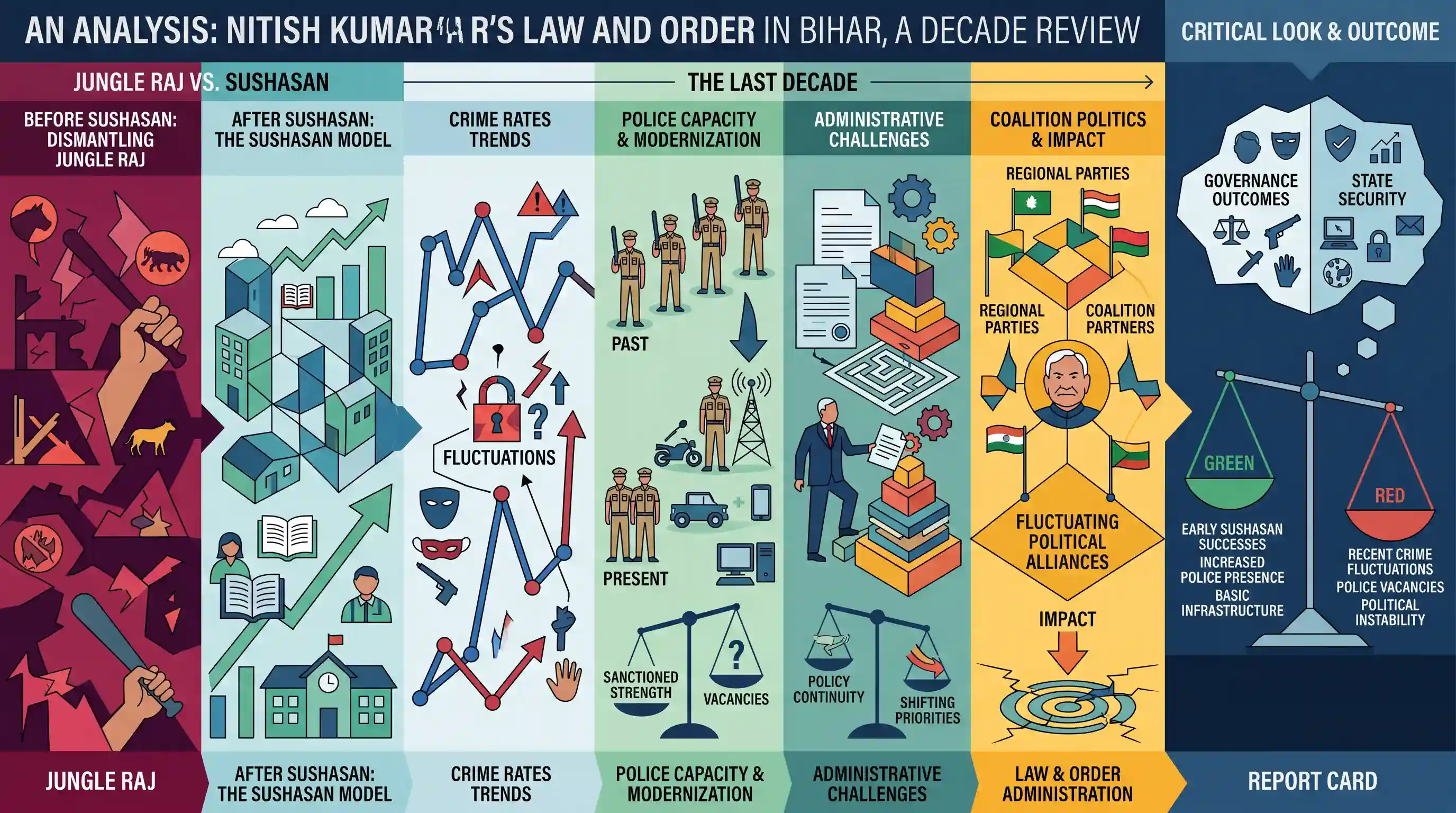
The article reviews the performance of Bihar Chief Minister Nitish Kumar on the law and order front over the past decade. Known initially for dismantling the so-called 'Jungle Raj' and establishing a model of 'Sushasan' (good governance), his administration's recent track record is analyzed in the context of fluctuating crime rates, police capacity, and administrative challenges. The piece explores how frequent political shifts and coalition realignments have impacted governance outcomes, providing a critical look at the intersection of regional politics and state security.
Key Points
- Evaluates the trajectory of law and order in Bihar under CM Nitish Kumar over the past ten years, contrasting recent trends with his initial 'Sushasan' (good governance) model.
- Highlights the impact of frequent political realignments and coalition shifts on administrative stability and police effectiveness.
- Analyzes crime data and public perception to assess whether the state's institutional capacity to control organized crime has weakened.
- Examines the political discourse surrounding crime in the state, with the opposition frequently targeting the government over perceived administrative failures.
Important Terms
National Crime Records Bureau (NCRB)

A nodal agency under the Ministry of Home Affairs (1986) responsible for collecting and analyzing crime data, facilitating the Crime and Criminal Tracking Network & Systems (CCTNS) and fingerprint records.
UPSC context
GS Paper 2 (Governance/Statutory Bodies); GS Paper 3 (Internal Security). Tests knowledge of crime-data infrastructure and evidence-based policy.
Good Governance (Sushasan)
Governance characterized by accountability, transparency, responsiveness, rule of law, and efficiency. In Bihar, it is termed 'Sushasan' to signify the transition from systemic lawlessness to administrative stability.
UPSC context
GS Paper 2 (Governance/Citizen's Charter). Vital for evaluating administrative performance and the efficacy of welfare state initiatives.
Rule of Law
A constitutional principle ensuring that law is supreme and applies equally to all. In policing, it demands that enforcement is legal, non-arbitrary, and protects individual rights against administrative overreach.
UPSC context
GS Paper 2 (Indian Constitution/Polity). Central to discussions on police accountability and the Basic Structure doctrine.
Police Reforms
Ongoing structural and cultural shifts aimed at modernizing law enforcement, reducing political interference, and implementing the 2006 Prakash Singh directives to ensure operational autonomy and accountability.
UPSC context
GS Paper 2 (Polity); GS Paper 3 (Internal Security). High-frequency topic regarding administrative integrity and judicial interventions.
Bihar Police
The state law enforcement agency responsible for internal security in Bihar. It currently faces challenges like a low police-to-population ratio (approx. 81/100,000) and reliance on the colonial-era Police Act of 1861.
UPSC context
GS Paper 2 (Governance). Tests understanding of state-list subjects and the practical hurdles in sub-national police administration.
Crime in India Report
An annual NCRB publication detailing national crime trends, categories (e.g., crimes against women, SC/STs), and disposal rates, serving as a benchmark for evaluating state-level law and order.
UPSC context
GS Paper 2 (Governance). Used for data-driven analysis of state performance and social justice challenges.
Prelims Trap
"Public order and Police are Concurrent List subjects under the 7th Schedule."
Aspirants confuse these with Criminal Law (Concurrent). Public Order and Police are strictly State List subjects (Entries 1 & 2), giving states primary jurisdiction.
Static Concepts Connected
How are internal security and criminal justice distributed in the 7th Schedule?
- State List: Entry 1 (Public Order) and Entry 2 (Police) make states primarily responsible for daily law and order administration.
- Concurrent List: Criminal Law and Criminal Procedure fall here, ensuring uniform penal codes across India alongside state enforcement.
- Union List: Deployment of armed forces in states in aid of civil power is an exclusive Union subject.
What are the core elements of Good Governance per the World Bank?
- Rule of Law: Fair legal frameworks that are enforced impartially, particularly concerning human rights and state security.
- Effectiveness & Efficiency: Institutions must produce results that meet societal needs while making the best use of resources.
- Accountability: Government institutions, the private sector, and civil society must be answerable to the public.
Cross-Topic Patterns
NCRB Data vs. Actual Crime Rates
UPSC often tests the nuance that a higher NCRB crime rate may reflect better digital FIR registration and police accessibility, rather than genuinely deteriorating law and order.
Coalition Instability & Policy Paralysis
Frequent executive realignments disrupt bureaucratic continuity. This connects GS2 coalition politics directly to GS3 investment climates and state economic performance.

Expect a GS2 Mains question linking frequent coalition shifts to administrative policy paralysis and law-and-order deficits in states.
Linked PYQs · 2
Linked PYQs · 2
- 2020MainsGS2
Institutional quality is a crucial driver of economic performance". In this context suggest reforms in Civil Service for strengthening democracy.
- 2022MainsGS2
“While the national political parties in India favour centralisation, the regional parties are in favour of State autonomy.” Comment.
