Comparative Electoral Systems: Israel Proportional vs India FPTP Model
Source:The Hindu ↗
কেন এটি গুরুত্বপূর্ণ
Understanding different democratic architectures like Israel's proportional representation versus India's First-Past-The-Post system provides crucial comparative perspectives for GS2 Polity and governance syllabus, especially regarding electoral design and political stability.
সারসংক্ষেপ
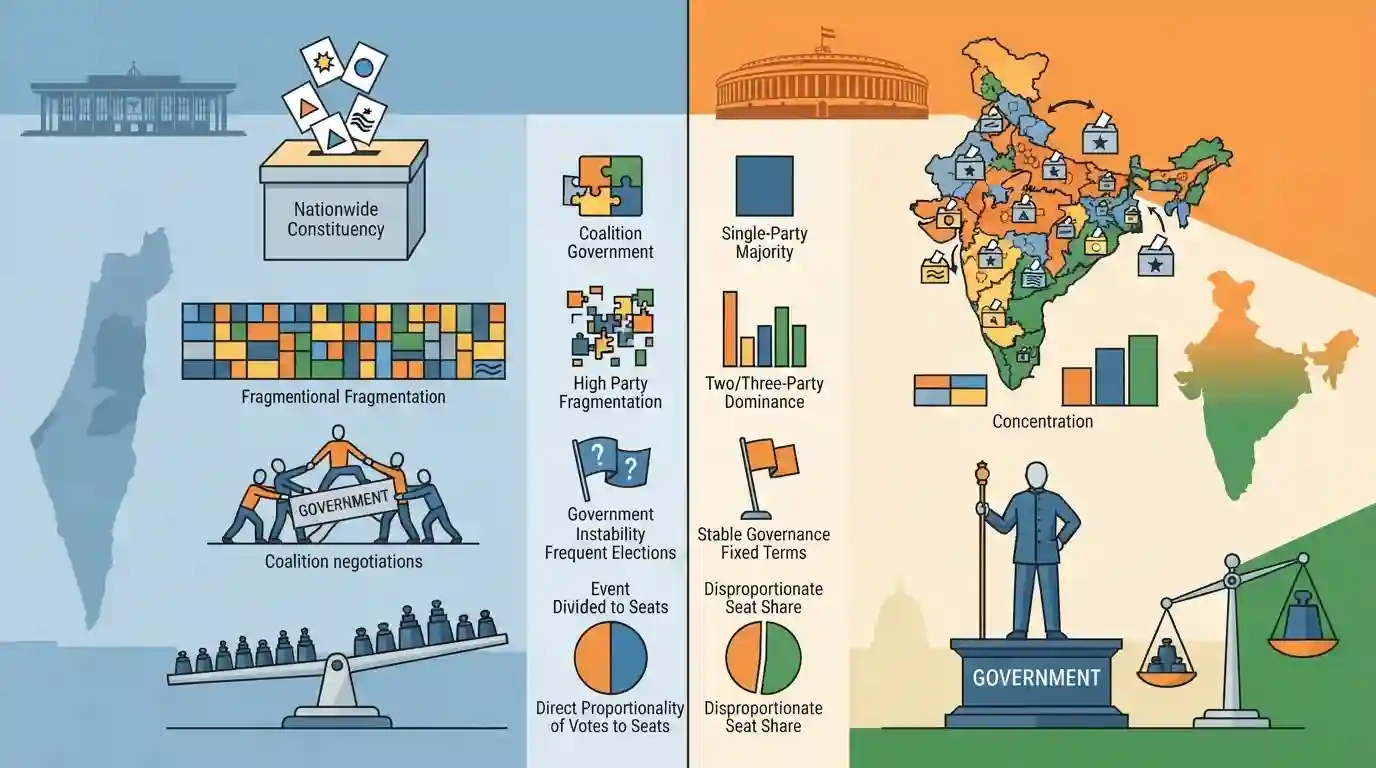
The article compares the electoral systems of Israel and India, contrasting Israel's proportional representation system and single nationwide constituency for the Knesset with India's First-Past-The-Post (FPTP) constituency-based system, highlighting how these structures shape governance, coalition politics, and stability.
মূল বিষয়
- Israel operates under a unicameral parliamentary system called the Knesset consisting of 120 members.
- Unlike India’s First-Past-The-Post (FPTP) system where geographical constituencies elect individual MPs, Israel uses a single nationwide constituency with Proportional Representation (PR).
- In Israel's PR system, parties must cross an electoral threshold (currently 3.25%) to win seats, making coalition governments a necessity.
- India follows a multi-party system with single-member constituencies, generally leading to majority governments or stable pre-poll alliances, contrasting with Israel's frequent post-election coalition negotiations and political instability.
গুরুত্বপূর্ণ শব্দ
Knesset

The unicameral national legislature of Israel consisting of 120 members elected via a nationwide proportional representation system with a single constituency.
UPSC context
UPSC GS Paper II (Comparative Constitutions): Helps compare foreign legislative and electoral frameworks with India's parliamentary democracy.
প্রিলিমস ফাঁদ
Israel uses territorial constituencies to elect members to the Knesset similar to India's Lok Sabha.
Aspirants often confuse Israel's single nationwide district Proportional Representation with India's regional constituency-based FPTP, assuming all democracies elect local MPs.
সংযুক্ত স্থির ধারণা
What are the key differences between First-Past-The-Post (FPTP) and Proportional Representation (PR) electoral systems?
- FPTP Mechanics:: Single-member territorial districts are used; the candidate with the highest votes wins, even without an absolute majority (e.g., India, UK).
- PR Mechanics:: Parties win seats in proportion to total vote share secured; often employs multi-member or nationwide constituencies (e.g., Israel, South Africa).
- FPTP Outcome:: Tends to produce stable single-party majority governments but can result in disproportionate seat-to-vote shares.
- PR Outcome:: Ensures high proportionality and minority representation but frequently necessitates coalition governments and lower stability.
আন্তঃবিষয় প্যাটার্ন
FPTP vs PR in Comparative Constitutions
India's comparative constitutional studies often contrast FPTP stability with Proportional Representation fractionalization across Weimar Germany, Israel, and New Zealand.

Expect a statement-based prelims question comparing FPTP and Proportional Representation mechanics, thresholds, and executive stability.
সংযুক্ত PYQ · 2
সংযুক্ত PYQ · 2
- 2023MainsGS2
Compare and contrast the British and Indian approaches to Parliamentary sovereignty.
- 2024MainsGS2
Examine the need for electoral reforms as suggested by various committees with particular reference to "one nation one election" principle.
