US India Trade Recalibration and WTO Dispute Resolution
Source:The Hindu ↗
Why It Matters
Understanding the nuances of the U.S.-India trade relationship is crucial for UPSC aspirants, as it touches upon both international relations (GS2) and economic diplomacy (GS3). It exemplifies the shift from multilateralism (WTO) to bilateralism in dispute resolution and highlights the strategic interplay between trade policies (like tariffs and GSP) and broader geopolitical alignments (like the Indo-Pacific strategy).
Summary
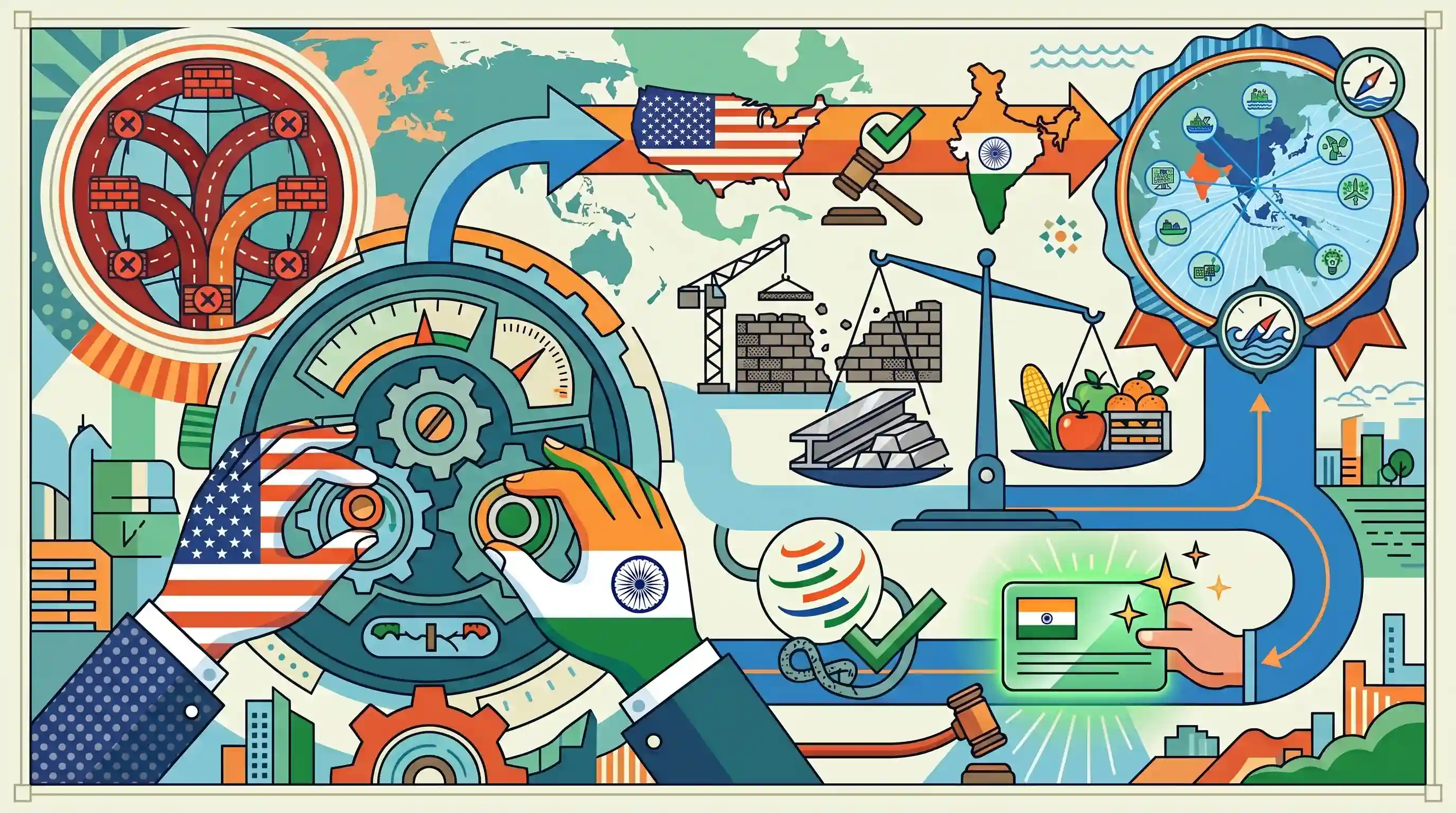
The article discusses recent adjustments and negotiations in the U.S.-India bilateral trade relationship. It highlights how the two nations are actively "tweaking" their trade dynamics by moving away from multilateral disputes towards bilateral resolutions. Key developments include the mutual withdrawal of retaliatory tariffs—specifically concerning Indian steel and aluminum exports and U.S. agricultural products—and the resolution of outstanding WTO disputes. The piece also touches upon the strategic necessity of these trade tweaks amidst global protectionist trends, the potential restoration of India's Generalized System of Preferences (GSP) status, and the overarching goal of deepening economic integration under platforms like the Indo-Pacific Economic Framework (IPEF).
Key Points
- The U.S. and India are recalibrating their bilateral trade relationship to resolve legacy issues and foster greater economic integration.
- A significant aspect of the 'tweaking' involves the mutual resolution of outstanding World Trade Organization (WTO) disputes through bilateral dialogue rather than multilateral arbitration.
- The adjustments include the rolling back of retaliatory tariffs, such as the U.S. easing Section 232 tariffs on Indian steel and aluminum, while India reduces duties on specific American agricultural products.
- There are ongoing discussions around restoring India's beneficiary status under the Generalized System of Preferences (GSP), which was previously revoked.
- These trade maneuvers are strategically aligned with broader geopolitical goals, including strengthening supply chain resilience and cooperation under the Indo-Pacific Economic Framework (IPEF).
Important Terms
Generalized System of Preferences (GSP)

A US trade program providing non-reciprocal, duty-free entry for thousands of products from designated developing countries to support their economic growth.
UPSC context
GS-2 (Bilateral relations) & GS-3 (Economy); tests knowledge of trade benefits and impact of their withdrawal on Indian exports.
Indo-Pacific Economic Framework (IPEF)
A US-led initiative with 14 partner countries focusing on four pillars: Trade, Supply Chain Resilience, Clean Economy, and Fair Economy (anti-corruption/tax).
UPSC context
GS-2 (International groupings); tests understanding of geostrategic economic partnerships and India’s role in the Indo-Pacific region.
World Trade Organization (WTO)
The global international organization governing trade rules between nations, serving as a platform for negotiating agreements and resolving trade disputes through a structured process.
UPSC context
GS-3 (Global institutions); tests awareness of multilateral trade frameworks and recent bilateral dispute resolutions between India and the US.
United States Trade Representative (USTR)
The US cabinet-level official and agency responsible for formulating trade policy, conducting bilateral/multilateral negotiations, and investigating foreign trade practices.
UPSC context
GS-2 (Bilateral relations); tests knowledge of key foreign trade entities and their role in trade negotiations and policy.
Retaliatory Tariffs
Punitive duties imposed by a country against a trading partner in response to perceived unfair trade barriers or previously imposed tariffs.
UPSC context
GS-3 (Economic Development); tests understanding of trade wars, protectionism, and the dynamics of bilateral trade friction.
Section 301
A US legal provision authorizing the USTR to investigate and take action against foreign government acts deemed "unfair," "unreasonable," or "discriminatory" toward US commerce.
UPSC context
GS-2 (Bilateral relations); tests knowledge of domestic laws in major economies that trigger international trade disputes.
Prelims Trap
The Indo-Pacific Economic Framework (IPEF) is a Free Trade Agreement providing mutual tariff reductions and market access.
IPEF is a non-binding economic initiative, not a traditional FTA. It does not include tariff reductions or market access commitments. Furthermore, India opted out of its Trade Pillar entirely.
Static Concepts Connected
How does the Generalized System of Preferences (GSP) relate to WTO rules?
- MFN Exception: GSP acts as a legally authorized exception to the WTO's Most-Favored-Nation (MFN) principle under the Enabling Clause.
- Non-reciprocal benefits: Developed nations grant unilateral tariff reductions to developing countries without demanding equivalent market access in return.
Why did India opt out of the IPEF's Trade Pillar?
- Domestic standards: India opposed the binding commitments on environment, labor, and digital economy standards, fearing they would act as non-tariff barriers to its exports.
- No market access: Unlike standard Free Trade Agreements, IPEF does not offer tariff reductions or reciprocal market access to offset these stringent compliance costs.
Cross-Topic Patterns
WTO Paralysis & Bilateralism
The U.S. and India resolving legacy trade disputes bilaterally reflects the ongoing paralysis of the WTO's Appellate Body, signaling a global shift from multilateral arbitration to bilateralism.
IPEF vs Traditional FTAs
Unlike traditional FTAs, IPEF is framed around supply-chain resilience and clean economy standards, linking international trade directly to geopolitical de-risking from China.

Expect a 2026 Prelims question contrasting India's IPEF Trade Pillar exclusion with the non-reciprocal nature of the GSP mechanism.
Linked PYQs · 2
Linked PYQs · 2
- 2025MainsGS3
What are the challenges before the Indian economy when the world is moving away from free trade and multilateralism to protectionism and bilateralism? How can these challenges be met?
- 2018MainsGS2
What are the key areas of reform if the WTO has to survive in the present context of "Trade War', especially keeping in mind the interest of India?
