India-US Trade Policy Forum Adjustments and Tariff Resolution
Source:The Hindu ↗
Why It Matters
The United States is India's largest trading partner. Tweaks to this trade relationship directly impact India's export competitiveness, macroeconomic stability, and broader geopolitical strategy in the Indo-Pacific region, making it a critical area of study for both IR (GS2) and Economy (GS3).
Summary
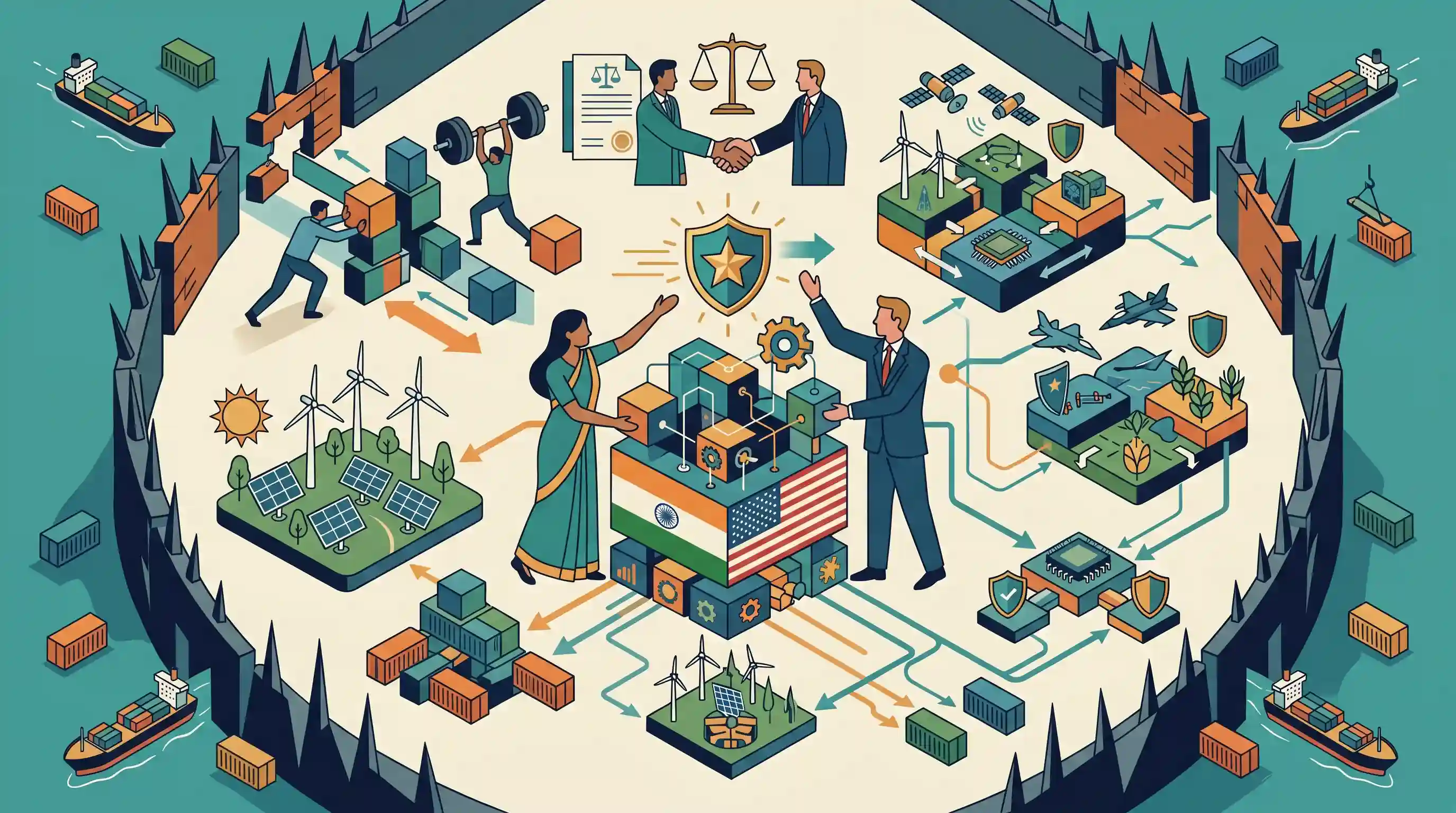
The article examines the ongoing adjustments and 'tweaks' in the India-US bilateral trade relationship aimed at resolving past frictions. Following periods of tariff wars and revoked privileges, both nations are actively engaging through mechanisms like the Trade Policy Forum (TPF) to roll back retaliatory tariffs and settle WTO disputes. The negotiations reflect a strategic convergence where economic ties are being aligned with broader geopolitical goals, such as supply chain resilience and reducing dependence on China. India continues to push for the restoration of its Generalized System of Preferences (GSP) status, while both countries pursue pragmatic, sector-specific agreements rather than a comprehensive Free Trade Agreement (FTA) in an era marked by rising global protectionism.
Key Points
- Resolution of Trade Friction: Focuses on the mutual rollback of retaliatory tariffs on specific goods (like agricultural products, steel, and aluminum) and the amicable out-of-court settlement of longstanding WTO disputes.
- Push for GSP Restoration: Highlights India's persistent diplomatic efforts to regain its beneficiary status under the US Generalized System of Preferences (GSP), which was revoked in 2019, to boost market access for Indian exporters.
- Strategic Economic Alignment: Underlines how trade tweaks are increasingly tied to strategic geopolitical goals, such as building resilient supply chains and the 'China Plus One' strategy.
- Targeted Bilateralism: Reflects a pragmatic shift toward targeted 'mini-deals' and issue-specific agreements through the Trade Policy Forum (TPF), circumventing the complexities of a comprehensive Free Trade Agreement (FTA) amid protectionist domestic sentiments.
Important Terms
Generalized System of Preferences (GSP)

A US trade program providing non-reciprocal, duty-free entry for thousands of products from designated developing countries. It aims to promote economic growth in developing nations; India's beneficiary status was revoked in 2019.
UPSC context
Relevant for GS Paper III (Economy) regarding export incentives and Paper II (International Relations) for India-US bilateral trade frictions.
Trade Policy Forum (TPF)
The primary bilateral mechanism for trade between India and the US. Co-chaired by India’s Commerce Minister and the US Trade Representative, it resolves trade barriers and facilitates sector-specific cooperation.
UPSC context
Significant for GS Paper II (Bilateral Relations), testing knowledge of formal mechanisms for resolving trade disputes and enhancing economic partnership.
Indo-Pacific Economic Framework (IPEF)
A US-led regional initiative with 14 partners focusing on four pillars: Trade, Supply Chains, Clean Economy, and Fair Economy. India has joined all pillars except the Trade pillar, where it maintains observer status.
UPSC context
Important for GS Paper II (International Relations), focusing on regional economic architecture and India's strategic balancing in the Indo-Pacific.
Initiative on Critical and Emerging Technology (iCET)
A bilateral framework led by the National Security Councils of India and the US to expand cooperation in strategic sectors like artificial intelligence, semiconductors, space, and defense technologies.
UPSC context
Crucial for GS Paper III (Science & Tech) and Paper II (International Relations), covering strategic technology transfers and defense cooperation.
World Trade Organization (WTO)
The global international organization dealing with the rules of trade between nations. India and the US utilize its dispute settlement mechanism to resolve trade conflicts, recently settling seven long-standing cases.
UPSC context
Tests GS Paper III (Economy) on global trade rules, dispute settlement mechanisms, and their impact on India’s sovereign trade policy.
Prelims Trap
"The Generalized System of Preferences (GSP) is a legally binding WTO agreement mutually negotiated between developed and developing nations."
GSP is a non-reciprocal, unilateral trade preference program granted by developed countries. It is an exception to MFN rules but is not a binding treaty and can be revoked anytime.
Static Concepts Connected
What is the Generalized System of Preferences (GSP)?
- Unilateral Concession: A preferential tariff system where developed countries grant zero or low duty to imports from developing countries.
- UNCTAD Origin: Instituted in 1971 under UNCTAD; it acts as a formal exception to the WTO's Most Favored Nation (MFN) principle.
- Non-reciprocal: Developing nations are not required to lower their own tariffs in return for receiving GSP benefits.
Why is the WTO Dispute Settlement Mechanism paralyzed?
- Two-tier System: The WTO uses a two-tier system consisting of ad hoc dispute settlement panels and a standing Appellate Body.
- Appellate Blockade: The Appellate Body has been dysfunctional since 2019 because the US systematically blocked the appointment of new judges.
- Bilateral Shift: Without the Appellate Body, appealed panel reports cannot be adopted, forcing nations like India and the US to seek out-of-court bilateral settlements.
Cross-Topic Patterns
Trade Deals & Tech Geopolitics
The shift from comprehensive FTAs to sector-specific 'mini-deals' mirrors strategic alignments in iCET and IPEF, prioritizing supply chain resilience and 'China Plus One' over mere tariff reductions.
WTO Paralysis & Bilateralism
The mutual termination of WTO disputes out-of-court directly reflects the structural crisis of the WTO's Appellate Body, accelerating a global shift towards bilateral trade resolutions over multilateralism.

WTO Appellate Body paralysis driving bilateral out-of-court settlements (like US-India mini-deals) is a high-probability GS2 Mains theme.
Linked PYQs · 4
Linked PYQs · 4
- 2019MainsGS2
‘What introduces friction into the ties between India and the United States is that Washington is still unable to find for India a position in its global strategy, which would satisfy India's national self-esteem and ambitions.’ Explain with suitable examples.
- 2025MainsGS3
What are the challenges before the Indian economy when the world is moving away from free trade and multilateralism to protectionism and bilateralism? How can these challenges be met?
- 2018MainsGS3
How would the recent phenomena of protectionism and currency manipulations in world trade affect macroeconomic stability of India?
- 2018MainsGS2
What are the key areas of reform if the WTO has to survive in the present context of "Trade War', especially keeping in mind the interest of India?
