Constitutional Provisions and Judicial Review of President Rule
Source:The Hindu ↗
Why It Matters
Article 356 and the S.R. Bommai judgment are foundational to understanding Indian federalism, Centre-State relations, and the system of checks and balances. It is highly relevant for both Prelims (constitutional provisions) and Mains (evaluating federal dynamics and judicial review).
Summary
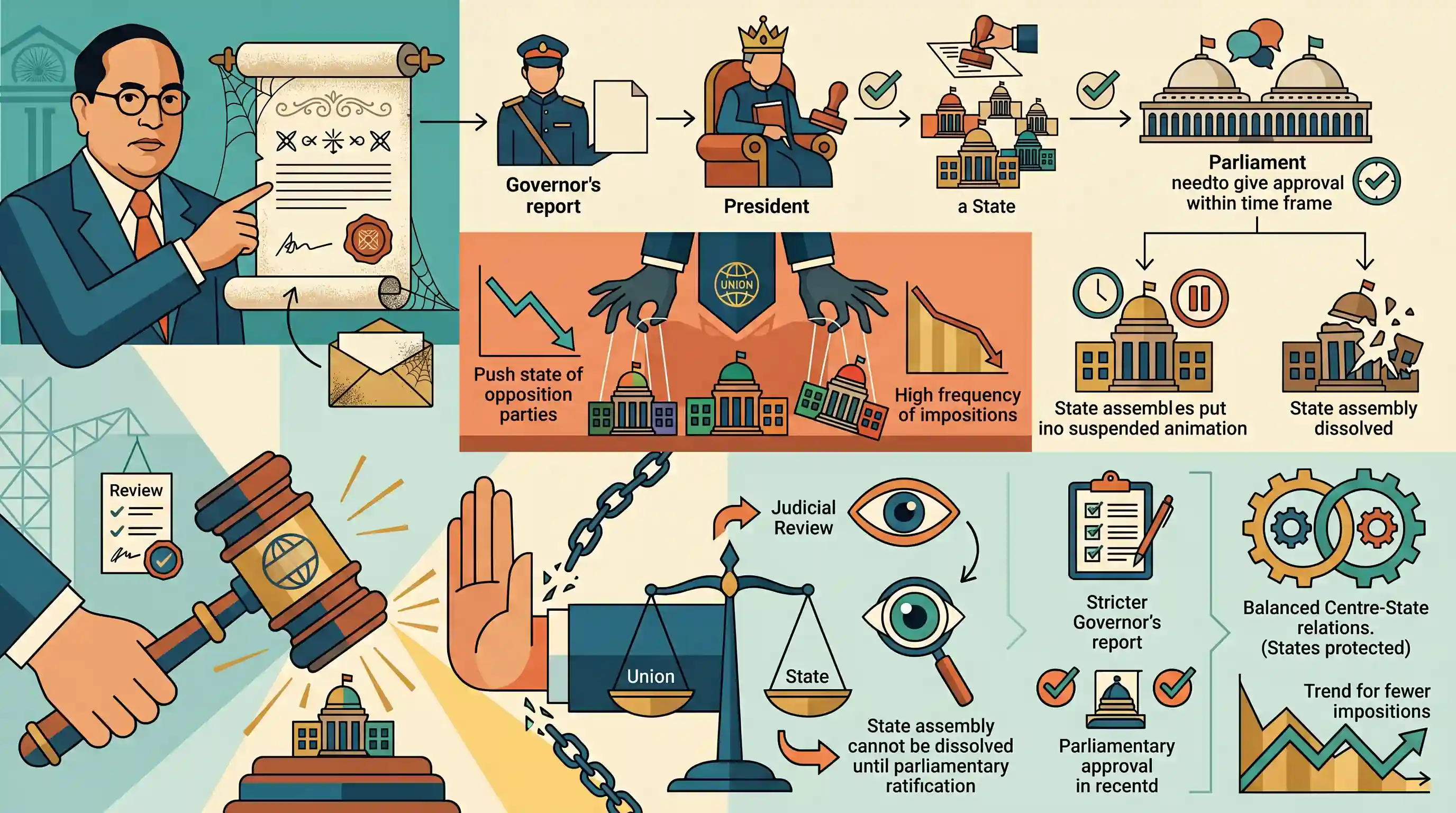
President's Rule under Article 356 of the Indian Constitution allows the Union government to assume control of a state's administration when its constitutional machinery breaks down. While originally intended as a 'dead letter' by Dr. B.R. Ambedkar, the provision was frequently misused for political reasons to dismiss opposition-ruled state governments. The process requires a Presidential proclamation—usually based on a Governor's report—and mandatory parliamentary approval within two months. A state assembly may be placed in suspended animation or dissolved. However, the landmark S.R. Bommai judgment in 1994 fundamentally altered its application by making the imposition subject to judicial review and prohibiting the dissolution of the state assembly before Parliament ratifies the proclamation. This judicial check has significantly curtailed the arbitrary use of Article 356 in recent decades.
Key Points
- Under Article 356, President's Rule can be imposed in a state if the constitutional machinery fails, based on a Governor's report or otherwise.
- Article 365 also allows for President's Rule if a state fails to comply with constitutional directions given by the Union government.
- The proclamation requires parliamentary approval by a simple majority within two months and can be extended in six-month increments up to a maximum of three years, subject to ECI certification after the first year.
- During President's Rule, the Governor administers the state on the President's behalf, and the state assembly can be kept in 'suspended animation' or dissolved.
- The landmark 1994 S.R. Bommai Supreme Court judgment established that Article 356 is subject to judicial review, and the state assembly cannot be dissolved until Parliament approves the proclamation, drastically reducing its misuse.
Important Terms
Article 356

Constitutional provision allowing the President to assume a state's administration if its constitutional machinery fails, based on a Governor's report or otherwise.
UPSC context
GS Paper II (Polity); tests emergency provisions and federal power dynamics.
Article 365
Provision stating that a state's failure to comply with Union directions enables the President to deem the state's constitutional machinery has failed.
UPSC context
GS Paper II (Polity); critical for administrative relations and Union-State conflict.
S.R. Bommai case (1994)
Landmark Supreme Court judgment (1994) that made President's Rule subject to judicial review and mandated a floor test to prove legislative majorities.
UPSC context
GS Paper II (Judiciary/Polity); tests federalism, basic structure, and judicial checks.
Suspended Animation
A state where the Legislative Assembly remains intact but inactive, losing its law-making powers until the proclamation of President's Rule is revoked or lapses.
UPSC context
GS Paper II (Polity); tests procedural knowledge of legislative status during emergencies.
Floor Test
A constitutional procedure to prove a government's majority in the Assembly; the Bommai case declared it the only valid method for testing majorities.
UPSC context
GS Paper II (Polity); essential for understanding Governor's discretion and legislative stability.
President's Rule
Also known as 'State Emergency,' it involves the dismissal of the state's Council of Ministers and the transfer of legislative powers to Parliament.
UPSC context
GS Paper II (Polity); central theme in federalism and Centre-State relation questions.
Prelims Trap
"The State Legislative Assembly is automatically dissolved as soon as the President proclaims Article 356."
Under the S.R. Bommai judgment (1994), the assembly can only be placed in suspended animation initially. It cannot be dissolved until Parliament ratifies the proclamation.
Static Concepts Connected
How is President's Rule approved and extended by Parliament?
- Parliamentary approval: The proclamation must be approved by both Houses of Parliament within two months using a simple majority.
- Maximum duration: Once approved, it lasts for six months. It can be extended up to a maximum of three years with approval every six months.
- 44th Amendment constraint: Extending beyond one year strictly requires either an active National Emergency or an ECI certification that state assembly elections cannot be held.
What is the constitutional difference between Article 356 and Article 365?
- Article 356: Triggered by a general breakdown of constitutional machinery in a state, usually assessed via a Governor's report or other means.
- Article 365: Invoked when a state explicitly fails to comply with, or give effect to, executive directions issued by the Union government.
Cross-Topic Patterns
National vs. State Emergency impacts
Unlike a National Emergency (Article 352) which grants concurrent powers, President's Rule (Article 356) completely dismisses the state executive and transfers all state legislative powers directly to the Parliament.
Role of Governor & Judicial Review
The Bommai judgment sets the foundation for later rulings (like Nabam Rebia) that strictly restrict the discretionary powers of the Governor, subordinating executive decisions to floor tests and judicial scrutiny.

Expect a 2026 prelims question contrasting the exact parliamentary approval conditions (majorities, timelines) of Arts 352, 356 & 360.
Linked PYQs · 2
Linked PYQs · 2
- 2018PrelimsGS1
If the President of India exercises his power as provided under Article 356 of the Constitution in respect of a particular State, then
- 2023MainsGS2
Account for the legal and political factors responsible for the reduced frequency of using Article 356 by the Union Governments since mid 1990s.
