India Mental Health Crisis Policy Responses And Structural Gaps
Source:The Hindu ↗
Why It Matters
Mental health directly impacts human capital and the demographic dividend. The topic spans GS1 (society and youth suicide) and GS2 (public healthcare infrastructure, right to health, and government policies), making it highly relevant for Mains analysis.
Summary
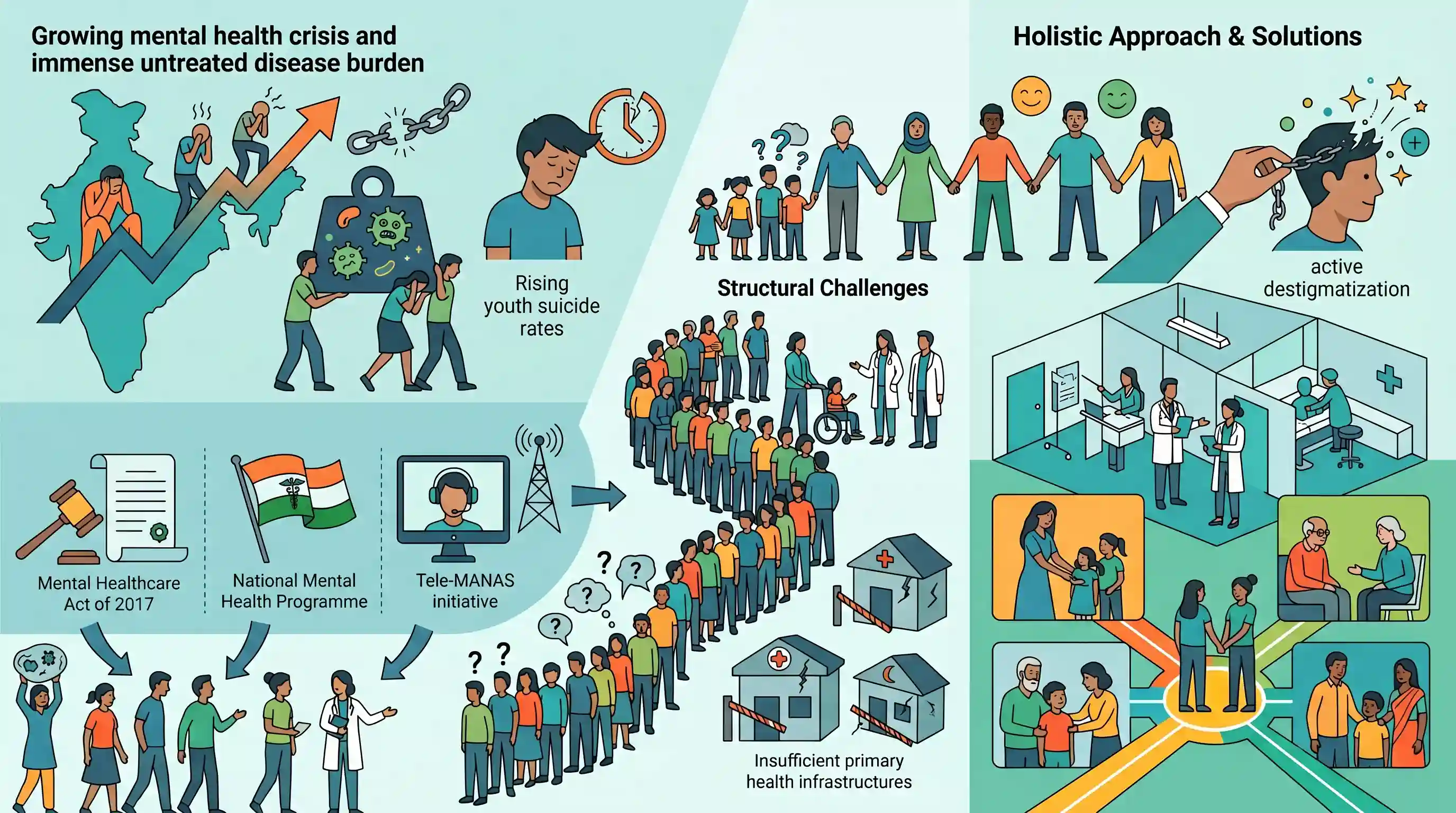
The article analyzes India's growing mental health crisis, characterized by rising suicide rates among youth and an immense untreated disease burden. It evaluates the impact of government interventions such as the Mental Healthcare Act of 2017, the National Mental Health Programme, and the digital Tele-MANAS initiative. Despite these efforts, structural challenges remain, including a drastic shortage of mental health professionals, lack of awareness, and insufficient primary health infrastructure. Tackling the crisis holistically necessitates the integration of mental health into public health services, active destigmatization, and targeted support for vulnerable groups.
Key Points
- India is grappling with a significant mental health burden, reflected in rising suicide rates, particularly among students, young adults, and women.
- The Mental Healthcare Act, 2017, decriminalized suicide attempts and recognized the right to mental healthcare, but gaps in grassroots implementation persist.
- Initiatives like the National Mental Health Programme (NMHP) and Tele-MANAS (a 24/7 tele-counselling service) are key government efforts to bridge the treatment gap.
- There is a severe shortage of trained mental health professionals (psychiatrists, clinical psychologists) relative to the population, hampering rural healthcare delivery.
- Addressing the crisis requires integrating mental health into the primary healthcare system, destigmatizing mental illness, and mitigating socio-economic pressures.
Important Terms
Mental Healthcare Act (MHCA), 2017

A 2017 law ensuring the right to mental healthcare and services. It decriminalizes suicide attempts by presuming severe stress, prohibits inhuman treatments like unmodified ECT, and allows "advance directives" for patients to specify future treatment preferences.
UPSC context
GS Paper II (Social Justice/Health). Tests understanding of rights-based legal frameworks and decriminalization of social issues.
Tele-MANAS
Tele Mental Health Assistance and Networking Across States; a 24/7 toll-free helpline (14416) launched in 2022. It provides free, confidential mental health counseling and specialist consultations as the digital arm of the National Mental Health Programme.
UPSC context
GS Paper II (Governance/Health). Tests knowledge of digital public infrastructure and technology-led interventions in the social sector.
National Mental Health Programme (NMHP)
A flagship initiative launched in 1982 to address India’s mental health burden. It aims to integrate mental health with general healthcare, ensure accessibility for vulnerable populations, and promote community-based rehabilitation and public awareness.
UPSC context
GS Paper II (Health). Tests awareness of the evolution of national health policies and integration of specialty care into primary health.
District Mental Health Programme (DMHP)
The operational arm of NMHP launched in 1996 to decentralize mental healthcare. It focuses on providing psychiatric services at district hospitals, training primary health workers for early detection, and conducting community outreach.
UPSC context
GS Paper II (Social Justice). Tests understanding of decentralization and community-level implementation of health services.
National Crime Records Bureau (NCRB)
An agency under the Ministry of Home Affairs responsible for collecting and analyzing crime data. Its annual "Accidental Deaths & Suicides in India" (ADSI) report provides official statistics for tracking suicide trends and triggers.
UPSC context
GS Paper II (Governance). Tests the ability to utilize official data for evidence-based analysis of socio-economic issues.
Prelims Trap
The Mental Healthcare Act 2017 completely repealed Section 309 of the Indian Penal Code regarding attempted suicide.
It did not repeal the section. It legally presumed 'severe stress' for the attempter, exempting them from prosecution, but the section remained in the IPC until the BNS 2023 overhaul.
Static Concepts Connected
What are the core provisions of the Mental Healthcare Act, 2017?
- Advance Directive: Allows a person to legally specify how they wish to be treated (or not treated) for mental illness in the future.
- Right to Care: Guarantees access to government-funded mental healthcare for BPL and homeless individuals, even without a physical BPL card.
- Decriminalizes Suicide: Presumes anyone attempting suicide is under severe stress, effectively protecting victims from trial and punishment under the penal code.
- Electroconvulsive Therapy (ECT): Bans ECT without muscle relaxants and anesthesia, and completely prohibits its use for minors.
What is the operational structure of the Tele-MANAS initiative?
- Nodal Agencies: NIMHANS serves as the apex nodal center, while IIIT-Bangalore provides the underlying technological infrastructure and support.
- Two-Tier System: Tier 1 provides immediate access to trained mental health counsellors; Tier 2 connects callers to specialists (psychiatrists/clinical psychologists) via e-Sanjeevani.
- Grassroots Linkage: Integrated with Ayushman Arogya Mandirs (Health and Wellness Centres) to ensure grassroots follow-ups for tele-consultation patients.
Cross-Topic Patterns
BNS 2023 and legal treatment of suicide
The Bharatiya Nyaya Sanhita (BNS) 2023 replaces the IPC and formally alters the legal treatment of suicide attempts, directly intersecting with the protections first established in the Mental Healthcare Act 2017.
Education policy & youth distress
Rising student suicides link the mental health crisis directly to the NEP 2020's mandate for embedded school counseling and the MoE's 'Manodarpan' psychosocial support initiative.
Digital Health and e-Sanjeevani integration
Tele-MANAS operates as part of India's broader digital health ecosystem, heavily integrating with the Ayushman Bharat Digital Mission (ABDM) and e-Sanjeevani for rural tele-psychiatry.

Expect a multi-statement Prelims question in 2026 combining Mental Healthcare Act 2017 (Advance Directives) and Tele-MANAS nodal bodies.
Linked PYQs · 4
Linked PYQs · 4
- 2023MainsGS1
Explain why suicide among young women is increasing in Indian society.
- 2021MainsGS2
“Besides being a moral imperative of a Welfare State, primary health structure is a necessary precondition for sustainable development.” Analyze.
- 2024MainsGS2
In a crucial domain like the public healthcare system the Indian State should play a vital role to contain the adverse impact of marketisation of the system. Suggest some measures through which the State can enhance the reach of public healthcare at the grassroots level.
- 2019MainsGS2
Performance of welfare schemes that are implemented for vulnerable sections is not so effective due to absence of their awareness and active involvement at all stages of policy process. Discuss.
