Impact of Global Warming on Coastal Sea Breeze Circulation Systems
Source:The Hindu ↗
Why It Matters
Sea breezes are vital for regulating coastal temperatures, dispersing pollutants, and influencing local precipitation. Understanding how global warming alters these local wind systems is crucial for GS-1 Geography (climatology) and GS-3 Environment, particularly for coastal urban planning and environmental conservation.
Summary
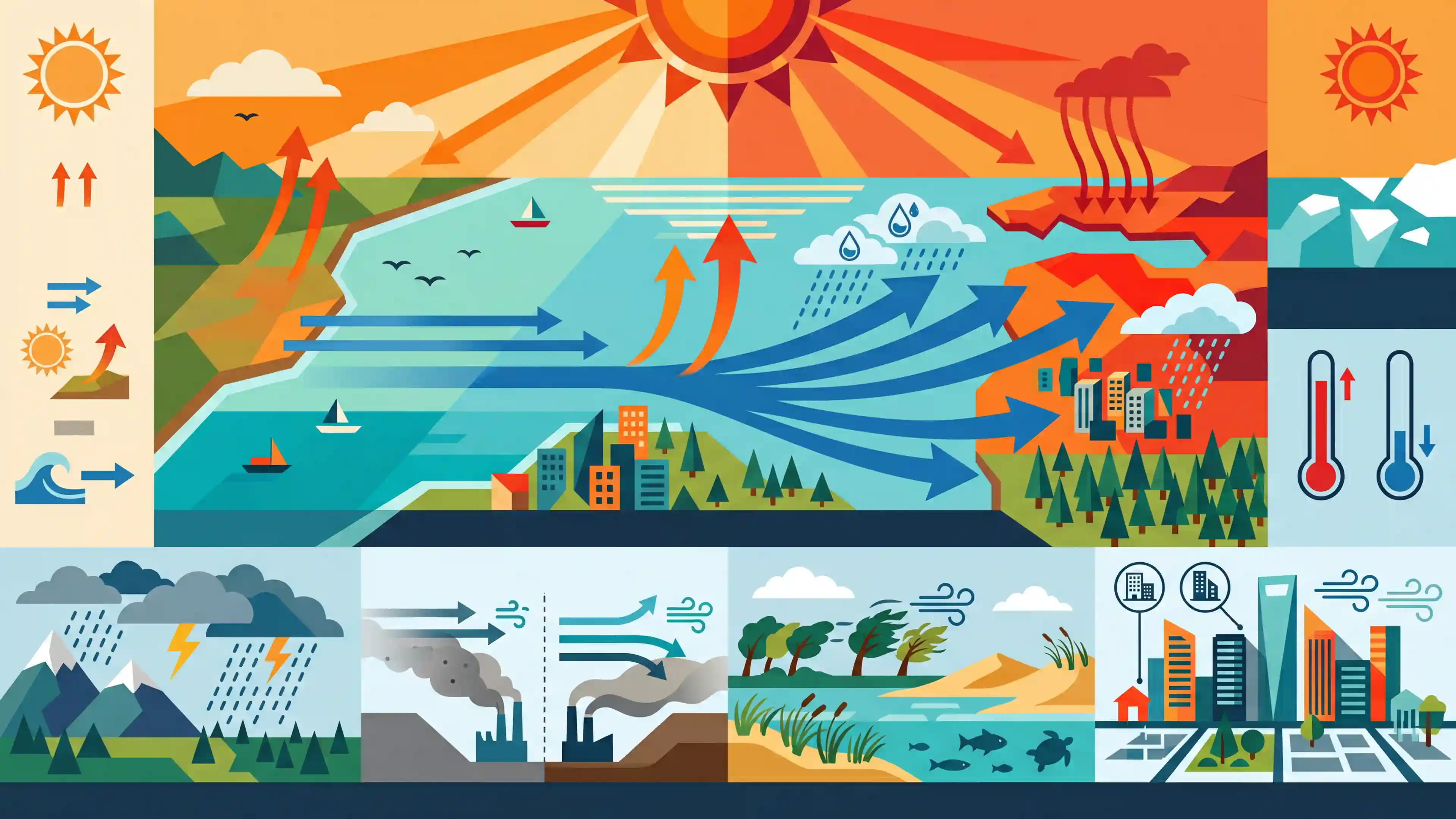
The article explores the impact of global warming on the sea breeze, a critical local wind system driven by the differential heating of land and ocean surfaces. As climate change accelerates, landmasses warm significantly faster than oceans, steepening the thermal gradient that drives sea breezes. This phenomenon can alter the intensity, duration, and inland penetration of these winds, consequently impacting coastal weather patterns, moisture transport, and local air quality. Such micro-climatic shifts have broader implications for coastal ecosystems, pollutant dispersion, and urban planning.
Key Points
- Mechanism of Sea Breeze: It is a local diurnal wind system driven by the thermal contrast between land and sea; land heats up faster than water during the day, creating a low-pressure zone that draws in cooler air from the ocean.
- Impact of Global Warming: Anthropogenic global warming causes land surfaces to heat up more rapidly than sea surfaces, steepening the land-ocean temperature gradient.
- Altered Wind Dynamics: A steeper thermal gradient can intensify the sea breeze, although its actual strength and inland penetration are also modulated by changes in broader atmospheric circulation and background winds.
- Secondary Impacts: Modifications in sea breeze patterns affect coastal temperature regulation, moisture transport, local cloud formation, and the dispersion of atmospheric pollutants in coastal urban areas.
- Regional Variations: The exact manifestation of these changes depends on local coastal topography, the urban heat island effect from coastal development, and regional climate systems.
Prelims Trap
"Global warming weakens sea breezes by rapidly heating ocean waters, reducing the thermal contrast with land."
Land has a lower specific heat capacity and warms faster than oceans. Global warming actually steepens this land-ocean thermal gradient, which can intensify sea breezes.
Static Concepts Connected
What drives the diurnal cycle of Sea and Land Breezes?
- Specific Heat: Land heats and cools faster than water due to its lower specific heat capacity and the lack of vertical mixing in solid ground.
- Daytime (Sea Breeze): During the day, land warms quickly, creating a low-pressure area. Cooler, high-pressure air from over the sea flows inland.
- Nighttime (Land Breeze): At night, land cools rapidly, creating high pressure. Air flows offshore toward the relatively warmer, low-pressure sea.
How does the Urban Heat Island (UHI) effect alter coastal microclimates?
- Thermal Contrast: Concrete and asphalt in coastal cities trap heat, creating localized low-pressure zones that interact with and can artificially enhance sea breeze intensity.
- Friction & Penetration: Rough urban topography (tall buildings) increases surface friction, slowing down natural breezes and reducing their inland cooling penetration.
- Pollutant Trapping: Weakened inland breeze penetration and temperature inversions can trap particulate matter over coastal cities, preventing natural pollutant dispersion.
Cross-Topic Patterns
Sea Breeze and Coastal Air Quality
Explains why coastal cities like Mumbai historically had better AQI than landlocked Delhi, but changing sea breeze dynamics and UHI are now exacerbating their smog days.
Macro vs. Micro Differential Heating
The Indian Monsoon operates on the exact same thermodynamic principle—differential heating of land and sea—as the local sea breeze, just on a planetary and seasonal scale.

Expect a multi-statement prelims question linking specific heat capacity, global warming's differential heating, and coastal UHI pollution.
Linked PYQs · 4
Linked PYQs · 4
- 2014PrelimsGS1
The seasonal reversal of winds is the typical characteristic of
- 2019MainsGS1
Assess the impact of global warming on the coral life system with examples.
- 2021MainsGS1
Briefly mention the alignment of major mountain ranges of the world and explain their impact on local weather conditions, with examples.
- 2022MainsGS3
Discuss global warming and mention its effects on the global climate. Explain the control measures to bring down the level of greenhouse gases which cause global warming, in the light of the Kyoto Protocol, 1997.
