Decarbonisation Pathways and Green Fuel Hubs in Global Shipping
Source:The Hindu ↗
Why It Matters
Decarbonising the maritime sector is essential for global climate goals. For India, it offers a dual opportunity: becoming a global production hub for alternative fuels (green hydrogen, ammonia, and methanol) and revitalizing its domestic shipbuilding industry through green technology investments.
Summary
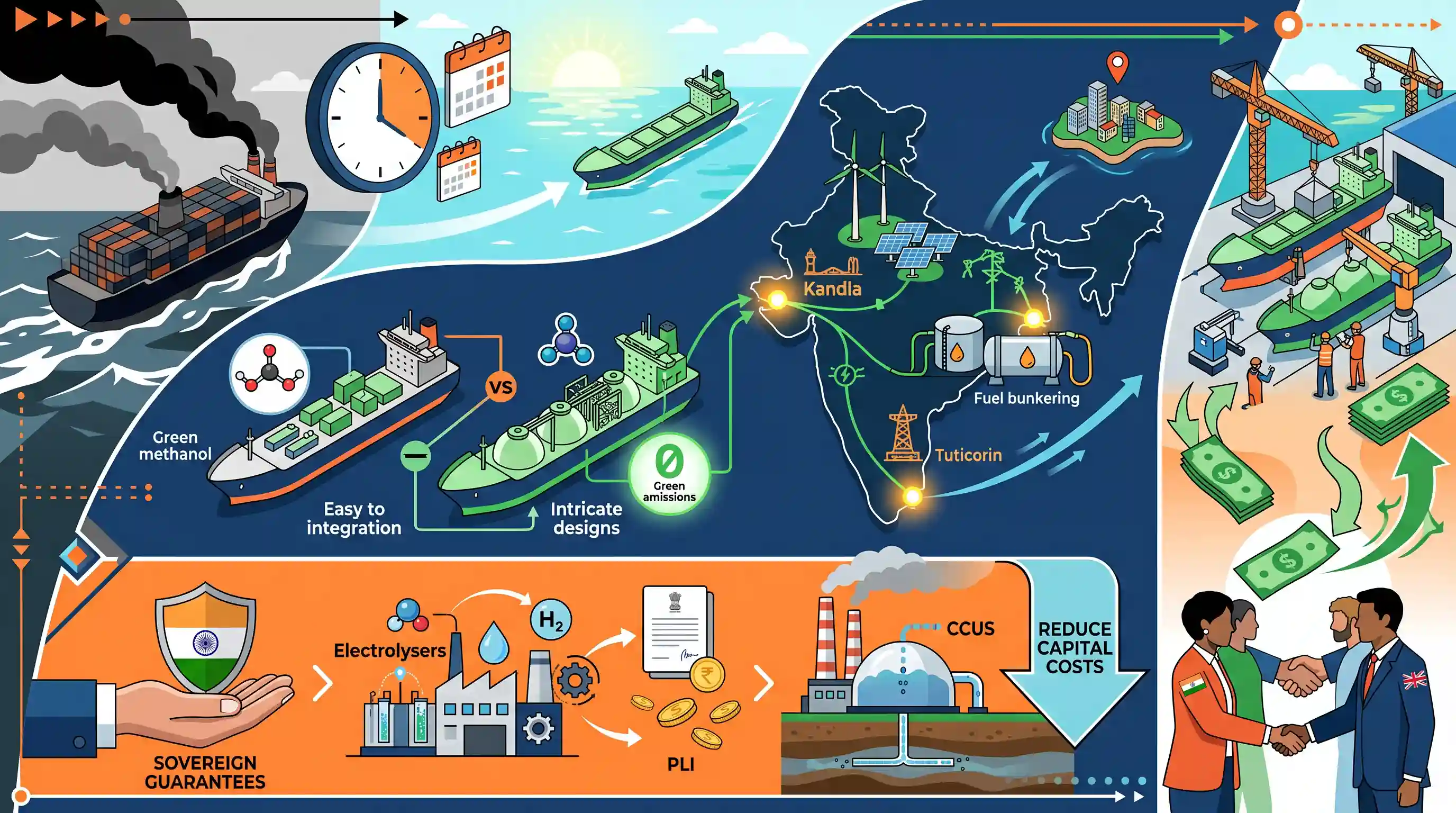
The global shipping industry is charting a course toward decarbonisation by 2040-50, moving away from fossil fuels like Very Low Sulphur Fuel Oil (VLSFO) toward cleaner alternatives such as green methanol and green ammonia. While green methanol is favored for its ease of integration into existing systems, ammonia offers zero greenhouse gas emissions but requires complex onboard modifications. India has an opportunity to become a significant green fuel supplier, planning bunkering points at key ports like Kandla and Tuticorin to serve domestic shipping and global hubs like Singapore. To achieve this, India must leverage sovereign guarantees, Production-Linked Incentive (PLI) schemes for electrolysers, and carbon capture (CCUS) incentives to reduce capital costs. Additionally, the transition provides a strategic pathway to revive India's shipbuilding sector through financial support and international partnerships.
Key Points
- Global shipping aims to decarbonise by 2040-50, transitioning from Very Low Sulphur Fuel Oil (VLSFO) to alternatives like green methanol and green ammonia, with LNG acting as an interim fuel.
- Green methanol is currently the preferred transition fuel as it functions as a drop-in replacement for VLSFO, whereas green ammonia requires complex onboard storage and engine modifications.
- India plans to develop green fuel bunkering hubs at ports like Kandla and Tuticorin (V.O. Chidambaranar port) to supply green fuels domestically and to global maritime hubs like Singapore.
- Scaling green fuel production in India will require sovereign guarantees to lower capital costs, PLI schemes for local electrolyser manufacturing, and incentives for carbon capture, utilisation, and storage (CCUS).
- The shift to green fuels presents an opportunity to revitalize India's shipbuilding industry through government incentives and strategic partnerships with countries like South Korea and Japan.
Important Terms
Production-Linked Incentive (PLI) Scheme

A government strategy providing financial incentives to domestic manufacturers based on incremental sales to boost local production and reduce import dependency.
UPSC context
GS-III: Indian Economy and Industry. Tests knowledge of manufacturing policy and self-reliance (Aatmanirbhar Bharat) initiatives.
Green Methanol
A low-carbon marine fuel produced from green hydrogen and captured industrial CO2; it requires minimal engine modifications, making it a viable 'transition fuel'.
UPSC context
GS-III: Science & Tech/Environment. Relevant for decarbonisation strategies and alternative energy sources for maritime trade.
Green Ammonia
A zero-carbon fuel synthesized from green hydrogen and nitrogen; while promising for long-term shipping goals, it requires complex onboard storage and handling.
UPSC context
GS-III: Environment and Climate Change. Tests understanding of zero-emission technologies and their role in global net-zero targets.
Bunkering
The process and infrastructure of supplying fuel (bunkers) to ships at ports, a strategic service for maritime trade hubs.
UPSC context
GS-III: Infrastructure (Ports & Shipping). Critical for India's ambition to become a global maritime logistics hub.
Carbon Capture, Utilisation and Storage (CCUS)
Technologies that capture CO2 from industrial sources to be reused (e.g., in fuel production) or stored underground to mitigate global warming.
UPSC context
GS-III: Environmental Conservation. Essential for climate change mitigation in 'hard-to-abate' industrial sectors.
Very Low Sulphur Fuel Oil (VLSFO)
Marine fuel with a sulfur content of 0.50% or less, mandated by the IMO 2020 regulations to reduce air pollution from ships.
UPSC context
GS-III: Environment. Relevant for International Maritime Organization (IMO) standards and marine pollution control (MARPOL).
Prelims Trap
"Both green ammonia and green methanol are zero-emission fuels at the point of combustion."
Green methanol emits CO2 when burned (though it is net-neutral if produced using captured carbon). Green ammonia (NH3), however, genuinely has zero carbon emissions at the point of combustion.
Static Concepts Connected
What is the difference between Green, Blue, and Grey Ammonia/Hydrogen?
- Grey (Fossil-based): Produced from natural gas (methane) using steam reforming without capturing the resulting emissions.
- Blue (Carbon Capture): Produced from fossil fuels, but the majority of carbon emissions are mitigated using Carbon Capture, Utilisation, and Storage (CCUS) technology.
- Green (Renewable): Produced via electrolysis of water powered by renewable energy. For ammonia, this green hydrogen is combined with atmospheric nitrogen, resulting in a zero-carbon footprint.
What are the key geographical features of Kandla and Tuticorin ports?
- Kandla (Deendayal Port): A major tidal port located in the Gulf of Kutch (Gujarat), originally developed to relieve pressure on Mumbai port post-partition. It is a major trade hub for liquid cargo.
- Tuticorin (V.O.C. Port): An artificial deep-sea port in Tamil Nadu, strategically located very close to the East-West international sea route, making it geographically ideal as a global green bunkering hub.
Cross-Topic Patterns
National Green Hydrogen Mission + Maritime Bunkering
Shipping fuels provide the massive captive demand needed to make India’s National Green Hydrogen Mission commercially viable, directly linking renewable energy targets with Sagarmala's port-led development.
PLI Schemes + Climate-Resilient Manufacturing
Expanding PLI schemes beyond traditional manufacturing to electrolysers and Carbon Capture (CCUS) reflects a shift from export-driven industrial policy to climate-resilient capacity building.

Expect a 2026 Prelims multi-statement question comparing the combustion properties of Green Ammonia (zero-CO2) vs Green Methanol.
Linked PYQs · 4
Linked PYQs · 4
- 2023PrelimsGS1
With reference to green hydrogen, consider the following statements: 1. It can be used directly as a fuel for internal combustion. 2. It can be blended with natural gas and used as fuel for heat or power generation. 3. It can be used in the hydrogen fuel cell to run vehicles. How many of the above statements are correct?
- 2023PrelimsGS1
Consider the following heavy industries: 1. Fertilizer plants 2. Oil refineries 3. Steel plants Green hydrogen is expected to play a significant role in decarbonizing how many of the above industries?
- 2025MainsGS3
Discuss the rationale of the Production Linked Incentive (PLI) scheme. What are its achievements? In what way can the functioning and outcomes of the scheme be improved?
- 2022MainsGS3
Do you think India will meet 50 percent of its energy needs from renewable energy by 2030 ? Justify your answer. How will the shift of subsidies from fossil fuels to renewables help achieve the above objective ? Explain.
