Australia regulatory framework and standards for training AI models
Source:The Hindu ↗
Why It Matters
As AI adoption accelerates globally, the regulation of AI training data, copyright infringement, and algorithmic bias has become a critical governance challenge. Australia's approach provides a valuable comparative model for India as it formulates its own AI regulatory framework to balance innovation with citizen protection and ethical standards.
Summary
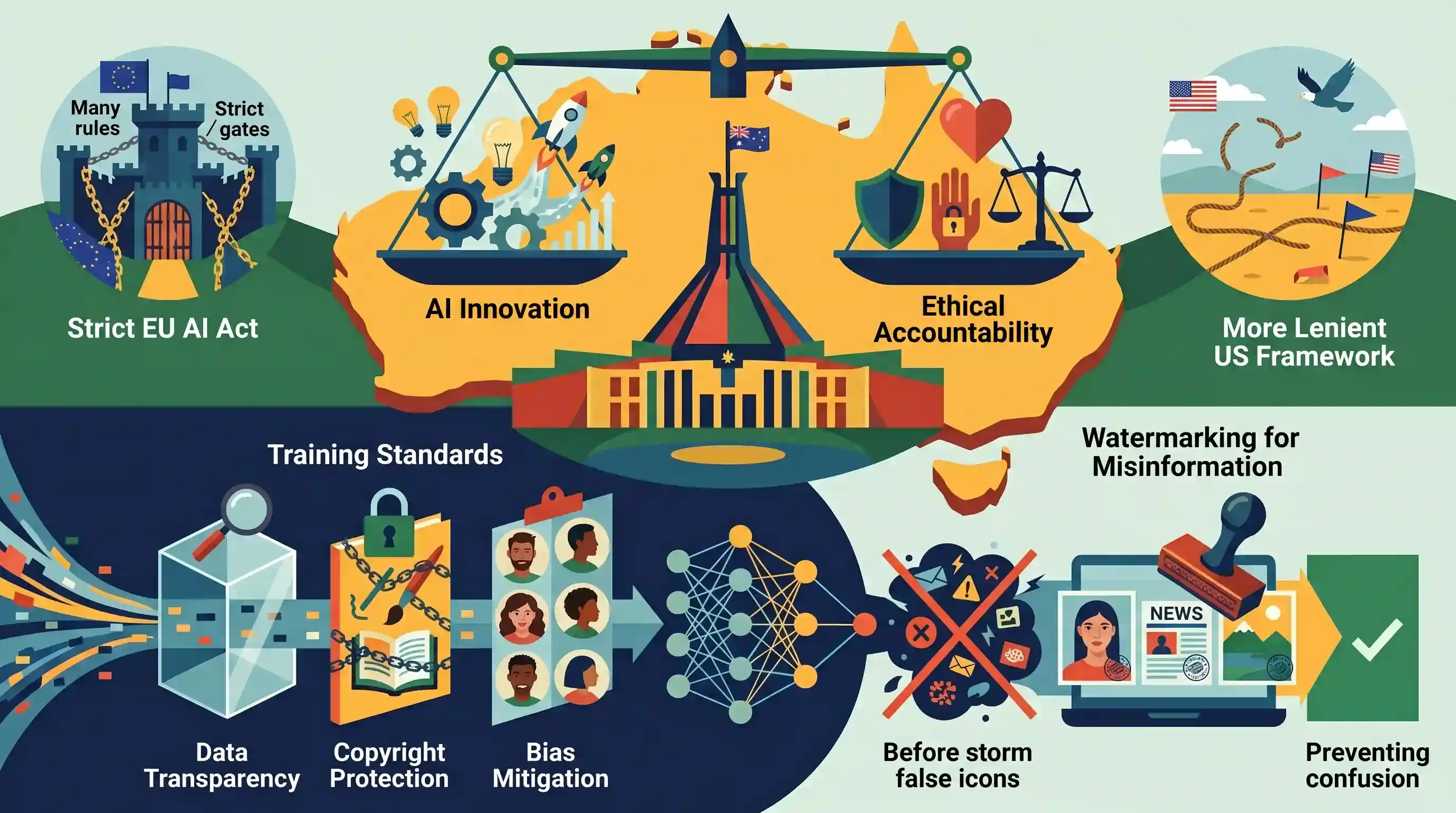
Australia has introduced a proposed set of mandatory safety guardrails aimed at regulating the development and deployment of high-risk Artificial Intelligence (AI) systems. The proposed framework focuses on establishing clear standards for AI training, particularly concerning data transparency, copyright protection, and the mitigation of algorithmic bias. It also includes mandates for watermarking AI-generated content to prevent misinformation. Australia's regulatory model attempts to strike a balance between fostering technological innovation and ensuring ethical accountability, offering a distinct approach compared to the stringent EU AI Act and the more lenient US framework.
Key Points
- Australia has proposed mandatory guardrails to regulate the development and deployment of high-risk Artificial Intelligence (AI) models.
- A significant focus of the regulations is on AI training standards, ensuring transparency regarding the data used to train AI and protecting the intellectual property and copyright of creators.
- The proposed rules mandate clear watermarking and labeling of AI-generated content to combat deepfakes and misinformation.
- The framework emphasizes mitigating algorithmic bias and ensuring human oversight in critical AI decisions to align with ethical standards.
- Australia's approach sits between the strict, risk-based EU AI Act and the more market-driven models of the United States.
Important Terms
EU AI Act

The world's first comprehensive legal framework for Artificial Intelligence, adopting a risk-based approach to categorize systems as unacceptable, high, limited, or minimal risk.
UPSC context
GS Paper 3 (S&T) and GS Paper 2 (International Relations); critical for understanding global regulatory benchmarks and digital sovereignty.
Bletchley Declaration
A historic global agreement signed by 28 nations, including India, to address safety risks posed by 'frontier AI' and promote international cooperation in governance.
UPSC context
GS Paper 2 (Global Groupings) and GS Paper 3 (S&T); represents a major diplomatic milestone in collective tech safety.
High-risk AI systems
AI applications in sensitive sectors—like healthcare, law enforcement, and critical infrastructure—that require strict oversight due to their potential impact on safety and fundamental rights.
UPSC context
GS Paper 3 (S&T) and GS Paper 4 (Ethics); tests the ability to evaluate technology's societal impact and regulatory necessity.
Algorithmic Bias
Systematic and repeatable errors where AI models produce discriminatory or unfair outcomes, often due to non-representative or prejudiced training data.
UPSC context
GS Paper 3 (S&T) and GS Paper 4 (Ethics); vital for discussing the social justice and accountability aspects of emerging technologies.
Watermarking
A technique for embedding identifiers in AI-generated content to assist in identifying synthetic media, aimed at curbing deepfakes and the spread of misinformation.
UPSC context
GS Paper 3 (Internal Security & S&T); relevant for addressing digital threats, misinformation, and intellectual property protection.
Prelims Trap
Australia has proposed mandatory safety guardrails that uniformly regulate all tiers of Artificial Intelligence development.
Australia's proposed guardrails are not universal; they adopt a targeted, risk-based approach specifically governing only "high-risk" AI systems, similar to the EU AI Act's tiering.
Static Concepts Connected
How does Indian Copyright Law apply to AI training datasets?
- Copyright Act, 1957: Protects original literary, dramatic, and artistic works. AI scraping often utilizes these works without creators' explicit permission, leading to infringement claims.
- Fair Dealing Exception: Section 52 allows limited use of copyrighted works for private research or review, creating a heavily debated legal grey area for commercial AI training.
What legal tools currently govern deepfakes and AI misinformation in India?
- IT Act, 2000: Section 66D penalizes cheating by personation using computer resources, which is frequently invoked against malicious deepfakes.
- IT Rules, 2021: Mandates digital intermediaries to take down impersonated or morphed content (including deepfakes) within 24 hours of receiving a user complaint.
- Bharatiya Nyaya Sanhita: Provisions regarding forgery, defamation, and public mischief are increasingly applied to penalize the creation and spread of harmful AI-generated misinformation.
Cross-Topic Patterns
AI Training vs. Global IPR Frameworks
The conflict between massive data scraping for Large Language Models (LLMs) and traditional copyright protections is an emerging GS3 theme, testing the limits of 'fair use' doctrines globally.
Comparative Tech Regulatory Ecosystems
Comparing the EU's strict rights-based AI Act, the US market-driven model, and middle-ground approaches like Australia's helps analyze India's emerging DPI-focused regulatory options.

Expect a multi-statement prelims question comparing the EU AI Act's strict risk-tiering with emerging 'middle-ground' frameworks.
Linked PYQs · 2
Linked PYQs · 2
- 2023MainsGS3
Introduce the concept of Artificial Intelligence (AI). How does Al help clinical diagnosis? Do you perceive any threat to privacy of the individual in the use of Al in healthcare?
- 2024MainsGS4
The application of Artificial Intelligence as a dependable source of input for administrative rational decision-making is a debatable issue. Critically examine the statement from the ethical point of view.
