Artificial Intelligence Transforms Teaching in Indian Classrooms
Source:The Hindu ↗
Why It Matters
The application of AI in education represents a critical intersection of social sector development (GS2) and technology (GS3). Understanding its potential benefits and limitations—such as the digital divide and data privacy—is vital for questions on e-governance, educational reforms, and India's readiness for the Fourth Industrial Revolution.
Summary
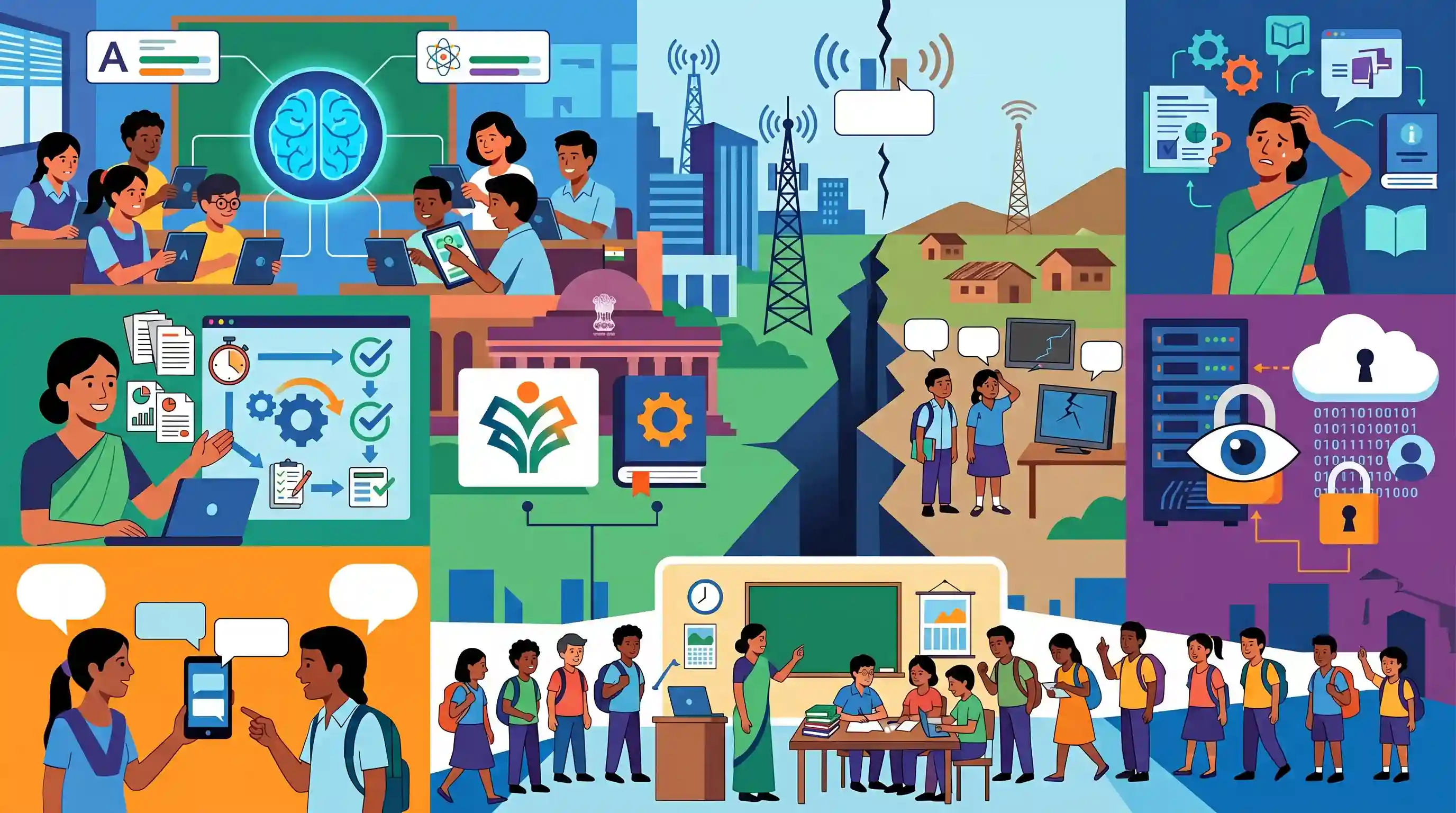
Artificial Intelligence is beginning to transform teaching and learning in Indian classrooms by introducing personalized learning experiences, automating administrative burdens, and bridging language barriers through real-time translation tools. While these advancements promise to enhance educational equity and align with the technological integration goals of the National Education Policy (NEP) 2020, severe infrastructural challenges persist. The rural-urban digital divide, inadequate teacher training, and pressing concerns surrounding data privacy must be systematically addressed to ensure that AI-driven EdTech benefits all students inclusively.
Key Points
- AI is enabling personalized learning pathways by analyzing student performance and adapting content to individual pacing and capabilities.
- Automation of routine administrative tasks, such as grading and attendance tracking, allows teachers to dedicate more time to interactive and pedagogical engagement.
- AI-driven translation tools (like Bhashini) help overcome India's linguistic diversity barriers by providing educational content in regional languages.
- Significant challenges impede widespread adoption, notably the digital divide, lack of internet access in rural areas, and insufficient digital literacy among educators.
- Data privacy and the ethical use of student data remain critical concerns as EdTech platforms aggregate massive amounts of personal information.
Important Terms
National Education Policy (NEP) 2020

A comprehensive framework introduced in 2020 to overhaul India's education system. It replaces the 10+2 structure with a 5+3+3+4 model and emphasizes technology integration, critical thinking, and multilingualism.
UPSC context
Relevant for GS Paper II (Social Justice/Education) and GS Paper III (Technology integration and economic growth).
DIKSHA (Digital Infrastructure for Knowledge Sharing)
The national digital infrastructure for school education that provides QR-coded textbooks and e-content. It is currently integrating AI-powered Personalized Adaptive Learning (PAL) to offer customized student learning pathways.
UPSC context
Key for GS Paper II and III topics involving Digital Public Infrastructure (DPI) and educational governance.
Bhashini
An AI-led language translation mission (NLTM) designed to provide real-time translation across 22 scheduled Indian languages. It aims to bridge the digital divide by making internet content accessible in native tongues.
UPSC context
Important for GS Paper III (Science & Technology/AI) and GS Paper II (Governance and inclusion).
Central Board of Secondary Education (CBSE)
India's national-level board of education for public and private schools. It is pioneering the integration of Artificial Intelligence and Computational Thinking curricula for students from Class 3 onwards.
UPSC context
Relevant for GS Paper II under 'Issues relating to development and management of Social Sector/Services relating to Education'.
Ministry of Education
The nodal ministry responsible for the formulation and implementation of national education policies. It oversees bodies like NCERT and CBSE and promotes digital initiatives to achieve "AI-sovereignty" in education.
UPSC context
Fundamental for GS Paper II (Governance and Policy-making) and understanding the administrative structure of Indian education.
Prelims Trap
"Bhashini is an AI translation tool developed exclusively for the education sector by the Ministry of Education."
Bhashini is developed under MeitY's Digital India initiative to build a National Public Digital Platform for languages across all domains, not just the education sector.
Static Concepts Connected
What are the core architectural pillars of the DIKSHA platform?
- Nodal Ministry: Launched by the Ministry of Education (MoE) as a national platform for school education.
- Open-Source Foundation: Built on the open-source platform Sunbird, offering a highly scalable and modular digital infrastructure that states can customize.
- Ecosystem Utility: Supports teacher training (NISHTHA), QR-coded textbooks, and Personalised Adaptive Learning (PAL) to minimize school dropouts.
How does the digital divide legally intersect with Article 21A (Right to Education)?
- De-facto Denial: Courts have noted that lacking internet/devices practically denies the fundamental right to education for disadvantaged groups during digital transitions.
- State Obligation: Under the RTE Act, 2009, the State must ensure equitable education, which increasingly implies providing inclusive digital infrastructure.
Cross-Topic Patterns
Algorithmic bias intersecting social justice
AI models trained on historically skewed data can inadvertently perpetuate caste or gender biases in adaptive learning, conflicting with constitutional mandates for social justice and educational equity.
India's DPI model extending to education
DIKSHA and Bhashini exemplify India's Digital Public Infrastructure (DPI) approach—utilizing open-source, interoperable systems to deliver public goods rather than relying on closed-loop corporate EdTech monopolies.

Expect a 2026 multi-statement Prelims Q contrasting the nodal ministries of Bhashini (MeitY) and DIKSHA (MoE) alongside open-source APIs.
Linked PYQs · 4
Linked PYQs · 4
- 2020PrelimsGS1
With the present state of development, Artificial Intelligence can effectively do which of the following? 1. Bring down electricity consumption in industrial units 2. Create meaningful short stories and songs 3. Disease diagnosis 4. Text-to-Speech Conversion 5. Wireless transmission of electrical energy Select the correct answer using the code given below:
- 2023MainsGS3
Introduce the concept of Artificial Intelligence (AI). How does Al help clinical diagnosis? Do you perceive any threat to privacy of the individual in the use of Al in healthcare?
- 2021MainsGS2
Has digital illiteracy, particularly in rural areas, coupled with lack of Information and Communication Technology (ICT) accessibility hindered socio-economic development? Examine with justification.
- 2020MainsGS2
National Education Policy 2020 is in conformity with the Sustainable Development Goal-4 (2030). It intends to restructure and reorient education system in India. Critically examine the statement.
