Artificial Intelligence Impact on Indian IT Industry Jobs
Source:The Hindu ↗
Why It Matters
India's IT sector is a vital engine for economic growth and formal employment. The transition to AI-driven services impacts the country's demographic dividend and structural employment, representing a critical intersection of economic policy, tech adaptation, and the Fourth Industrial Revolution.
Summary
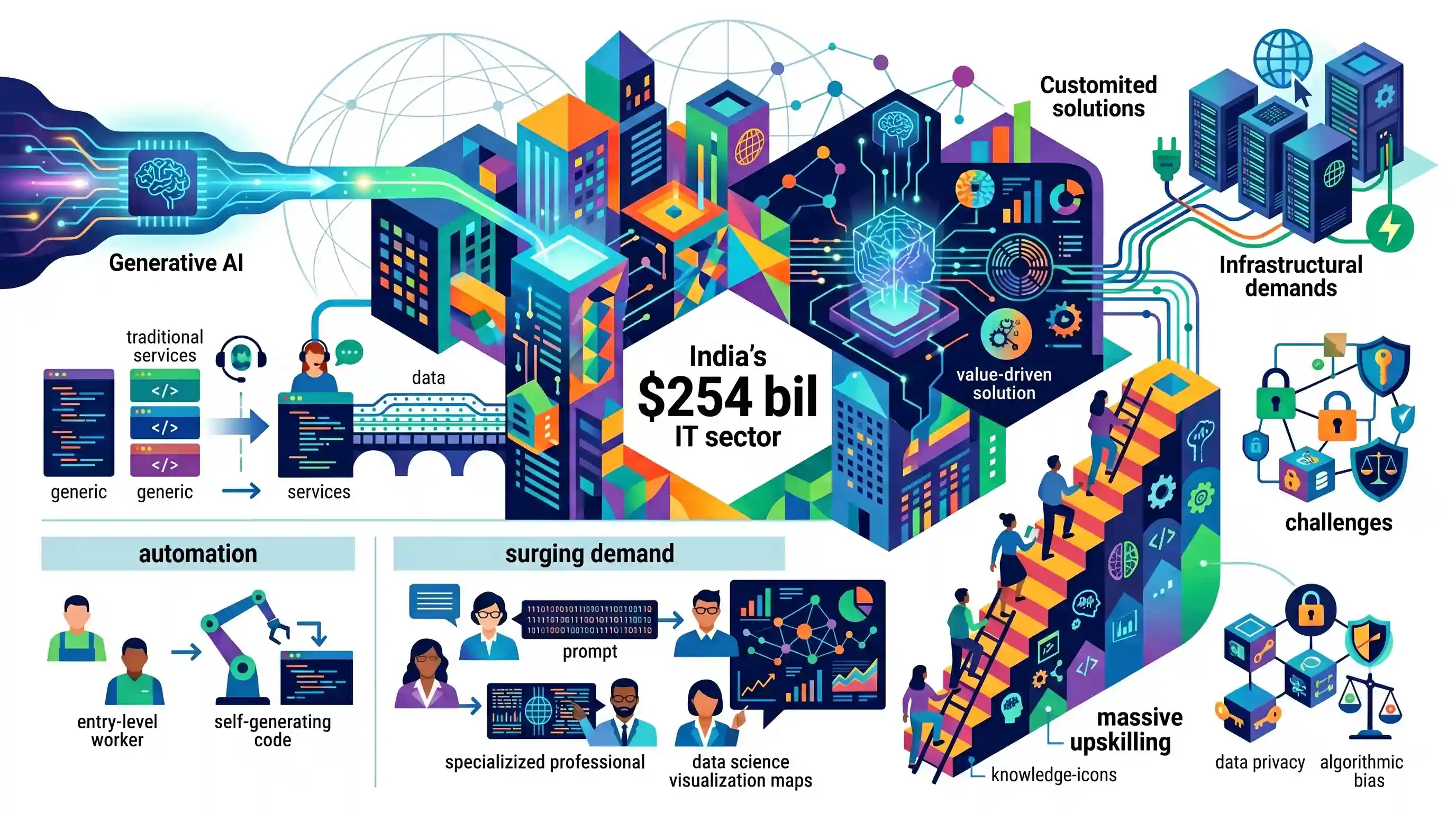
The article examines the profound impact of Artificial Intelligence (AI) and Generative AI on India's $254 billion Information Technology (IT) sector. IT majors are pivoting from traditional, cost-arbitrage software services to specialized, value-driven AI solutions. This transition is reshaping the employment landscape by automating routine coding tasks, thereby reducing entry-level hiring while simultaneously surging the demand for specialized AI roles. Consequently, massive upskilling initiatives are underway to train the workforce in prompt engineering and data science. The industry is also grappling with infrastructural demands and critical ethical challenges, including data privacy and algorithmic bias, marking a critical phase of structural adaptation.
Key Points
- The Indian IT sector is undergoing a massive transformation, shifting from basic cost-arbitrage coding services to high-value Artificial Intelligence (AI) and Generative AI (GenAI) solutions.
- Automation of routine coding and software testing is reducing the demand for traditional entry-level 'fresher' jobs, altering the industry's hiring landscape.
- Major IT firms are heavily investing in reskilling and upskilling their existing workforce in emerging areas like prompt engineering, machine learning, and data analytics.
- The sector is forging strategic partnerships with global tech giants (such as Nvidia, Microsoft, and AWS) to build robust AI infrastructure and cloud capabilities.
- Alongside technological shifts, companies are navigating complex challenges involving ethical AI, algorithmic bias, data privacy, and intellectual property rights.
Important Terms
Tata Consultancy Services (TCS)

India's largest IT services firm and a global leader in digital transformation. It is a major contributor to the country's software exports, GDP, and private-sector employment.
UPSC context
GS-III (Economy); tests the role of the services sector, export-led growth, and indigenization of technology.
Infosys
A global leader in digital services and consulting, known for pioneering the Global Delivery Model. It is a primary engine of India's service-led economic growth and workforce skilling.
UPSC context
GS-III (Economy/S&T); representative of the evolution of India's IT-BPM sector and global competitiveness.
Nvidia
The world's leading designer of high-performance Graphics Processing Units (GPUs). Its hardware forms the foundational infrastructure necessary for training and deploying modern artificial intelligence and machine learning models.
UPSC context
GS-III (Science & Technology); relevant to semiconductor missions, AI infrastructure, and global technological sovereignty.
Microsoft
A global technology giant providing essential cloud (Azure) and GenAI infrastructure. In India, it partners with the government to advance AI skilling and digital public infrastructure.
UPSC context
GS-III (Economy/S&T); highlights public-private partnerships in the Digital India and IndiaAI missions.
HCLTech
India's third-largest IT services company, specializing in digital, engineering, and cloud services. It is a key player in the industry's pivot toward agentic AI and specialized software products.
UPSC context
GS-III (Economy); demonstrates corporate structural adaptation to emerging technologies and R&D outsourcing.
Wipro
A major Indian IT services firm and a global leader in business process management. It is currently undergoing significant restructuring to prioritize AI-first strategies and operational efficiency.
UPSC context
GS-III (Economy); reflects trends in workforce optimization and the challenges of service-sector transformation.
Prelims Trap
AI-driven job displacements in the Indian IT sector primarily represent cyclical unemployment.
AI causes structural unemployment, not cyclical. Job losses stem from a permanent technological shift and skill mismatch (basic coding vs. AI skills), rather than a temporary downturn in the business cycle.
Static Concepts Connected
What distinguishes structural unemployment from cyclical unemployment?
- Structural Unemployment: Caused by a fundamental mismatch between the skills workers possess and the skills demanded by employers (e.g., AI replacing basic coding skills).
- Cyclical Unemployment: Triggered by macroeconomic downturns or recessions where the overall aggregate demand for goods, services, and labor falls.
How does Generative AI differ from Traditional/Predictive AI?
- Generative AI: Creates novel content (text, code, images, audio) by learning underlying data distributions using foundation models and Large Language Models (LLMs).
- Predictive AI: Focuses on analyzing historical data to forecast future outcomes, detect anomalies, or classify information (e.g., recommendation engines, spam filters).
Cross-Topic Patterns
Sovereign AI Compute & Data Localization
Procuring GPUs under the IndiaAI Mission links directly to the DPDP Act. Localizing AI infrastructure ensures data sovereignty and prevents over-reliance on foreign cloud providers for critical data processing.
GCCs and India's Service-Led Growth
The shift of Global Capability Centres from basic BPOs to AI innovation hubs tests India's ability to upgrade its service-led growth model and leverage its demographic dividend for intellectual capital.

GenAI’s role in structural unemployment and the IndiaAI Mission’s compute goals will likely feature in a 2026 GS3 multi-statement question.
Linked PYQs · 4
Linked PYQs · 4
- 2023MainsGS3
Introduce the concept of Artificial Intelligence (AI). How does Al help clinical diagnosis? Do you perceive any threat to privacy of the individual in the use of Al in healthcare?
- 2023MainsGS3
Most of the unemployment in India is structural in nature. Examine the methodology adopted to compute unemployment in the country and suggest improvements.
- 2022MainsGS3
Economic growth in the recent past has been led by increase in labour productivity." Explain this statement. Suggest the growth pattern that will lead to creation of more jobs without compromising labour productivity.
- 2020PrelimsGS1
With the present state of development, Artificial Intelligence can effectively do which of the following? 1. Bring down electricity consumption in industrial units 2. Create meaningful short stories and songs 3. Disease diagnosis 4. Text-to-Speech Conversion 5. Wireless transmission of electrical energy Select the correct answer using the code given below:
