Regulatory Framework for AI Medical Technology in India
Source:The Hindu ↗
हे का महत्त्वाचे आहे
With the rapid integration of Artificial Intelligence into healthcare and clinical diagnostics, understanding the regulatory frameworks, safety standards, and governance challenges of AI-MedTech is vital for GS3 (Science and Technology) and GS2 (Health Policy).
सारांश
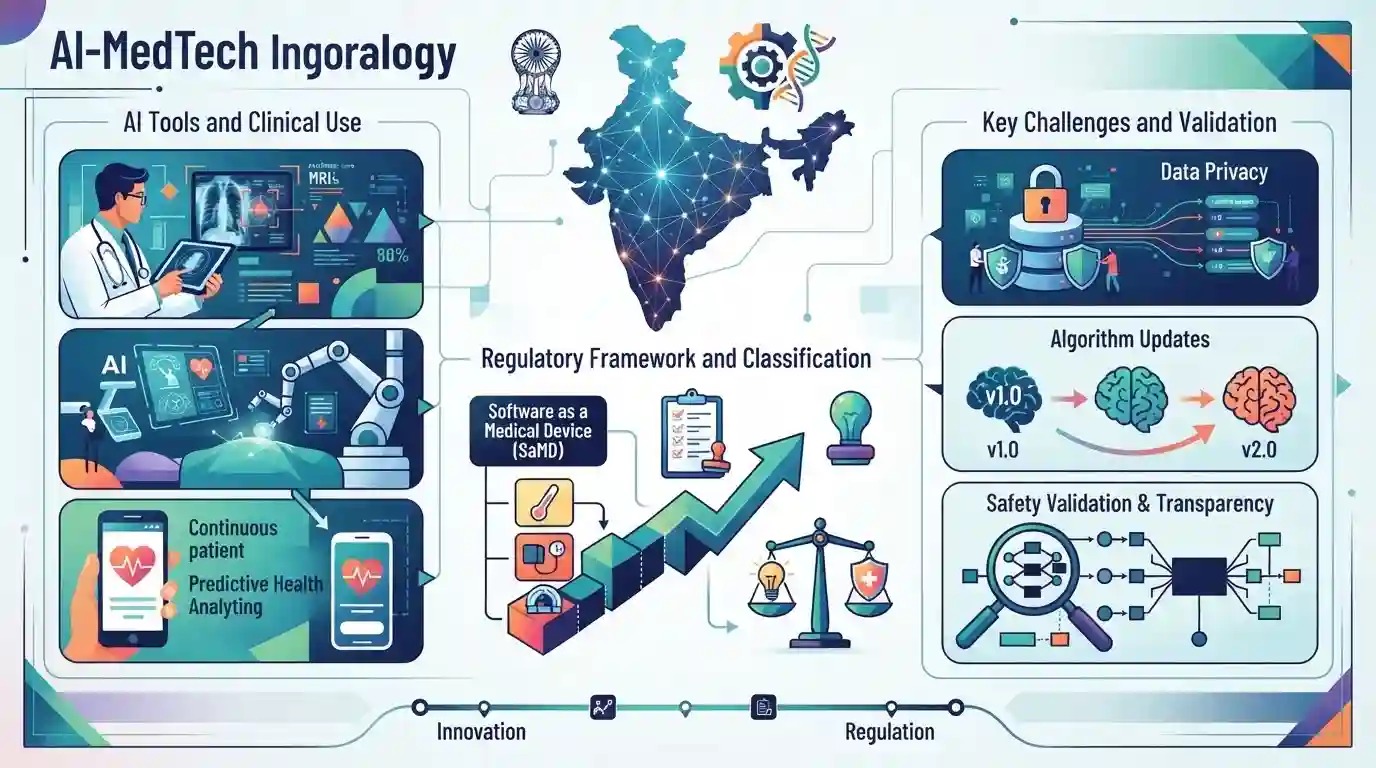
The article explores the evolving regulatory landscape of Artificial Intelligence-driven Medical Technology (AI-MedTech) in India. It highlights how software and AI tools used for clinical diagnosis and healthcare delivery are classified and regulated under medical device frameworks, addressing key challenges such as data privacy, algorithm updates, safety validation, and the balance between fostering technological innovation and protecting patient rights.
मुख्य मुद्दे
- Artificial Intelligence in Medical Technology (AI-MedTech) is increasingly playing a pivotal role in diagnostics, patient care, and clinical workflows in India.
- Regulation of AI-MedTech devices in India falls under the framework of medical devices regulation, primarily governed by the Central Drugs Standard Control Organization (CDSCO) and the Medical Devices Rules.
- Software as a Medical Device (SaMD) faces unique regulatory challenges concerning continuous learning algorithms, data privacy, liability, and validation standards.
- Balancing innovation with patient safety requires evolving regulatory sandboxes, robust clinical data protection frameworks, and transparent oversight mechanisms.
महत्त्वाच्या संज्ञा
Drugs and Cosmetics Act

The primary legislation in India that regulates the import, manufacture, distribution, and sale of drugs and cosmetics, providing the overarching statutory authority under which medical devices and AI-MedTech are regulated.
UPSC context
UPSC GS Paper III (Science & Technology - IT & Computers, Health): Tests understanding of statutory frameworks governing medical devices and emerging technologies.
Medical Devices Rules
Rules notified under the Drugs and Cosmetics Act that establish a risk-based classification system (Classes A, B, C, and D) for medical devices, including software as a medical device (SaMD).
UPSC context
UPSC GS Paper III (Health/Technology): Important for questions on regulatory standards, compliance, and medical technology oversight in India.
Central Drugs Standard Control Organization (CDSCO)
The national regulatory body in India responsible for regulating drugs, medical devices, and diagnostics, ensuring safety, efficacy, and quality standards through frameworks like the Drugs and Cosmetics Act.
UPSC context
UPSC GS Paper II & III (Governance and Health): Crucial for evaluating institutional mechanisms governing health technology and drug safety.
पूर्वपरीक्षा सापळा
AI tools used for clinical diagnosis are regulated exclusively under the Information Technology (IT) Act and Ministry of Electronics and Information Technology (MeitY) rules.
Aspirants often assume AI software in healthcare is governed purely by IT Ministry guidelines or the DPDP Act, missing that clinical diagnostic software is formally regulated as a 'medical device' by CDSCO.
संबंधित स्थिर संकल्पना
How are medical devices and Software as a Medical Device (SaMD) regulated in India?
- CDSCO Mandate: Governing Authority: Regulated by the Central Drugs Standard Control Organization (CDSCO) under the Drugs and Cosmetics Act and Medical Devices Rules, 2017.
- Risk Classes: Risk-Based Classification: Categorized into four classes (Class A - low risk to Class D - critical risk) based on vulnerability and intended clinical use.
- SaMD Definition: SaMD Scope: Software intended for medical purposes without being part of a hardware medical device is formally classified as Software as a Medical Device.
आंतर-विषय नमुने
Health-Tech Data + Digital Personal Data Protection Act
The intersection of DPDP Act, 2023 and medical device regulations forms a multi-ministry compliance matrix for health-tech startups.
AI Standards + Global Trade Harmonisation
India's adoption of IMDRF (International Medical Device Regulators Forum) standards aligns domestic SaMD approvals with global trade requirements.

AI-MedTech classification under Medical Devices Rules, 2017 and CDSCO risk classes (A-D) will feature in Science & Tech prelims match-the-following.
संबंधित PYQ · 2
संबंधित PYQ · 2
- 2023MainsGS3
Introduce the concept of Artificial Intelligence (AI). How does Al help clinical diagnosis? Do you perceive any threat to privacy of the individual in the use of Al in healthcare?
- 2024MainsGS2
In a crucial domain like the public healthcare system the Indian State should play a vital role to contain the adverse impact of marketisation of the system. Suggest some measures through which the State can enhance the reach of public healthcare at the grassroots level.
