Attappady Infant Deaths and Tribal Health Crisis
Source:The Hindu ↗
Why It Matters
It provides critical insights into the intersection of tribal welfare, public healthcare delivery, and malnutrition, which are core themes in GS Paper 2 (Vulnerable sections and social sector policy) and GS Paper 1 (Tribal development issues).
Summary
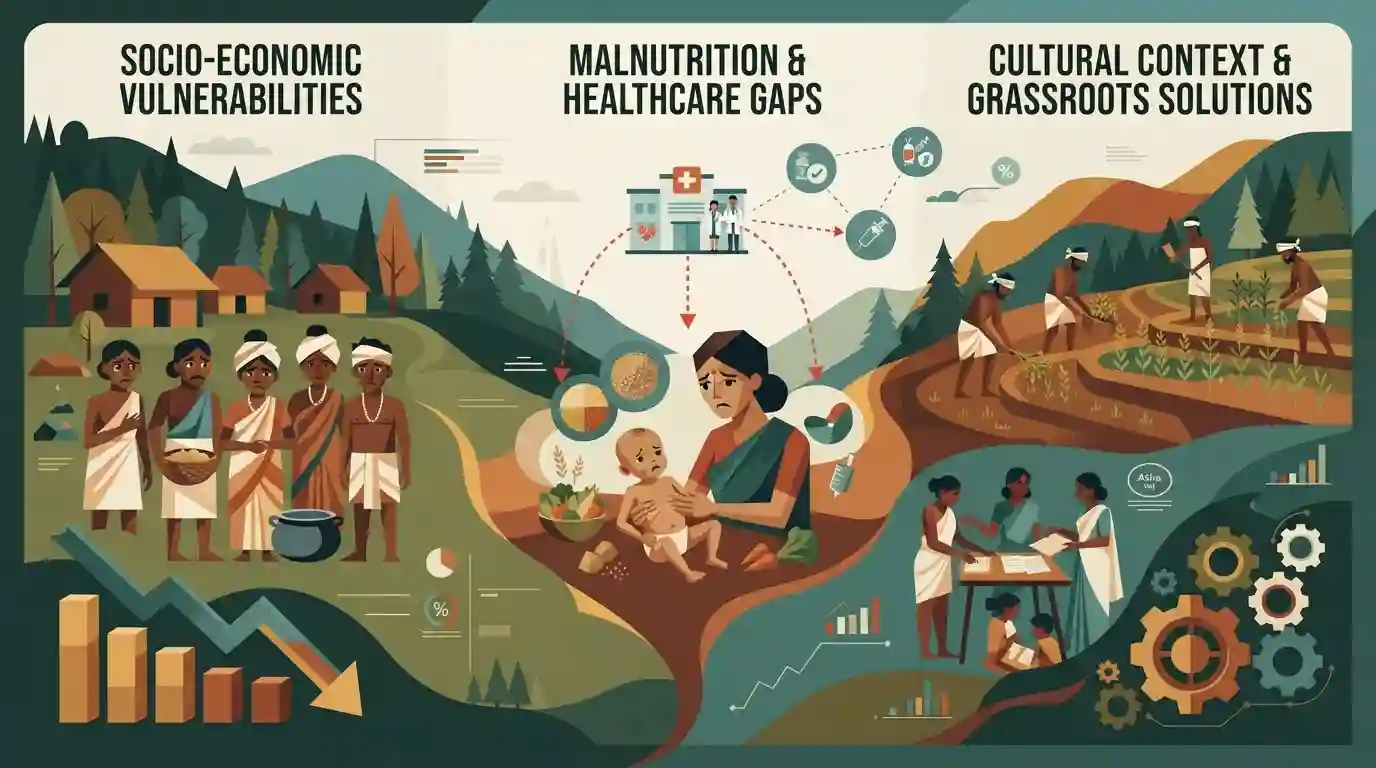
The persistent issue of infant deaths in Kerala's Attappady region exposes deep-rooted socio-economic vulnerabilities, malnutrition, and healthcare gaps among tribal communities. The crisis underlines the limitations of standard public health interventions when dealing with Particularly Vulnerable Tribal Groups (PVTGs) without incorporating localized cultural contexts, sustainable livelihoods, and robust grassroots delivery mechanisms.
Key Points
- Persistent infant and child deaths in Attappady, Kerala, highlight systemic failures in tribal healthcare and welfare delivery.
- Key issues include severe malnutrition, adolescent pregnancies, lack of localized livelihood support, and socio-cultural barriers.
- Existing interventions often fail due to a lack of community-centric approaches and poor coordination between health and tribal departments.
- Addressing the crisis requires a multi-sectoral approach focusing on nutritional security, maternal healthcare, and sustainable livelihood generation tailored to Particularly Vulnerable Tribal Groups (PVTGs).
Important Terms
Particularly Vulnerable Tribal Groups (PVTGs)

A sub-classification of Scheduled Tribes recognized by the government as experiencing extreme socio-economic isolation, pre-agricultural technology, declining populations, and high vulnerability.
UPSC context
UPSC GS Paper I (Indian Society - Vulnerable Sections) and GS Paper II (Social Justice - Welfare Schemes for Tribes).
Integrated Child Development Services (ICDS)
A flagship central scheme providing early childhood care, nutrition, immunization, and pre-school education through Anganwadi centers to combat malnutrition and child mortality.
UPSC context
UPSC GS Paper II (Health, Human Resources, and Social Sector Schemes).
National Health Mission (NHM)
A central health initiative providing universal, equitable, and affordable healthcare, focusing on maternal-child health and strengthening public health systems via grassroots workers like ASHAs.
UPSC context
UPSC GS Paper II (Issues Relating to Development and Management of Social Sector/Healthcare).
Static Concepts Connected
What are the criteria for identifying a Particularly Vulnerable Tribal Group (PVTG) in India?
- Tech Level: Pre-agricultural level of technology used for subsistence activities.
- Population: Stagnant or declining population growth rate over successive decades.
- Literacy: Extremely low level of literacy compared to the general population.
- Economy: Subsistence level of economy relying heavily on forest produce.
Cross-Topic Patterns
PVTG Health Crises & Sustainable Development Goals
Public health failures in PVTG regions connect tribal welfare schemes with SDG 3 (Good Health) and SDG 2 (Zero Hunger) targets in human development questions.

PVTGs + malnutrition + health delivery bottlenecks will likely feature in a multi-statement Mains/Prelims question on tribal vulnerability.
Linked PYQs · 3
Linked PYQs · 3
- 2024MainsGS2
Poverty and malnutrition create a vicious cycle, adversely affecting human capital formation. What steps can be taken to break the cycle ?
- 2024MainsGS2
In a crucial domain like the public healthcare system the Indian State should play a vital role to contain the adverse impact of marketisation of the system. Suggest some measures through which the State can enhance the reach of public healthcare at the grassroots level.
- 2025MainsGS1
Does tribal development in India centre around two axes, those of displacement and of rehabilitation? Give your opinion.
