Attappady Infant Mortality and Tribal Healthcare Crisis in Kerala
Source:The Hindu ↗
ఇది ఎందుకు ముఖ్యం
It provides a critical case study on how localized structural exclusions and health crises persist among vulnerable tribal populations even within a state renowned for high human development indices.
సారాంశం
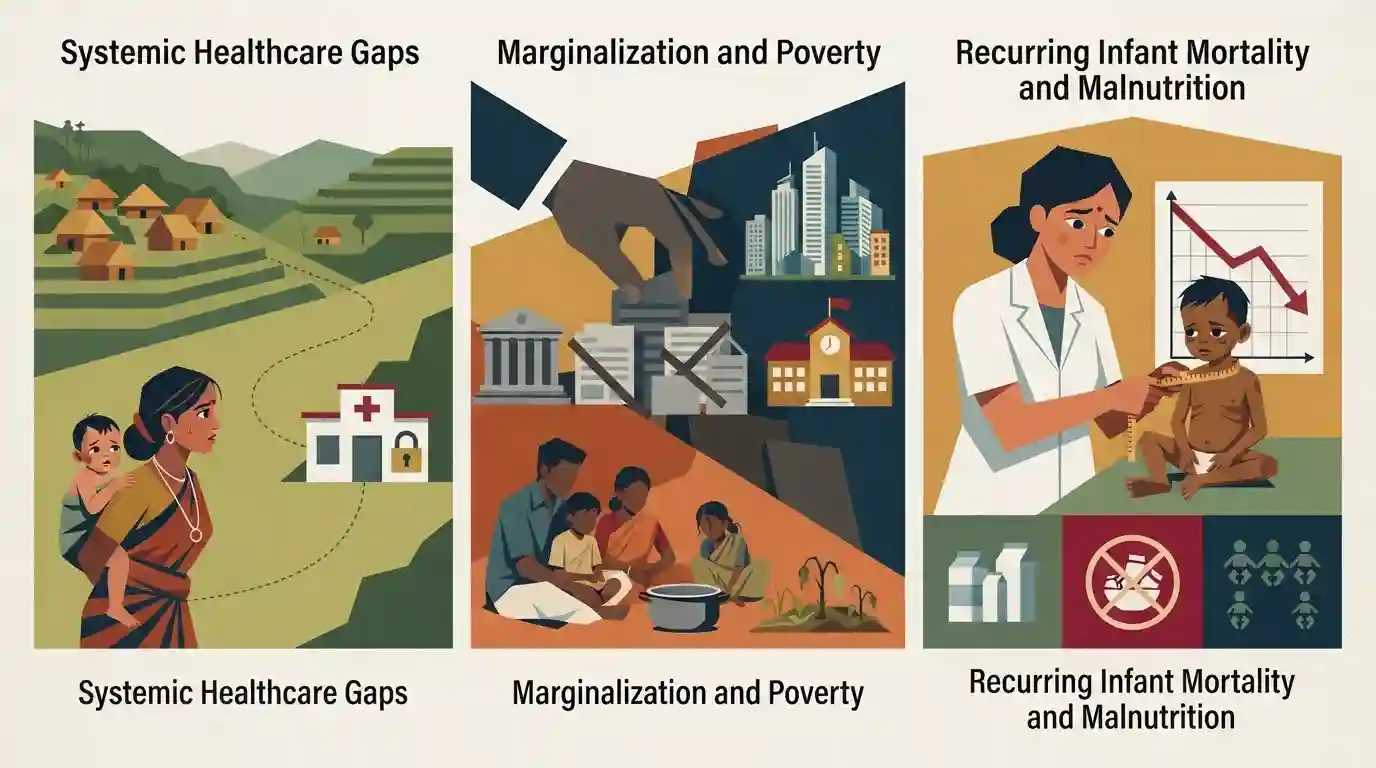
The article examines the recurring issue of infant mortality and malnutrition in Attappady, Kerala, revealing how marginalization, systemic healthcare gaps, and socio-economic deprivation persist among tribal groups despite the State's broader developmental achievements.
ముఖ్య అంశాలు
- Infant deaths in Attappady, Kerala, highlight a severe, deep-rooted crisis involving healthcare failures, extreme malnutrition, and social marginalization among tribal communities.
- Despite Kerala's generally high social development indices, vulnerable tribal groups (PVTGs) like the Irula, Kurumba, and Mudugar face systemic exclusions and land alienation.
- The crisis underscores structural bottlenecks in public healthcare delivery at the grassroots, nutritional deficiencies, and the failure of targeted welfare interventions.
- Experts call for holistic interventions integrating culturally sensitive healthcare, livelihood security, food security, and community participation to break the cycle of poverty and malnutrition.
ముఖ్యమైన పదాలు
Particularly Vulnerable Tribal Groups (PVTGs)

Particularly Vulnerable Tribal Groups (PVTGs) are marginalized tribal communities identified by pre-agricultural technology, stagnant population growth, extremely low literacy, and subsistence economies, requiring special government protection.
UPSC context
UPSC Mains GS Paper II (Vulnerable Sections & Scheduled Tribes) and GS Paper I (Indian Society). Tests welfare measures and marginalization issues.
Health Department Kerala
The administrative wing responsible for healthcare delivery, disease control, and public health infrastructure implementation across Kerala, tasked with addressing recurring health crises like malnutrition in tribal belts.
UPSC context
UPSC Mains GS Paper II (Health & Social Sector). Tests state-level public healthcare delivery, structural gaps, and administrative accountability in marginalized regions.
Government of Kerala
The elected state government of Kerala, responsible for governance, public policy, and social welfare execution within the state, including targeted interventions for tribal development and health.
UPSC context
UPSC Mains GS Paper II (Governance & Polity). Tests state capacity, welfare policy implementation, and administrative responses to human development deficits.
ప్రిలిమ్స్ ఉచ్చు
Kerala's high human development indices ensure uniform health and nutritional outcomes across all its districts and demographic subgroups.
Aspirants often assume Kerala's 100% literacy and top health indicators uniformly apply across all districts and demographic subgroups, ignoring isolated tribal pockets.
అనుసంధానమైన స్థిర భావనలు
What are Particularly Vulnerable Tribal Groups (PVTGs) and their key criteria?
- Identification Criteria: Criteria include pre-agricultural level of technology, stagnant or declining population, extremely low literacy, and subsistence economy.
- Ministry & Count: Identified by the Ministry of Home Affairs, currently 75 PVTGs exist across India, with specific state-level lists notified.
- Targeted Welfare: Special protection and targeted funds under schemes like PM-JANMAN are directed specifically toward bridging socio-economic gaps for PVTGs.
అంతర-అంశ నమూనాలు
Public Health & Kerala Model Development Paradox
Attappady's recurring health crisis contrasts sharply with Kerala's high HDI, exposing the micro-level exclusion of PVTGs from mainstream public welfare gains.
PVTGs, Land Alienation, and Tribal Governance
The plight of Irula, Kurumba, and Mudugar communities tests the efficacy of Fifth Schedule governance, tribal land alienation laws, and PESA implementation.

PVTG health crises + nutritional security + decentralized welfare implementation likely to form a direct Mains GS-1/GS-2 question.
అనుసంధాన PYQలు · 3
అనుసంధాన PYQలు · 3
- 2024MainsGS2
In a crucial domain like the public healthcare system the Indian State should play a vital role to contain the adverse impact of marketisation of the system. Suggest some measures through which the State can enhance the reach of public healthcare at the grassroots level.
- 2024MainsGS2
Poverty and malnutrition create a vicious cycle, adversely affecting human capital formation. What steps can be taken to break the cycle ?
- 2025MainsGS1
Does tribal development in India centre around two axes, those of displacement and of rehabilitation? Give your opinion.
