Juvenile Justice System Implementation and Rehabilitation Gaps
Source:Indian Express ↗
Why It Matters
The effectiveness of the juvenile justice system is a crucial metric of social justice and human rights in India. For UPSC aspirants, understanding the gaps between the legislative intent of the JJ Act 2015 and its ground-level implementation is essential for analyzing topics related to child rights, judicial reforms, and the efficacy of institutional mechanisms protecting vulnerable populations.
Summary
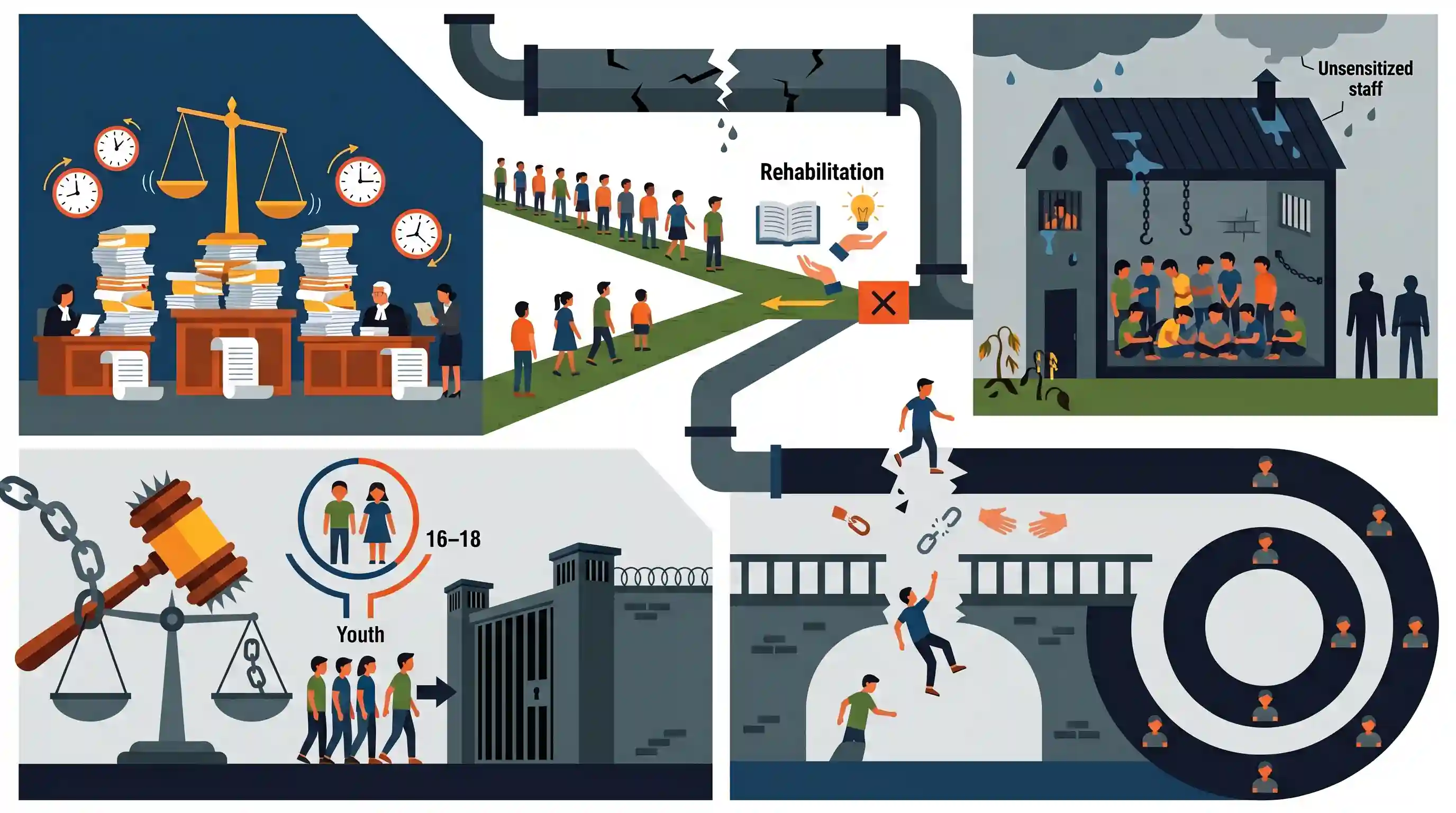
India's juvenile justice system faces severe systemic failures in its core mandate of rehabilitating children in conflict with the law. Despite the progressive framework intended by the Juvenile Justice (Care and Protection of Children) Act, 2015, the system is plagued by heavy case pendency at Juvenile Justice Boards (JJBs) and inadequate infrastructure in observation homes. Furthermore, the 2015 provision allowing 16-18-year-olds to be tried as adults for heinous crimes is viewed as a shift towards retributive justice, undermining reformative goals. A lack of sensitized staff, psychological support, and post-release social reintegration programs leaves vulnerable youth trapped in a cycle of delinquency, fundamentally failing the child protection mandate.
Key Points
- The Juvenile Justice (Care and Protection of Children) Act, 2015 marked a controversial shift by allowing juveniles aged 16-18 to be tried as adults for heinous crimes, prioritizing retribution over the core principle of rehabilitation.
- Juvenile Justice Boards (JJBs) and Child Welfare Committees (CWCs) suffer from severe functional bottlenecks, leading to long pendency of cases and violating the right to timely justice for children.
- Observation homes and special homes frequently lack adequate infrastructure, educational facilities, and essential mental health support, causing them to function more like punitive detention centers than rehabilitative spaces.
- There is a critical shortage of trained probation officers, child psychologists, and sensitized legal staff, resulting in an adversarial rather than a child-centric approach to juvenile justice.
- The system heavily lacks robust post-release social reintegration and community support mechanisms, failing to address the socioeconomic roots of delinquency and increasing the likelihood of recidivism.
Important Terms
Juvenile Justice (Care and Protection of Children) Act, 2015

India's primary legislation governing children in conflict with the law and those in need of care, emphasizing rehabilitation while allowing 16-18-year-olds to be tried as adults for heinous crimes.
UPSC context
GS-II: Welfare schemes for vulnerable sections; tests understanding of legal frameworks for child protection and reformative vs. retributive justice.
United Nations Convention on the Rights of the Child (UNCRC)
An international human rights treaty ratified by India in 1992, establishing that every child (under 18) has inherent rights to survival, development, protection, and participation.
UPSC context
GS-II: International relations and social justice; tests knowledge of global standards influencing India’s domestic child welfare laws.
Juvenile Justice Board (JJB)
A district-level quasi-judicial body responsible for adjudicating cases involving 'children in conflict with the law,' focusing on reform and reintegration rather than punitive measures.
UPSC context
GS-II: Statutory/Quasi-judicial bodies; tests understanding of the institutional mechanisms for juvenile legal proceedings.
Child Welfare Committee (CWC)
A district-level statutory body with the powers of a Metropolitan Magistrate, mandated to provide care, protection, and rehabilitation for vulnerable, abandoned, or orphaned children.
UPSC context
GS-II: Mechanisms for protection of vulnerable sections; crucial for questions on district-level child safety networks.
National Commission for Protection of Child Rights (NCPCR)
A statutory body established under the CPCR Act, 2005, to monitor the implementation of child rights laws (like POCSO and JJ Act) and ensure their alignment with the Constitution.
UPSC context
GS-II: Statutory bodies and social sector issues; focuses on the oversight role in safeguarding children's fundamental rights.
Prelims Trap
Juveniles aged 16-18 accused of heinous crimes are automatically tried as adults under the JJ Act.
Transfer to an adult court is not automatic. The Juvenile Justice Board (JJB) must first conduct a preliminary assessment of the child's physical and mental capacity to commit the crime.
Static Concepts Connected
What is the difference between JJBs and CWCs under the Juvenile Justice Act?
- JJB Mandate: Adjudicates cases of 'Children in Conflict with Law' (juvenile offenders) and assesses if 16-18-year-olds should be tried as adults.
- CWC Mandate: Acts as the final statutory authority for 'Children in Need of Care and Protection' (CNCP), handling abandoned, destitute, or abused children.
How does the Juvenile Justice Act, 2015 classify offences?
- Petty Offences: Crimes for which the maximum punishment under IPC or any other law is imprisonment up to three years.
- Serious Offences: Crimes with a stipulated punishment of imprisonment between three to seven years.
- Heinous Crimes: Offences carrying a minimum punishment of seven years or more, which triggers the adult-trial provision for older juveniles.
Cross-Topic Patterns
Prison reforms vs juvenile detention
Inadequate observation home infrastructure and heavy case pendency mirror the broader crisis of overcrowding and staff deficits in India's adult prison system, regularly tested under GS-II governance.
UNCRC obligations & retributive justice
Trying children as adults engages debates over India's compliance with the UN Convention on the Rights of the Child (UNCRC), which strictly prioritizes reformative over retributive justice.

Expect a 2026 Prelims statement contrasting the distinct roles of JJBs vs CWCs, alongside the exact JJ Act definition of a 'heinous crime'.
Linked PYQs · 2
Linked PYQs · 2
- 2025MainsGS2
The National Commission for Protection of Child Rights has to address the challenges faced by children in the digital era. Examine the existing policies and suggest measures the Commission can initiate to tackle the issue.
- 2019MainsGS2
Performance of welfare schemes that are implemented for vulnerable sections is not so effective due to absence of their awareness and active involvement at all stages of policy process. Discuss.
