Macroeconomic Buffers Help India Weather West Asia Energy Shock
Source:Indian Express ↗
Why It Matters
The article provides an excellent contemporary case study of how macroeconomic buffers (forex reserves), monetary policy (RBI interventions), and strategic energy diversification can insulate India from severe external geopolitical shocks. This is highly relevant for GS3 topics on economic planning, energy security, and managing inflation.
Summary
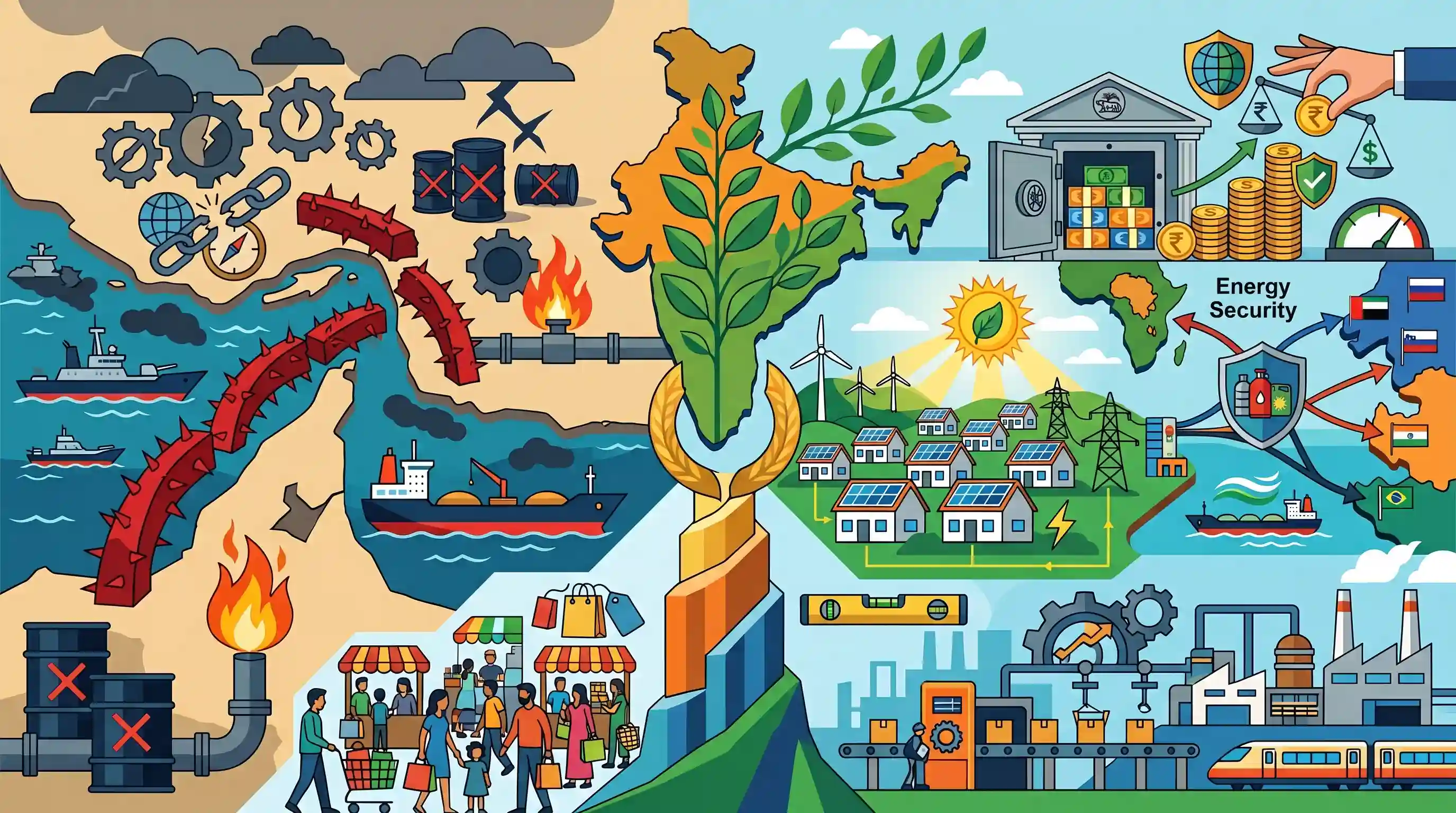
Despite a global energy crisis precipitated by a shutdown of the Strait of Hormuz in West Asia, India\'s economy demonstrated significant resilience. By leveraging strong foreign exchange reserves, the RBI stabilized the currency and controlled inflation. Additionally, strategic diversification of oil imports and a push towards domestic renewable energy programs like PM Surya Ghar Yojana insulated the economy. Strong domestic demand and booming manufacturing further underscored India\'s macroeconomic stability amidst geopolitical shocks.
Key Points
- The shutdown of the Strait of Hormuz triggered a global energy crisis, yet India maintained its position as the fastest-growing major economy.
- The Reserve Bank of India utilized robust foreign exchange reserves to stabilize the currency and manage imported inflation effectively.
- Strategic diversification of crude oil procurement allowed India to circumvent the severe energy shortages experienced by other nations.
- Domestic initiatives like the PM Surya Ghar Yojana and ethanol blending buffered the Indian market from international price shocks.
- Despite remaining vulnerable due to importing 90% of its crude oil, India\'s strong domestic demand, high GST collections, and manufacturing growth underscore its macroeconomic resilience.
Important Terms
PM Surya Ghar Yojana

Central government rooftop solar scheme launched in 2024 to provide up to 300 units of free electricity monthly to 10 million households, targeting 30GW capacity by 2027.
UPSC context
GS Paper 3: Energy Security and Renewable Energy. Tests understanding of decentralised solar power and climate commitments.
Ethanol-Blended Petrol Programme
A policy initiative to mix biomass-derived ethanol with petrol; India successfully advanced its 20% (E20) blending target to 2025 to reduce oil imports and emissions.
UPSC context
GS Paper 3: Environment and Energy. Focuses on biofuel targets, energy independence, and agrarian income.
Reserve Bank of India (RBI)
India's central bank responsible for monetary policy, maintaining price stability, managing foreign exchange reserves, and intervening in forex markets to curb rupee volatility.
UPSC context
GS Paper 3: Indian Economy. Tests knowledge of external sector management, inflation control, and monetary policy tools.
Goods and Services Tax (GST)
A comprehensive, destination-based indirect tax reform implemented in 2017 that subsumed various central and state levies to create a unified national market.
UPSC context
GS Paper 3: Fiscal Policy. Analyzes tax formalization, revenue buoyancy, and its impact on the federal structure.
Prelims Trap
"The Strait of Hormuz connects the Red Sea to the Gulf of Aden, acting as a key transit route."
Aspirants often mix up Middle Eastern chokepoints. Hormuz links the Persian Gulf to the Gulf of Oman, while Bab-el-Mandeb links the Red Sea to the Gulf of Aden.
Static Concepts Connected
How does the RBI use forex reserves to control imported inflation?
- Selling USD: The RBI sells dollars from its reserves to increase USD supply in the market, arresting the steep depreciation of the Indian Rupee.
- Lowering Import Costs: A stabilized or stronger rupee makes dollar-denominated essential imports, such as crude oil and fertilizers, cheaper in domestic currency terms.
- Liquidity Sterilization: The RBI may use Open Market Operations (OMOs) to manage the rupee liquidity that is absorbed during its aggressive forex market interventions.
What are the crucial maritime chokepoints for India's energy security?
- Strait of Hormuz: Connects the Persian Gulf to the Gulf of Oman; a massive portion of India's crude oil and LNG imports transit through here.
- Bab-el-Mandeb: Connects the Red Sea to the Gulf of Aden, critical for trade transiting to Europe via the Suez Canal.
- Strait of Malacca: Connects the Indian Ocean to the South China Sea, vital for energy transit to East Asia and India's Act East trade.
Cross-Topic Patterns
Ethanol blending and Food Security
The push for ethanol to buffer crude shocks links directly to agricultural cropping patterns (sugarcane/maize diversion) and the food vs. fuel debate under the National Policy on Biofuels.
Maritime Chokepoints & BoP Vulnerability
Disruptions in West Asia severely impact India’s Current Account Deficit (CAD) due to inelastic oil demand. Robust forex reserves prevent a BoP crisis, linking geopolitics to macroeconomic stability.

Expect a multi-statement question mapping West Asian maritime chokepoints directly to India's macroeconomic indicators (CAD) in 2026.
Linked PYQs · 3
Linked PYQs · 3
- 2017MainsGS2
The question of India's Energy Security constitutes the most important part of India's economic progress. Analyze India's energy policy cooperation with West Asian countries.
- 2022PrelimsGS1
With reference to the Indian economy, consider the following statements: 1. If the inflation is too high, Reserve Bank of India (RBI) is likely to buy government securities. 2. If the rupee is rapidly depreciating, RBI is likely to sell dollars in the market. 3. If interest rates in the USA or European Union were to fall, that is likely to induce RBI to buy dollars. Which of the statements given above are correct?
- 2022MainsGS3
Do you think India will meet 50 percent of its energy needs from renewable energy by 2030 ? Justify your answer. How will the shift of subsidies from fossil fuels to renewables help achieve the above objective ? Explain.
