Macroeconomic Impacts of West Asia Conflict on India Economy
Source:Indian Express ↗
Why It Matters
Understanding the transmission channels of global geopolitical shocks to the domestic economy is crucial for UPSC aspirants. It bridges International Relations (GS2) with Economic Development (GS3), testing knowledge on inflation, CAD, energy vulnerability, and RBI's monetary policy responses.
Summary
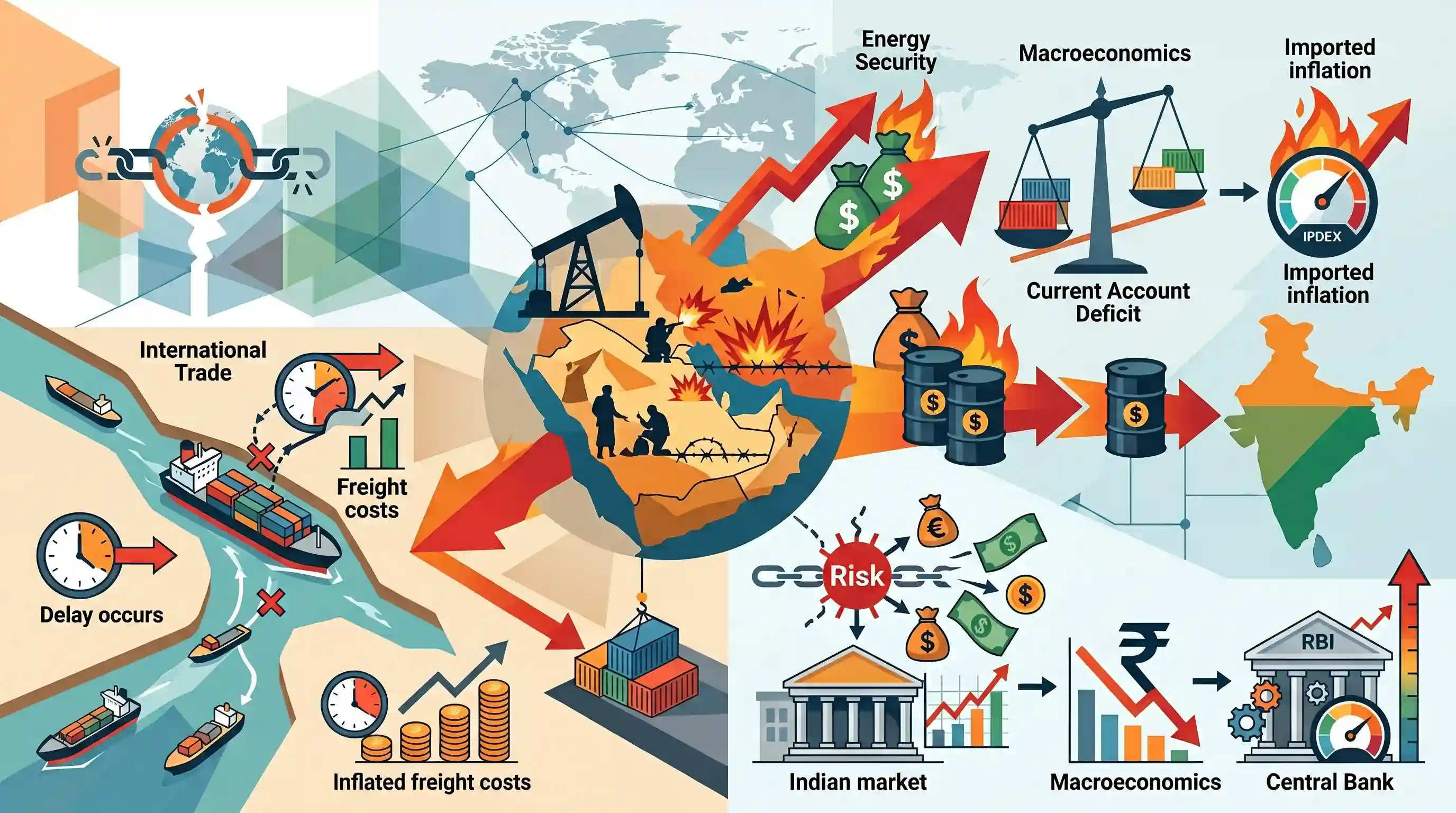
The escalating conflict in West Asia (Middle East) poses significant headwinds for the Indian economy. While India's domestic growth fundamentals remain relatively stable, external vulnerabilities are exposed through three main channels: energy prices, supply chain logistics, and capital flows. A surge in crude oil prices threatens to widen India's Current Account Deficit (CAD) and increase imported inflation. Simultaneously, maritime trade disruptions in the Red Sea are inflating freight costs and delaying shipments, impacting export competitiveness. Furthermore, geopolitical risk aversion triggers capital flight (FPI outflows), putting downward pressure on the Rupee and complicating the RBI's inflation management strategy.
Key Points
- Energy Security Risk: As India imports over 80% of its crude oil, price spikes driven by West Asian instability directly inflate the import bill, worsen the Current Account Deficit (CAD), and trigger imported inflation.
- Trade and Supply Chain Disruptions: Geopolitical tensions and attacks in the Red Sea have forced commercial shipping to reroute via the Cape of Good Hope, sharply increasing freight costs and transit times for Indian exports.
- Financial Market Volatility: Heightened global uncertainty prompts foreign portfolio investors (FPIs) to pull capital out of emerging markets like India, leading to stock market volatility and Rupee depreciation.
- Monetary Policy Dilemma: The Reserve Bank of India (RBI) faces the challenge of managing imported inflation and a weakening currency, which may force it to keep interest rates elevated, thereby constraining domestic growth.
Important Terms
Current Account Deficit (CAD)

A measurement of a country's trade where the value of imported goods, services, and transfers exceeds the value of its exports.
UPSC context
GS Paper III (Economy). Essential for understanding Balance of Payments, external vulnerabilities, and the impact of global shocks on the Rupee.
Imported Inflation
Price increases in a domestic economy caused by the rising cost of imported inputs (like crude oil) or a depreciation in the national currency.
UPSC context
GS Paper III (Economy). Tests knowledge of cost-push inflation and the challenges of managing monetary policy during global supply chain disruptions.
Organization of the Petroleum Exporting Countries (OPEC)
An intergovernmental organization that coordinates petroleum policies among member nations to stabilize oil prices; its production quotas directly affect India's energy security and fiscal deficit.
UPSC context
GS Paper II (International Relations). Crucial for analyzing global energy governance and the economic impact of Middle East geopolitics on India.
Foreign Portfolio Investment (FPI)
Investments made by foreign entities in a country's financial assets, such as stocks and bonds, without gaining management control; noted for high volatility during geopolitical crises.
UPSC context
GS Paper III (Economy). Important for studying capital flow volatility, investment models, and the "capital flight" risks associated with global risk aversion.
International North-South Transport Corridor (INSTC)
A 7,200 km multimodal transportation network connecting India, Iran, and Russia, designed as a shorter, cost-effective alternative to the Suez Canal trade route.
UPSC context
GS Paper II (IR) & III (Infrastructure). Key for questions on Eurasian connectivity, trade diversification, and strategic logistics in the West Asian region.
India-Middle East-Europe Economic Corridor (IMEC)
A proposed multimodal economic corridor linking India, the Middle East, and Europe via sea and rail, aimed at enhancing trade and energy connectivity.
UPSC context
GS Paper II (IR). Strategic project relevant for analyzing regional integration, G20 outcomes, and India's counter-strategy to global infrastructure initiatives.
Prelims Trap
Rupee depreciation during global crises automatically narrows the Current Account Deficit by boosting export competitiveness.
India's import basket is heavily skewed toward price-inelastic crude oil. Rupee depreciation inflates the oil import bill immediately, widening the CAD before export benefits materialize.
Static Concepts Connected
What is "Imported Inflation" in India's context?
- Global Price Spikes: Driven by external commodity price rises (e.g., crude oil), raising input costs for domestic producers independently of local demand dynamics.
- Exchange Rate Effect: A depreciating Rupee magnifies the cost of imports, meaning identical dollar-priced goods cost more in domestic currency, passing costs to consumers.
- Monetary Policy Dilemma: Forces the central bank to maintain elevated interest rates to anchor inflation expectations, which can inadvertently suppress domestic economic growth.
What are the key West Asian maritime chokepoints?
- Bab-el-Mandeb: Strait connecting the Red Sea to the Gulf of Aden, acting as the highly vulnerable southern gate to the Suez Canal.
- Strait of Hormuz: Connects the Persian Gulf to the Gulf of Oman, acting as the primary transit route for West Asian oil exports to India.
- Cape of Good Hope: The alternative, longer route around southern Africa utilized by commercial shipping to bypass Red Sea hostilities, which drastically increases freight costs and transit times.
Cross-Topic Patterns
Red Sea crisis accelerates IMEC and INSTC
Vulnerability of the Suez route validates India's strategic push for multi-modal alternatives like INSTC (via Iran/Russia) and IMEC, fusing supply chain resilience with geopolitical diplomacy.
Safe-haven capital flight vs FDI
West Asian shocks highlight the volatility of Foreign Portfolio Investments (hot money) which flee to safe havens during crises, sharply contrasting with the structural stickiness of Foreign Direct Investment.

Expect a Prelims question linking Red Sea geography, freight rerouting via the Cape of Good Hope, and its 'imported inflation' impact.
Linked PYQs · 5
Linked PYQs · 5
- 2025MainsGS2
"Energy security constitutes the dominant kingpin of India's foreign policy, and is linked with India's overarching influence in Middle Eastern countries.” How would you integrate energy security with India's foreign policy trajectories in the coming years?
- 2018MainsGS3
How would the recent phenomena of protectionism and currency manipulations in world trade affect macroeconomic stability of India?
- 2025MainsGS3
What are the challenges before the Indian economy when the world is moving away from free trade and multilateralism to protectionism and bilateralism? How can these challenges be met?
- 2024PrelimsGS1
Consider the following statements : Statement-I : Sumed pipeline is a strategic route for Persian Gulf oil and natural gas shipments to Europe. Statement-II : Sumed pipeline connects the Red Sea with the Mediterranean Sea. Which one of the following is correct in respect of the above statements?
- 2025PrelimsGS1
India is one of the founding members of the International North-South Transport Corridor (INSTC), a multimodal transportation corridor, which will connect
