India Afghanistan Diplomacy and Principled Pragmatism Approach
Source:Indian Express ↗
ఇది ఎందుకు ముఖ్యం
This topic is vital for GS Paper II (International Relations - India and its neighborhood) as it unpacks India's realpolitik adjustments, balancing national security against shifting geopolitical realities in Central and South Asia.
సారాంశం
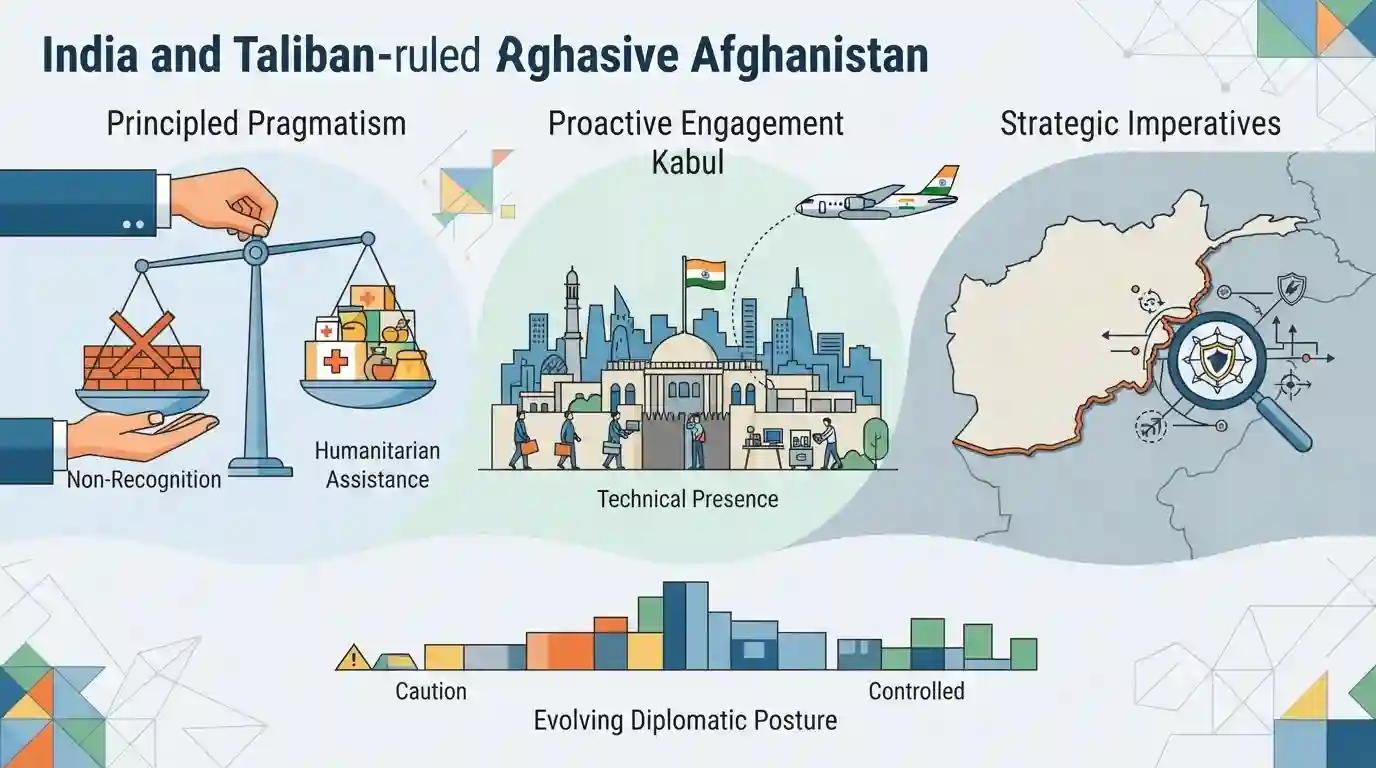
The article analyses India's evolving diplomatic posture towards Taliban-ruled Afghanistan, characterising it as a form of 'principled pragmatism'. It highlights how New Delhi balances non-recognition of the regime with proactive engagement through humanitarian assistance, technical presence in Kabul, and strategic imperatives regarding regional security and counter-terrorism.
ముఖ్య అంశాలు
- India's policy towards the Taliban regime in Afghanistan is defined as 'principled pragmatism', balancing security concerns with humanitarian assistance and regional stability.
- Despite lack of formal diplomatic recognition, India has maintained a 'technical team' in Kabul to coordinate humanitarian aid, medicine, and food supplies.
- The approach reflects strategic realism: safeguarding Indian developmental investments in Afghanistan while preventing the country from becoming a safe haven for anti-India terror groups like LeT or JeT.
- Geopolitical challenges include Pakistan's role, China's growing footprint, and the need to engage regional platforms without compromising India's core security interests.
ముఖ్యమైన పదాలు
Principled Pragmatism

A diplomatic approach balancing ethical concerns, non-recognition, and human rights advocacy with proactive humanitarian aid, technical presence, and strategic security cooperation.
UPSC context
Important for GS Paper II (International Relations - India's Neighborhood Policy and Strategic Interests). Tests understanding of India's nuanced diplomatic posture toward non-democratic regimes.
Taliban
The executive arm of the Taliban that seized power in Afghanistan in August 2021, presenting regional security, counter-terrorism, and humanitarian challenges for neighboring states.
UPSC context
Important for GS Paper II (International Relations - Regional Security) and GS Paper III (Internal Security - Border Management & Terrorism). Tests analysis of evolving geopolitical threats.
Ministry of External Affairs India
The central government ministry of India responsible for the execution, formulation, and management of the nation's foreign policy and diplomatic engagements globally.
UPSC context
Important for GS Paper II (International Relations - India's Foreign Policy and Institutional Frameworks). Tests knowledge of executive governance structures handling external affairs.
ప్రిలిమ్స్ ఉచ్చు
Since India has not granted formal diplomatic recognition to the Taliban regime, New Delhi maintains zero official presence or interaction inside Afghanistan.
Aspirants often assume non-recognition of a regime means a total absence of diplomatic or technical engagement, confusing formal de jure recognition with de facto operational presence.
అనుసంధానమైన స్థిర భావనలు
What are the key doctrines and evolutions defining India's approach to its immediate neighborhood?
- Gujral Doctrine: Guided by the Gujral Doctrine, India's neighborhood policy emphasizes non-reciprocal accommodation and building trust with smaller neighbors.
- Neighborhood First: Neighborhood First policy prioritizes diplomatic, economic, and humanitarian cooperation with immediate South Asian neighbors to ensure regional stability.
- Principled Pragmatism: Principled pragmatism balances idealistic concerns like human rights and democracy with hard security realism and developmental imperatives.
అంతర-అంశ నమూనాలు
Taliban Engagement + FATF Counter-Terror Financing
India's diplomatic balancing act with the Taliban connects neighborhood security with anti-money laundering and terror financing frameworks monitored by the FATF.
Central Asia Connectivity + Chabahar Port Synergy
Maintaining technical presence in Kabul intersects with India's broader connectivity strategies in Central Asia, bypassing Pakistan via Chabahar Port.

India's 'principled pragmatism' towards the Taliban will likely appear in a multi-statement question on India's neighborhood policy.
అనుసంధాన PYQలు · 2
అనుసంధాన PYQలు · 2
- 2024MainsGS2
Critically analyse India's evolving diplomatic, economic and strategic relations with the Central Asian Republics (CARs) highlighting their increasing significance in regional and global geopolitics.
- 2024MainsGS2
Discuss the geopolitical and geostrategic importance of Maldives for India with a focus on global trade and energy flows. Further also discuss how this relationship affects India's maritime security and regional stability amidst international competition ?
