India Slips to 6th Largest Economy Amid Currency Depreciation
Source:Indian Express ↗
Why It Matters
Understanding the difference between nominal GDP and PPP is fundamental for UPSC aspirants. Changes in global economic rankings driven by currency depreciation (like the Rupee falling against the Dollar) demonstrate the macroeconomic impact of exchange rate volatility on India's $5 trillion economy target and global standing.
Summary
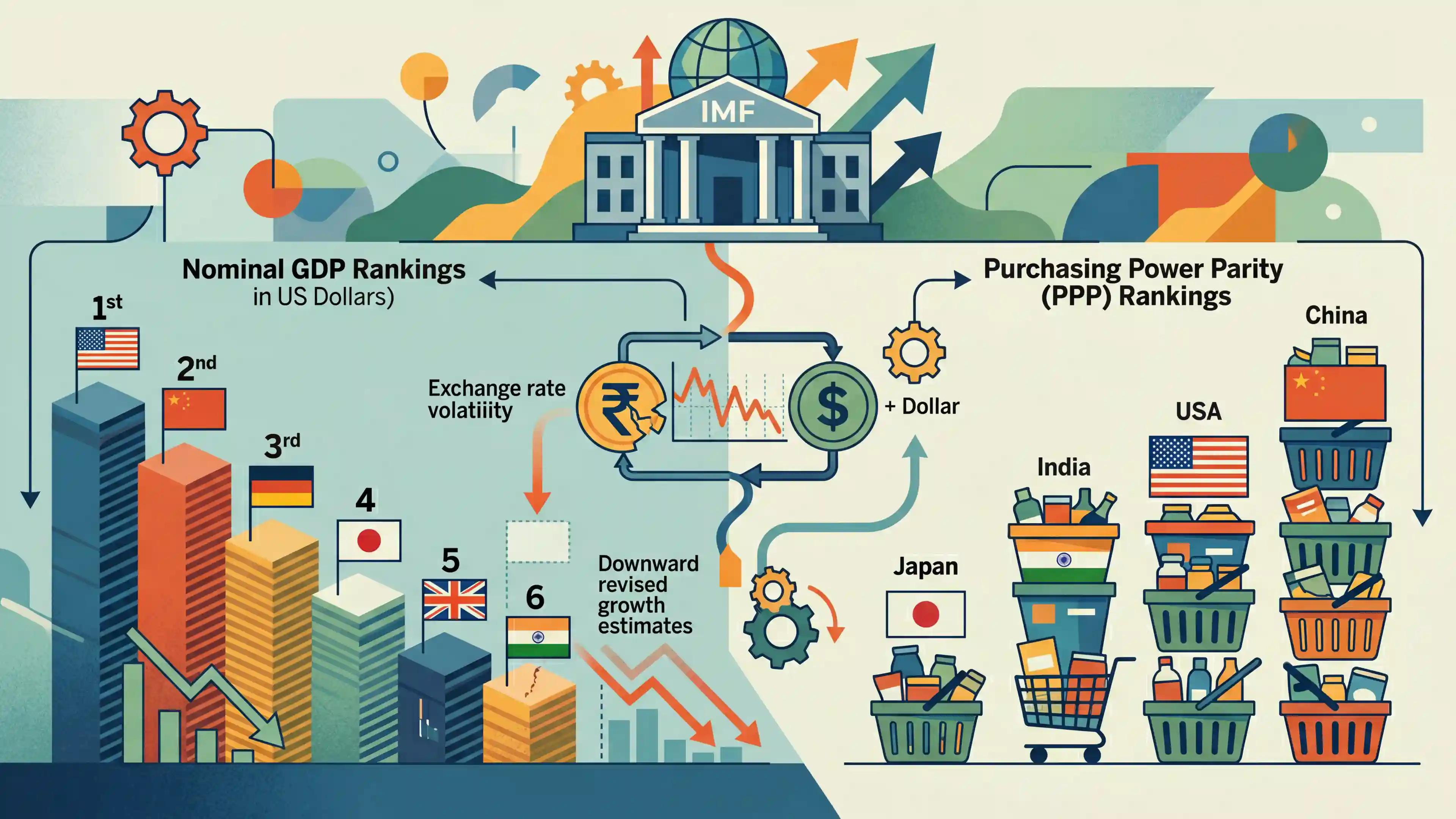
According to an update from the International Monetary Fund (IMF), India has slipped to the position of the 6th largest economy in the world in nominal terms, having been overtaken by the UK and Japan. This slide is largely attributed to the depreciation of the Indian Rupee against the US Dollar and recent downward revisions in GDP growth estimates. Because global economic rankings are calculated in US Dollars, a weaker domestic currency mechanically shrinks the nominal size of the economy on the global stage. However, despite the drop in the nominal GDP ranking, India maintains its position as the 3rd largest economy globally in terms of Purchasing Power Parity (PPP), reflecting the real volume of goods and services produced. The report highlights the vulnerability of international economic comparisons to exchange rate volatility.
Key Points
- India has slipped to the 6th position in the global nominal GDP rankings, overtaken by the UK and Japan according to the IMF.
- The drop is primarily attributed to the depreciation of the Indian Rupee against the US Dollar, which reduces the dollar-denominated value of India's GDP.
- Downward revisions in India's GDP growth estimates have further impacted the nominal size of the economy in the global rankings.
- Despite the slide in nominal terms, India continues to be the 3rd largest economy in the world when measured by Purchasing Power Parity (PPP).
- The development highlights how nominal GDP rankings are highly sensitive to exchange rate fluctuations.
Important Terms
International Monetary Fund (IMF)

A 190-nation organization (founded 1944) fostering global monetary cooperation, financial stability, and international trade. It provides policy advice, technical assistance, and emergency loans to countries facing balance-of-payments crises.
UPSC context
GS Paper II (International Institutions) and GS III (Economic Development). Tests global financial governance and India's relationship with Bretton Woods institutions.
World Economic Outlook (WEO)
A flagship IMF report published twice a year (April and October) providing global economic analysis and growth forecasts for member nations. It is a benchmark for tracking India's global economic ranking.
UPSC context
GS Paper III (Indian Economy). Vital for prelims (reports/indices) and mains (analyzing India's growth trajectory relative to global peers).
Nominal GDP
The total market value of goods and services produced within a country at current prices. It includes inflation and is used for global comparisons after conversion into a common currency (usually USD).
UPSC context
GS Paper III (National Income). Tests distinction between volume-based growth (Real GDP) and price-based/currency-influenced valuation (Nominal GDP).
Purchasing Power Parity (PPP)
An economic theory comparing different countries' currencies through a 'basket of goods' approach. It adjusts for cost-of-living differences, often ranking India's economy significantly higher than nominal exchange rate measures do.
UPSC context
GS Paper III (Growth and Development). Essential for understanding real economic strength and standard of living comparisons across nations.
Exchange Rate Volatility
Significant fluctuations in a currency's value against foreign benchmarks. Rupee depreciation against the dollar can 'shrink' the nominal size of India's economy in global rankings despite strong domestic growth.
UPSC context
GS Paper III (External Sector). Tests understanding of currency dynamics, capital flows, and their impact on India's international economic standing.
Prelims Trap
India recently slipped to the 6th position globally in terms of both nominal GDP and Purchasing Power Parity (PPP).
UPSC often swaps nominal and PPP rankings. India is 6th in nominal (dollar) terms due to currency depreciation, but firmly remains 3rd in PPP terms.
Static Concepts Connected
How does GDP at Purchasing Power Parity (PPP) differ from Nominal GDP?
- Nominal GDP: Measures output using current market exchange rates. It is highly susceptible to daily currency volatility and international capital flows.
- PPP GDP: Measures output by comparing the cost of a standard basket of goods across nations, neutralizing exchange rate distortions to reflect real living standards.
- The India Divergence: India ranks much higher in PPP (3rd) because non-tradable goods and domestic services are significantly cheaper locally than in developed nations like the US.
What are the key flagship reports published by the IMF?
- World Economic Outlook: Published twice a year, tracking global GDP estimates, macroeconomic projections, and country economic rankings.
- Global Financial Stability Report: Assesses vulnerabilities in the global financial system and tracks international capital market trends.
- Fiscal Monitor: Analyzes public finance developments, debt levels, and fiscal policy projections globally.
Cross-Topic Patterns
Rupee depreciation & Imported Inflation
A sliding Rupee mechanically reduces nominal dollar-GDP, but critically inflates India's import bill for crude oil and electronics, stressing the Current Account Deficit and feeding domestic imported inflation.
Nominal GDP size and Sovereign Credit Ratings
Falling nominal GDP in dollar terms alters debt-to-GDP optics for foreign investors, potentially influencing sovereign credit ratings even if domestic macroeconomic fundamentals and real output remain robust.

Expect a 2026 Prelims statement contrasting Nominal vs PPP GDP calculation methodologies using the IMF World Economic Outlook rankings.
Linked PYQs · 5
Linked PYQs · 5
- 2019PrelimsGS1
Consider the following statements: 1. Purchasing Power Parity (PPP) exchange rates are calculated by comparing the prices of the same basket of goods and services in different countries. 2. In terms of PPP dollars, India is the sixth largest economy in the world. Which of the statements given above is/are correct?
- 2021PrelimsGS1
Consider the following statements : The effect of devaluation of a currency is that it necessarily 1. improves the competitiveness of the domestic exports in the foreign markets 2. increases the foreign value of domestic currency 3. improves the trade balance Which of the above statements is/are correct?
- 2022PrelimsGS1
With reference to the Indian economy, consider the following statements: 1. If the inflation is too high, Reserve Bank of India (RBI) is likely to buy government securities. 2. If the rupee is rapidly depreciating, RBI is likely to sell dollars in the market. 3. If interest rates in the USA or European Union were to fall, that is likely to induce RBI to buy dollars. Which of the statements given above are correct?
- 2021MainsGS3
Explain the difference between computing methodology of India's Gross Domestic Product (GDP) before the year 2015 and after the year 2015.
- 2014PrelimsGS1
Which of the following organizations brings out the publication known as 'World Economic Outlook'?
