Nominal GDP Rankings and Exchange Rate Fluctuation Impacts
Source:Indian Express ↗
Why It Matters
This article is crucial for understanding how currency depreciation (rupee fall) impacts macroeconomic indicators like nominal GDP in dollar terms. It tests the aspirant's conceptual clarity on the differences between real GDP, nominal GDP, and PPP, as well as the role of exchange rate fluctuations in global economic rankings.
Summary
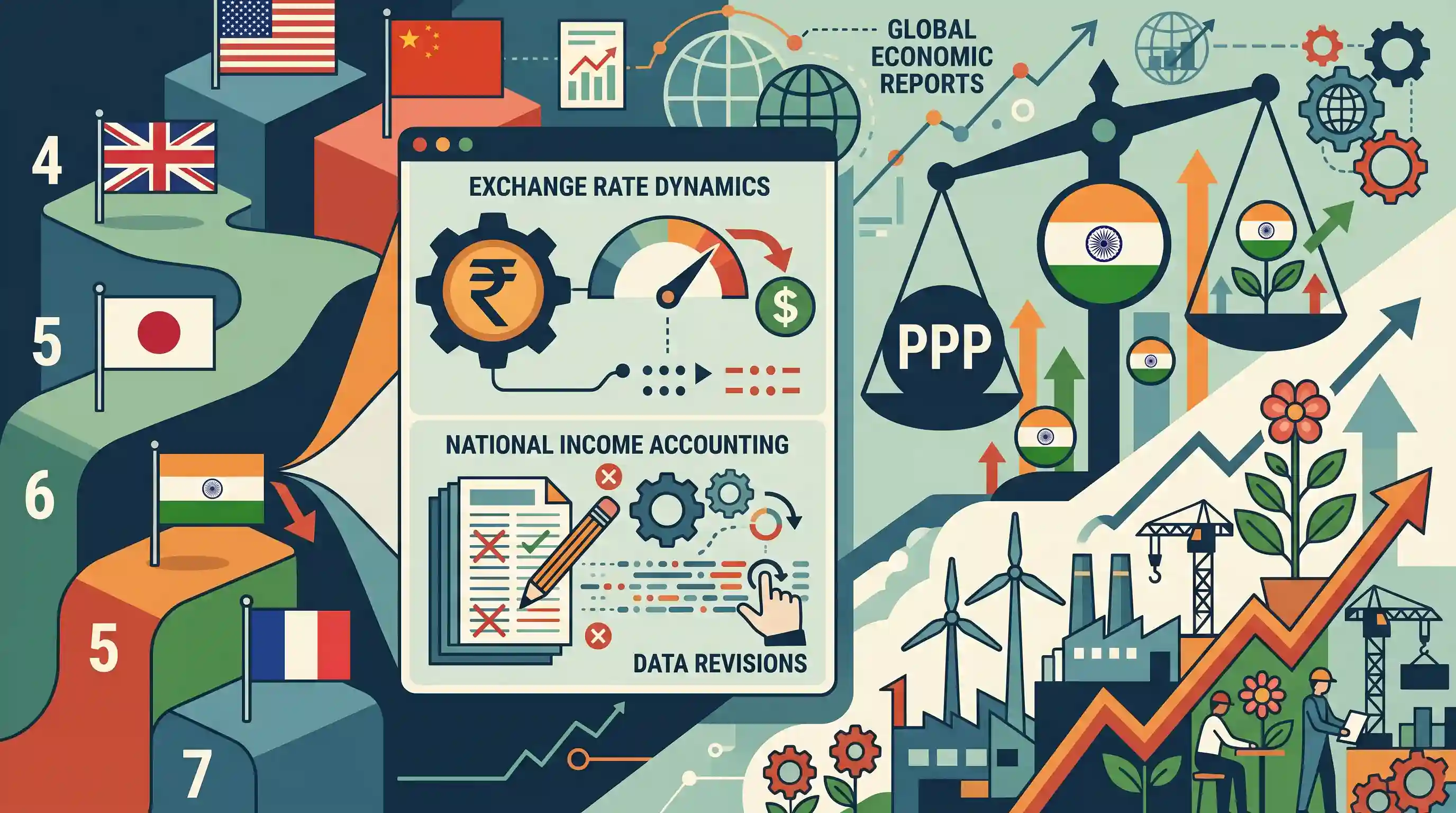
According to the IMF's latest update, India has slipped to the 6th largest economy globally, having been overtaken by the UK and Japan. This slide in ranking is not primarily driven by a collapse in domestic production, but rather by the depreciation of the Indian Rupee against the US Dollar and recent GDP data revisions. The development highlights how nominal GDP comparisons in USD are highly sensitive to exchange rate fluctuations, drawing a sharp contrast with India's continued robust real GDP growth and its standing in Purchasing Power Parity (PPP) terms.
Key Points
- The IMF's latest World Economic Outlook report indicates that India has slipped from the 5th to the 6th largest economy in the world in nominal terms.
- The United Kingdom and Japan have overtaken India in the global GDP rankings.
- A primary reason for this slide is the significant depreciation of the Indian Rupee against the US Dollar, which mechanically lowers India's nominal GDP when converted into USD.
- Statistical revisions and adjustments to GDP calculation methodologies have also factored into the recalibrated rankings.
- Despite the drop in nominal dollar-denominated rankings, India's real GDP growth rate remains strong, highlighting the distinction between currency-adjusted nominal size and actual economic output growth.
Important Terms
International Monetary Fund (IMF)

A global financial agency that monitors economic trends and publishes the World Economic Outlook, providing the benchmark data for international GDP rankings.
UPSC context
GS Paper II (International Institutions) and GS Paper III (Economy); tests knowledge of global governance and economic reporting.
Nominal GDP
The total market value of goods and services produced within a country, calculated at current prices without adjusting for inflation or cost-of-living differences.
UPSC context
GS Paper III (National Income Accounting); crucial for understanding how exchange rates impact India's global ranking and $5-trillion milestone.
Real GDP
An inflation-adjusted measure reflecting the actual volume of goods and services produced, using constant base-year prices to track true economic growth.
UPSC context
GS Paper III (Economic Growth); tests the ability to distinguish between price-driven expansion and structural increase in economic production.
Purchasing Power Parity (PPP)
An economic theory that adjusts exchange rates to equalize the cost of a common basket of goods, reflecting a nation's true standard of living.
UPSC context
GS Paper III (Development); essential for comparing international living standards where India consistently ranks significantly higher than in nominal terms.
Currency Depreciation
A decrease in the value of a currency in a floating exchange rate system, making domestic output appear smaller in international (USD) terms.
UPSC context
GS Paper III (External Sector); tests understanding of how exchange rate volatility affects trade, capital flows, and global economic standing.
Base Year Revision
The process of updating the benchmark year for national accounts to better reflect current economic structures, technologies, and the informal sector.
UPSC context
GS Paper III (National Income); tests technical knowledge of statistical recalibration and its impact on reported growth rates and GDP size.
Prelims Trap
India has recently slipped to the 6th largest economy globally in both nominal and Purchasing Power Parity (PPP) terms.
This statement confuses measurement metrics. While India fell to 6th in nominal USD terms due to Rupee depreciation, it firmly remains the 3rd largest global economy in PPP terms.
Static Concepts Connected
How does Purchasing Power Parity (PPP) differ from Nominal Exchange Rates?
- Nominal Exchange Rate: Calculated based on the daily supply and demand of currencies in the forex market; highly vulnerable to external shocks.
- PPP Method: Compares the price of an identical basket of goods/services across countries, stripping away the distortion of volatile market exchange rates.
- Impact on Rankings: Developing nations like India rank much higher in PPP terms because non-tradable domestic goods and labor are significantly cheaper.
What factors primarily cause a domestic currency to depreciate against the USD?
- Current Account Deficit: Higher import bills (e.g., crude oil, gold) lead to increased demand for dollars, weakening the domestic currency.
- Capital Outflows: When foreign portfolio investors (FPIs) pull out funds due to rising US interest rates, the sudden dollar outflow depreciates the Rupee.
- Inflation Differentials: Persistently higher domestic inflation relative to the US erodes the purchasing power of the Rupee, leading to its depreciation over time.
Cross-Topic Patterns
Rupee slide + Imported Inflation
A weaker Rupee inherently inflates India's import bill (especially crude oil and electronics), complicating the RBI's flexible inflation targeting mandate and widening the Current Account Deficit.
GDP revisions + Base Year changes
The news highlights statistical recalculations. Any future changes to the macroeconomic base year (currently 2011-12) will similarly recalibrate real versus nominal growth trajectories, a recurring UPSC focus area.

A 2026 prelims question will likely test Nominal vs PPP GDP rankings, checking if aspirants know currency depreciation shrinks nominal size.
Linked PYQs · 5
Linked PYQs · 5
- 2018MainsGS3
How would the recent phenomena of protectionism and currency manipulations in world trade affect macroeconomic stability of India?
- 2020MainsGS3
Define potential GDP and explain its determinants. What are the factors that have been inhibiting India from realizing its potential GDP?
- 2019MainsGS3
Do you agree with the view that steady GDP growth and low inflation have left the Indian economy in good shape? Give reasons in support of your arguments.
- 2022PrelimsGS1
With reference to the Indian economy, consider the following statements: 1. An increase in Nominal Effective Exchange Rate (NEER) indicates the appreciation of rupee. 2. An increase in the Real Effective Exchange Rate (REER) indicates an improvement in trade competitiveness. 3. An increasing trend in domestic inflation relative to inflation in other countries is likely to cause an increasing divergence between NEER and REER. Which of the above statements are correct?
- 2022PrelimsGS1
With reference to the Indian economy, consider the following statements: 1. If the inflation is too high, Reserve Bank of India (RBI) is likely to buy government securities. 2. If the rupee is rapidly depreciating, RBI is likely to sell dollars in the market. 3. If interest rates in the USA or European Union were to fall, that is likely to induce RBI to buy dollars. Which of the statements given above are correct?
