Exchange Rate Depreciation and India Global Economic Ranking
Source:Indian Express ↗
Why It Matters
Fluctuations in global economic rankings underscore the significant impact of currency exchange rates on nominal GDP. For UPSC aspirants, understanding the relationship between domestic currency depreciation and global economic standing is key to analyzing India's macroeconomic stability and global competitiveness.
Summary
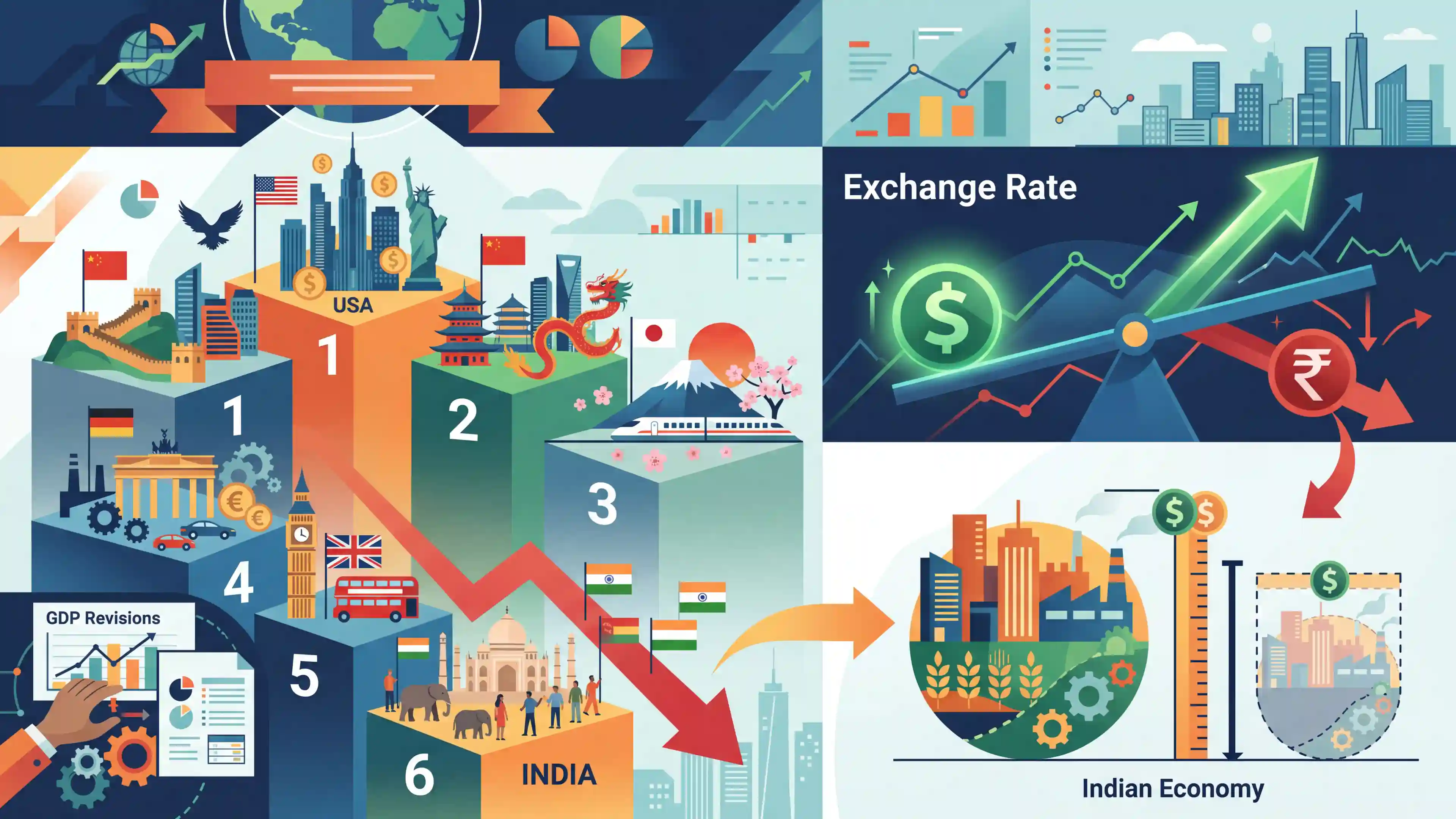
According to an IMF report, India has slipped to the 6th largest economy in the world, being overtaken by the UK and Japan. This shift in global rankings is largely driven by the depreciation of the Indian Rupee against the US Dollar, which shrinks the nominal size of India's economy when measured in USD terms. Additionally, GDP revisions have contributed to this slide, highlighting the impact of exchange rate fluctuations on international economic comparisons.
Key Points
- India has slipped to the 6th position in the global economy rankings according to a recent IMF report.
- The United Kingdom and Japan have overtaken India in nominal GDP terms.
- The decline in ranking is primarily attributed to the depreciation of the Indian Rupee against the US Dollar, which reduces the dollar value of India's GDP.
- Revisions in GDP growth calculations and base effects have also played a role in this macroeconomic shift.
Important Terms
International Monetary Fund (IMF)

A global organization of 190+ countries working to foster global monetary cooperation, secure financial stability, and facilitate international trade. It provides loans to member nations facing balance-of-payments crises.
UPSC context
GS Paper II/III: International institutions and their impact on Indian economic sovereignty and global governance.
Nominal GDP
The total value of all goods and services produced within a country's borders, calculated at current market prices without adjusting for inflation or currency fluctuations.
UPSC context
GS Paper III: Indian Economy and issues relating to planning, mobilization of resources, and growth. Tests understanding of economic indicators.
Exchange Rate Depreciation
A fall in the value of a currency in a floating exchange rate system due to market forces like high demand for foreign currency or weak domestic fundamentals.
UPSC context
GS Paper III: External sector and its impact on domestic growth, exports, and international rankings.
Base Year Revision
The process of updating the benchmark year used for calculating GDP to better reflect the current structure of the economy, including new industries and consumption patterns.
UPSC context
GS Paper III: National income accounting and changes in methodology affecting economic data accuracy and policy planning.
World Economic Outlook (WEO)
A flagship biannual report published by the IMF that analyzes global economic developments and provides growth projections for member countries.
UPSC context
GS Paper III: Important for Prelims (reports/indices) and Mains (global economic trends and India’s comparative performance).
Real GDP
A measure of economic output that adjusts nominal GDP for inflation, providing a more accurate reflection of a country's actual production growth over time.
UPSC context
GS Paper III: Distinguishing between 'statistical' shifts (nominal) and 'structural' growth (real) in the Indian economy.
Prelims Trap
A drop in India's global GDP ranking implies a contraction in its real domestic output.
Rankings use Nominal GDP in USD. A drop is usually driven by exchange rate depreciation, not a contraction in actual domestic production. Furthermore, India remains 3rd in PPP terms.
Static Concepts Connected
How does Nominal GDP differ from GDP at Purchasing Power Parity (PPP)?
- Nominal GDP: Measures the total value of goods and services produced, converted to USD using current market exchange rates.
- GDP at PPP: Adjusts for differences in the cost of living and local price levels between countries to compare absolute purchasing power.
- India's Ranking: India ranks lower in nominal terms (e.g., 5th or 6th) but consistently ranks 3rd globally in PPP terms due to lower domestic living costs.
What are the macroeconomic effects of domestic currency depreciation?
- Nominal GDP Impact: Mathematically reduces the country's overall economic size when expressed in a foreign currency like the US Dollar.
- Export Competitiveness: Makes domestic goods cheaper for foreign buyers, potentially boosting export volumes and competitiveness.
- Imported Inflation: Increases the domestic cost of essential imports (like crude oil and fertilizers), widening the trade deficit and fueling domestic inflation.
Cross-Topic Patterns
Exchange Rates + Imported Inflation
Currency depreciation shrinks nominal GDP in dollars but also fuels imported inflation by making crude oil and essential imports costlier, directly impacting the RBI's monetary policy stance.
Base Year Revisions + Fiscal Metrics
Revisions in GDP methodology alter absolute GDP figures, which mathematically shifts critical macroeconomic indicators like the Fiscal Deficit-to-GDP and Debt-to-GDP ratios, often influencing sovereign credit ratings.

Expect a 2026 multi-statement question contrasting Nominal vs PPP GDP rankings and the mechanical effects of currency depreciation on them.
Linked PYQs · 4
Linked PYQs · 4
- 2022PrelimsGS1
With reference to the Indian economy, consider the following statements: 1. If the inflation is too high, Reserve Bank of India (RBI) is likely to buy government securities. 2. If the rupee is rapidly depreciating, RBI is likely to sell dollars in the market. 3. If interest rates in the USA or European Union were to fall, that is likely to induce RBI to buy dollars. Which of the statements given above are correct?
- 2021PrelimsGS1
Consider the following statements : The effect of devaluation of a currency is that it necessarily 1. improves the competitiveness of the domestic exports in the foreign markets 2. increases the foreign value of domestic currency 3. improves the trade balance Which of the above statements is/are correct?
- 2021MainsGS3
Explain the difference between computing methodology of India's Gross Domestic Product (GDP) before the year 2015 and after the year 2015.
- 2018MainsGS3
How would the recent phenomena of protectionism and currency manipulations in world trade affect macroeconomic stability of India?
