Historical Oil Shocks and India Energy Security Evolution
Source:Indian Express ↗
Why It Matters
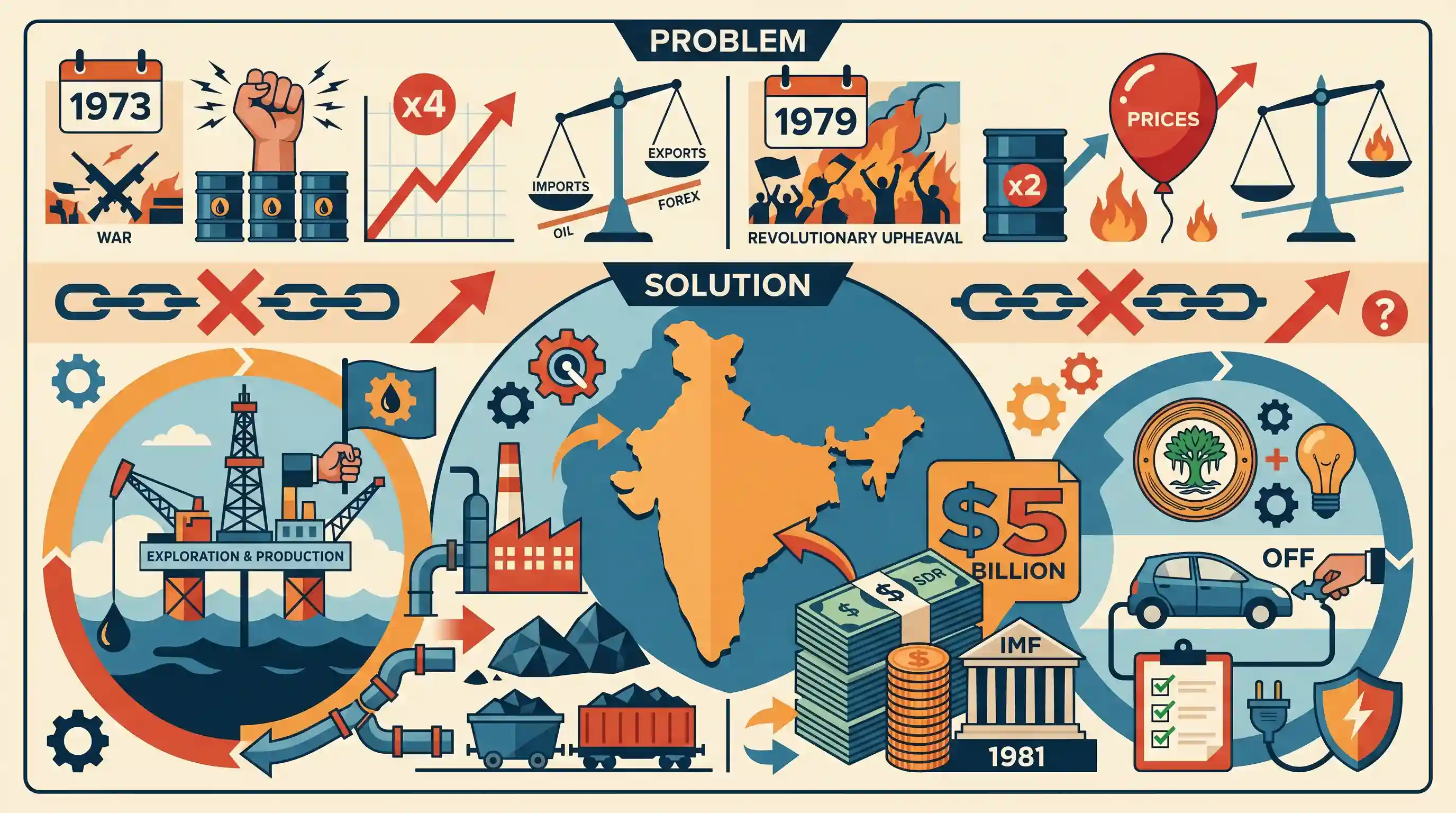
The 1970s oil shocks fundamentally reshaped India's energy policy, forcing a pivot toward domestic exploration (Bombay High) and conservation. Understanding these historical crises provides critical context for analyzing India's modern-day vulnerabilities to Middle East geopolitical shocks, its strategic petroleum reserves policy, and its ongoing transition to renewable energy.
Summary
The article traces India's macroeconomic and strategic policy responses to the twin global oil shocks of the 1970s—the 1973 OAPEC embargo following the Yom Kippur War and the 1979 crisis triggered by the Iranian Revolution. These geopolitical events caused crude prices to quadruple and later double, inflicting severe balance of payment (BoP) crises and rampant inflation on the Indian economy. To manage the fallout, India adopted a multi-pronged survival strategy: securing massive IMF loans (including a $5 billion Extended Fund Facility in 1981), aggressively ramping up domestic exploration which led to the operationalization of the Bombay High offshore field, shifting industrial focus toward coal, and establishing the Petroleum Conservation Research Association (PCRA) to mandate energy efficiency.
Key Points
- The 1973 Yom Kippur War triggered an OAPEC oil embargo, quadrupling global crude prices, severely depleting India's foreign exchange reserves, and driving inflation above 20%.
- The 1979 Iranian Revolution caused the second major oil shock, halving Iran's output, doubling global prices, and precipitating another severe Balance of Payments (BoP) crisis in India.
- To manage the macroeconomic fallout, India secured critical international financial assistance, including a historic $5 billion Extended Fund Facility from the IMF in 1981.
- The crises catalyzed India's drive for energy self-reliance, accelerating the exploration and operationalization of the Bombay High offshore oilfield by ONGC, which significantly reduced import dependence in the 1980s.
- The government introduced sweeping energy conservation measures, promoted a shift to coal for power generation, and established the PCRA to drive nationwide petroleum efficiency.
Important Terms
Extended Fund Facility (EFF)

An IMF lending facility providing medium-term financial assistance to countries facing serious balance of payment problems due to structural weaknesses, requiring longer engagement and repayment periods.
UPSC context
GS-III Economy; tested under International Institutions and India's history of managing external debt and macroeconomic crises.
Organization of Arab Petroleum Exporting Countries (OAPEC)
An intergovernmental organization of Arab oil-producing nations (est. 1968) that used oil as a political weapon during the 1973 embargo against countries supporting Israel.
UPSC context
GS-I Post-Independence History; critical for understanding geopolitical shocks that forced India to pivot toward energy self-reliance.
Balance of Payments (BoP)
A systematic record of all economic transactions between residents of a country and the rest of the world, highlighting external financial health and currency stability.
UPSC context
GS-III Economy; a core concept for analyzing external sector vulnerability, foreign exchange reserves, and macroeconomic stability.
Petroleum Conservation Research Association (PCRA)
A national agency under the Ministry of Petroleum and Natural Gas (est. 1978) mandated to promote energy efficiency and fuel conservation to reduce oil import dependence.
UPSC context
GS-III Energy/Environment; relevant for institutional measures toward energy efficiency and reducing the fiscal burden of oil imports.
Bombay High
India's most significant offshore oilfield, discovered in 1974 by ONGC in the Arabian Sea; it was a strategic turning point for domestic energy production.
UPSC context
GS-I Geography/GS-III Economy; important for mapping domestic natural resources and understanding India's strategy for reducing import dependence.
Oil and Natural Gas Corporation (ONGC)
India's premier public sector enterprise for hydrocarbon exploration and production, responsible for major domestic discoveries that support national energy security.
UPSC context
GS-III Infrastructure/Energy; tests knowledge of the role of PSUs in strategic resource mobilization and energy self-reliance.
Prelims Trap
"India first utilized the IMF's Extended Fund Facility (EFF) during the 1991 balance of payments crisis."
India actually secured a massive $5 billion EFF loan from the IMF in 1981 to manage the severe BoP crisis triggered by the 1979 oil shock.
Static Concepts Connected
What is the IMF's Extended Fund Facility (EFF)?
- Core purpose: Provides financial assistance to countries facing serious medium-term balance of payments problems due to structural weaknesses.
- Repayment terms: Features longer engagement and repayment periods (typically 4.5 to 10 years) compared to standard Stand-By Arrangements.
- Conditionality: Requires the borrowing country to adopt comprehensive economic reform programs addressing underlying structural flaws.
What is the Petroleum Conservation Research Association (PCRA)?
- Nodal agency: A registered society set up in 1978 under the Ministry of Petroleum and Natural Gas.
- Core mandate: Promotes energy efficiency and conservation across major economic sectors, aiming to reduce India's reliance on oil imports.
- Public campaigns: Executes mass media and awareness campaigns, notably 'Saksham' (Sanrakshan Kshamta Mahotsav), to educate citizens on fuel conservation.
Cross-Topic Patterns
1980s BoP vs 1991 Crisis
The structural adjustments required for the 1981 IMF EFF loan laid the early, often-ignored macroeconomic groundwork for the deeper 1991 liberalization policies.
Geopolitics and imported inflation
The 1970s link between Middle Eastern conflicts and India's imported inflation mirrors current macroeconomic vulnerabilities regarding the Strait of Hormuz and Red Sea shipping disruptions.
Offshore exploration and UNCLOS
Bombay High's 1970s success pushed India's maritime focus, linking post-independence economic history directly to EEZ resource exploitation governed by UNCLOS.

Post-independence economic history is trending. Expect a chronological arrangement question linking global crises to India's IMF borrowings.
Linked PYQs · 4
Linked PYQs · 4
- 2025MainsGS1
Trace India's consolidation process during early phase of independence in terms of polity, economy, education and international relations.
- 2018MainsGS3
“Access to affordable, reliable, sustainable and modern energy is the sine qua non to achieve Sustainable Development Goals (SDGs).” Comment on the progress made in India in this regard.
- 2020PrelimsGS1
"Gold Tranche" (Reserve Tranche) refers to
- 2025PrelimsGS1
Consider the following activities : I. Production of crude oil II. Refining, storage and distribution of petroleum III. Marketing and sale of petroleum products IV. Production of natural gas How many of the above activities are regulated by the Petroleum and Natural Gas Regulatory Board in our country?
