India EU Trade Agreement Negotiation Strategy and Geopolitics
Source:Indian Express ↗
Why It Matters
The India-EU FTA is arguably the most substantial and strategically significant trade pact negotiated by India in recent history. It highlights how broader geopolitical maneuvers—like supply chain diversification and US strategic pressure—are shaping modern bilateral trade, making it highly relevant for GS2 (International Relations) and GS3 (Economy) analysis.
Summary
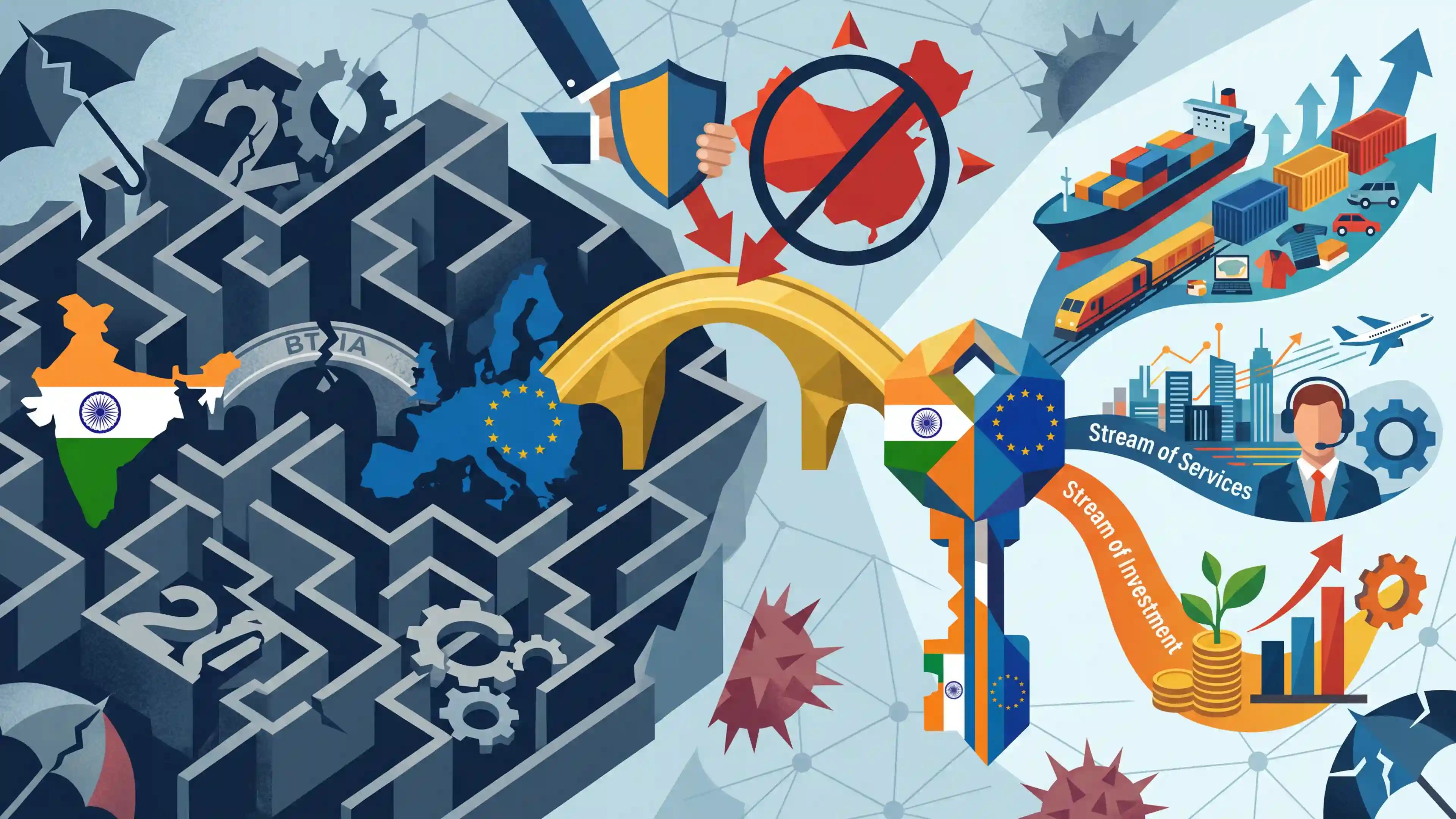
The article explains the successful conclusion of the historic India-European Union (EU) Free Trade Agreement (FTA), resolving two decades of complex and frequently stalled negotiations (historically termed the Broad-based Trade and Investment Agreement or BTIA). It highlights how a pragmatic 'flyover strategy'—bypassing insurmountable sticking points to focus on achievable consensus—coupled with shifting geopolitical alignments and 'US pressure' to counter China, helped clinch the deal. The pact represents a monumental shift in bilateral economic relations, aiming to boost cross-border trade in goods, services, and investment despite a global trend toward protectionism.
Key Points
- The historic India-EU Free Trade Agreement (FTA) has been clinched after two decades of stalled and complex negotiations, originally launched in 2007 as the BTIA.
- A pragmatic 'flyover strategy' was deployed by negotiators, temporarily bypassing historically intractable issues (like dairy tariffs and data adequacy) to secure the broader agreement.
- Geopolitical alignment played a crucial role, with US pressure and the 'China+1' supply-chain diversification strategy pushing Western partners to rapidly integrate India into the global trade framework.
- The agreement, often dubbed the 'Mother of All Deals', promises significant market access expansions for Indian services and manufacturing, while opening India to European capital goods and investments.
Important Terms
India-EU Free Trade Agreement (FTA)

A landmark 2026 economic pact between India and the EU, aiming to liberalize 90-99% of bilateral trade. It addresses goods, services, and investment, representing the world's largest free-trade zone by population.
UPSC context
GS Paper 2 (Bilateral/Global Agreements) & GS 3 (Economy). Tests India's trade diplomacy and integration into global value chains.
Broad-based Trade and Investment Agreement (BTIA)
The 2007-launched framework for India-EU trade talks. It stalled in 2013 due to disputes over data security, intellectual property, and market access for automobiles and wines before being rebranded/concluded as the 2026 FTA.
UPSC context
GS Paper 2 (International Relations). Tests knowledge of historical impediments and the evolution of India's external economic relations.
Carbon Border Adjustment Mechanism (CBAM)
An EU climate policy imposing carbon costs on imports of carbon-intensive goods (steel, aluminium, cement). In the 2026 FTA, a technical dialogue was established to mitigate its impact on Indian exporters.
UPSC context
GS Paper 3 (Environment & Economy). Evaluates challenges of 'green protectionism' and India's transition to low-carbon industrial exports.
Flyover Strategy
A pragmatic negotiation tactic mentioned in the article where negotiators bypass complex, insurmountable sticking points (like agriculture) to focus on achieving consensus in areas where a deal is possible.
UPSC context
GS Paper 2 (International Relations/Diplomacy). Relevant for understanding modern 'early-harvest' or 'phased' approaches to complex international trade negotiations.
European Union (EU)
An economic and political union of 27 European countries. It is India's largest trading partner as a bloc, accounting for roughly 11.5% of India's total trade in goods and services.
UPSC context
GS Paper 2 (Global Groupings). Crucial for understanding India's engagement with major economic blocs and strategic partners in Europe.
Strategic Autonomy
India's foreign policy principle of pursuing independent decision-making and diverse partnerships (e.g., balancing relations with Russia, US, and EU) to safeguard national interests without joining formal alliances.
UPSC context
GS Paper 2 (Indian Foreign Policy). Core theme for Mains, testing India's ability to navigate global conflicts and multi-alignment.
Prelims Trap
The recently concluded India-EU FTA grants India 'data secure' status and eliminates all tariffs on dairy imports.
The deal utilized a 'flyover strategy' that specifically bypassed these historically intractable issues (data adequacy and dairy) to finalize the broader trade agreement.
Static Concepts Connected
What is 'Data Adequacy' status under European Union norms?
- GDPR mandate: Under GDPR, the EU restricts personal data transfers to non-EU countries unless they demonstrate an equivalent, adequate level of domestic data protection.
- Impact on IT: Without this status, Indian IT and BPO service exporters face significantly higher compliance costs, complex legal clauses, and hurdles in handling European client data.
What distinguishes the Broad-based Trade and Investment Agreement (BTIA)?
- Historical nomenclature: Launched in 2007, it was the specific umbrella nomenclature for the comprehensive negotiations between India and the European Union.
- Comprehensive scope: Unlike standard FTAs, it aimed to comprehensively integrate trade in goods, services, investment protection, IP rights, and public procurement.
Cross-Topic Patterns
Geopolitics driving trade pacts
The 'China+1' strategy shows how strategic supply-chain de-risking now overrides pure tariff negotiations, echoing the rapid conclusion of the recent India-Australia ECTA and India-EFTA pacts.
CBAM vs Free Trade Paradox
While the FTA boosts market access, the EU's Carbon Border Adjustment Mechanism (CBAM) simultaneously acts as a de facto non-tariff barrier for Indian steel and aluminum exports.

Expect a 2026 multi-statement Prelims question contrasting India-EU FTA's bypassed sectors (dairy/data) against EU's upcoming CBAM tariffs.
Linked PYQs · 2
Linked PYQs · 2
- 2017PrelimsGS1
'Broad-based Trade and Investment Agreement (BTIA)' is sometimes seen in the news in the context of negotiations held between India and
- 2025MainsGS3
What are the challenges before the Indian economy when the world is moving away from free trade and multilateralism to protectionism and bilateralism? How can these challenges be met?
