Cyber Warfare Preparedness and Critical Infrastructure Protection
Source:Indian Express ↗
Why It Matters
Cyber warfare and the protection of Critical Information Infrastructure are consistently tested in UPSC Mains GS3. Understanding the strategic dimensions of cyber conflicts and India's preparedness is crucial for answering questions on internal security threats.
Summary
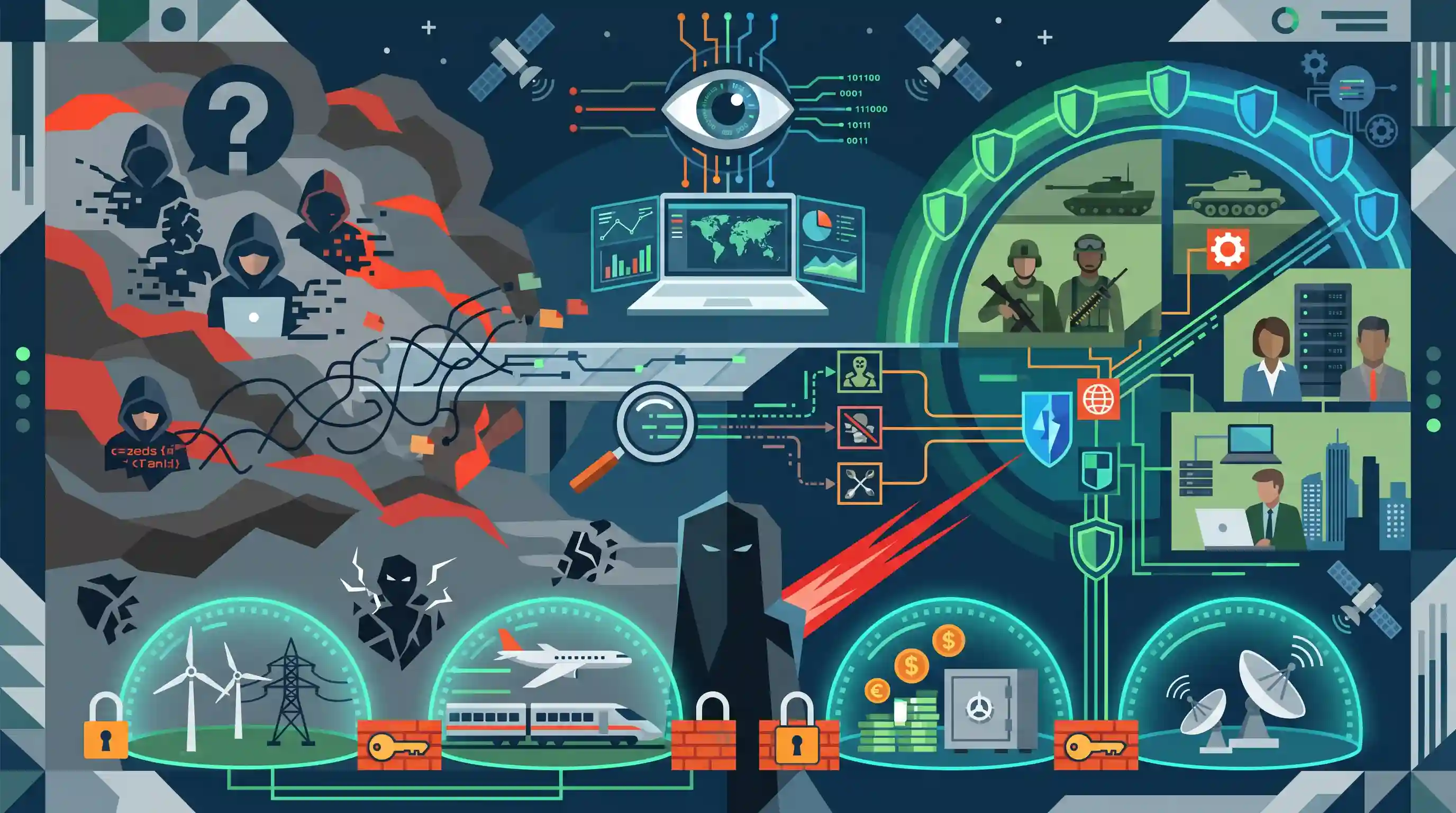
The article discusses India's strategic approach to navigating the complexities and uncertainties ("fog of war") inherent in cyber warfare, as illustrated by "Operation Sindoor." It highlights the challenges of attribution, maintaining situational awareness, and coordinating defense responses during cyber conflicts. The piece emphasizes the critical need for robust cyber defense frameworks, institutional synergy among military and civilian agencies, and advanced capabilities to secure critical information infrastructure against both state and non-state threat actors.
Key Points
- Cyber warfare introduces a "fog of war" characterized by uncertainty, anonymity, and difficulties in timely attribution of attacks.
- The scenario of Operation Sindoor highlights the necessity of real-time situational awareness and rapid response mechanisms in countering sophisticated cyber threats.
- Securing Critical Information Infrastructure (CII) is paramount to preventing crippling disruptions to national security and the economy during cyber conflicts.
- Effective cyber defense requires institutional synergy between civilian, military, and intelligence agencies, emphasizing the role of organizations like the Defence Cyber Agency (DCA).
- Investment in robust cyber capabilities, including AI-driven threat intelligence, is crucial for India to maintain strategic deterrence in cyberspace.
Important Terms
Operation Sindoor

A 2025 Indian military response to the Pahalgam terror attack, involving kinetic strikes and a significant cyber-warfare dimension to counter state-linked propaganda and infrastructure threats.
UPSC context
GS Paper III: Internal Security. Tests awareness of modern hybrid warfare and India's strategic response to cross-border terrorism.
Defence Cyber Agency (DCA)
A tri-service agency of the Indian Armed Forces established in 2019 to handle cyber warfare, including offensive operations and defending military networks against external threats.
UPSC context
GS Paper III: Security Challenges. Tests knowledge of India's military institutional framework for digital-age combat.
National Critical Information Infrastructure Protection Centre (NCIIPC)
The national nodal agency established under the IT Act, 2000, to safeguard India's critical sectors (energy, telecom, etc.) from debilitating cyberattacks and disruptions.
UPSC context
GS Paper III: Cyber Security. Tests understanding of infrastructure protection and roles of nodal security agencies.
CERT-In (Indian Computer Emergency Response Team)
The national agency under MeitY responsible for incident response, forecasting, and alerting the Indian cyber community about threats like malware and phishing.
UPSC context
GS Paper III: Cyber Security. Core agency for national digital defense and incident management protocols.
Critical Information Infrastructure (CII)
Computer resources whose incapacitation or destruction would have a debilitating impact on national security, economy, public health, or safety.
UPSC context
GS Paper III: Internal Security. Tests conceptual clarity on vital digital assets protected under Section 70 of the IT Act.
National Cyber Security Policy
A 2013 framework aimed at protecting public/private digital infrastructure, building a secure cyber ecosystem, and creating a workforce of cybersecurity professionals.
UPSC context
GS Paper III: Cyber Security. Tests understanding of policy-level initiatives for national cyber resilience.
Prelims Trap
CERT-In is the nodal agency mandated to protect India's Critical Information Infrastructure (CII).
CERT-In handles national incident response. The National Critical Information Infrastructure Protection Centre (NCIIPC), functioning under NTRO, is specifically mandated to protect CII.
Static Concepts Connected
What is the institutional framework for India's cyber security?
- NCIIPC: Nodal agency to protect Critical Information Infrastructure; operates under the National Technical Research Organisation (NTRO).
- CERT-In: National nodal agency for responding to computer security incidents, operating under MeitY.
- Defence Cyber Agency: Tri-service command reporting to the Chief of Defence Staff (CDS), handling military cyber operations and warfare.
- I4C: Indian Cyber Crime Coordination Centre functioning under the MHA to tackle cybercrime comprehensively across the country.
How is Critical Information Infrastructure (CII) legally protected in India?
- IT Act 2000: Section 70 defines CII as computer resources whose incapacitation severely impacts national security, economy, or public health.
- Designated Sectors: Currently includes power & energy, banking/finance, telecom, transport, government, and strategic & public enterprises.
- Strict Penalties: Unauthorized access to a designated CII system is punishable with imprisonment extending up to 10 years.
Cross-Topic Patterns
Cyber attribution + International Law
The "fog of war" in cyber attacks complicates international law (Tallinn Manual), making it exceptionally hard to legally attribute state-sponsored attacks and invoke self-defense under UN Charter Article 51.
AI in Offensive/Defensive Cyber Ops
Links GS-3 S&T with Internal Security. Artificial Intelligence is a dual-use weapon, powering automated spear-phishing and RATs, while simultaneously enabling real-time predictive threat-hunting for defense.

Prelims 2026 will likely test the exact statutory backing and jurisdiction differences between NCIIPC, CERT-In, and Defence Cyber Agency.
Linked PYQs · 3
Linked PYQs · 3
- 2021MainsGS3
Keeping in view India's internal security, analyse the impact of cross-border cyber attacks. Also discuss defensive measures against these sophisticated attacks.
- 2017MainsGS3
Discuss the potential threats of Cyber attack and the security framework to prevent it.
- 2020MainsGS3
Discuss different types of cyber crimes and measures required to be taken to fight the menace.
