Food Security System Reforms and Climate Resilience in India
Source:Indian Express ↗
हे का महत्त्वाचे आहे
Food security is a core pillar of India's socioeconomic stability and development. Analyzing systemic bottlenecks in procurement, storage, and distribution helps aspirants evaluate structural reforms needed for sustainable agriculture and nutritional security under emerging climate and fiscal constraints.
सारांश
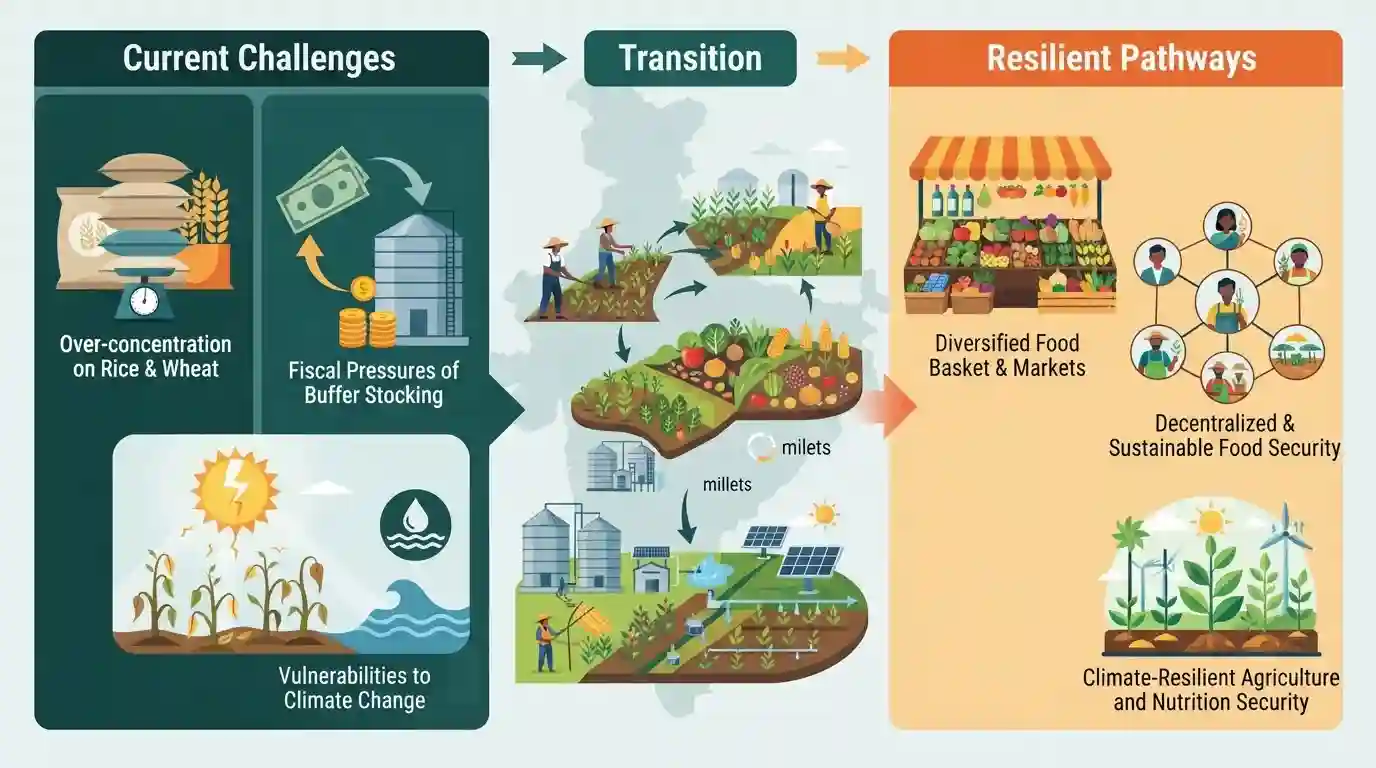
The article discusses the structural challenges facing India's food security system, including over-concentration on rice and wheat, fiscal pressures of buffer stocking, and vulnerabilities to climate change. It outlines pathways to build a more resilient, diversified, and sustainable food security architecture.
मुख्य मुद्दे
- India's current food security system heavily relies on wheat and paddy procurement through Minimum Support Prices (MSP), leading to ecological stress, over-reliance on a few states, and heavy fiscal burdens.
- Climate change poses severe threats to agricultural productivity, necessitating a shift towards climate-resilient, diversified cropping systems (such as millets, pulses, and oilseeds).
- Reforms in buffer stock management, decentralized storage, and leveraging digital technology can minimize post-harvest losses and improve supply chain efficiency.
- Enhancing nutritional security alongside caloric security requires revamping the Public Distribution System (PDS) and expanding the inclusion of nutritious coarse grains.
महत्त्वाच्या संज्ञा
Public Distribution System (PDS)

India's primary subsidized food and commodity distribution network managed jointly by the Centre and States, ensuring food security and price stabilization for vulnerable populations.
UPSC context
UPSC GS Paper III (Agriculture/Food Security) - crucial for testing mechanisms of food grain distribution, leakages, and subsidy management.
National Food Security Act (NFSA)
Landmark 2013 legislation providing legal entitlements to subsidized food grains to approximately 67% of India's population.
UPSC context
UPSC GS Paper II & III - tests rights-based social welfare, nutritional security, and statutory welfare obligations.
Food Corporation of India (FCI)
The nodal central agency responsible for procuring food grains at Minimum Support Prices, maintaining buffer stocks, and distributing them to states.
UPSC context
UPSC GS Paper III - tests institutional frameworks of agricultural marketing, food storage, and fiscal implications of buffer stocking.
पूर्वपरीक्षा सापळा
central pool reserves exceeding mandatory buffer norms year-round at a static threshold
Aspirants often assume buffer stock norms are fixed annually; actually, norms vary across quarters (April 1, July 1, October 1, January 1) reflecting crop seasonality.
संबंधित स्थिर संकल्पना
What are the components of the Economic Cost of foodgrains for the FCI?
- Procurement Cost: Procurement cost includes MSP paid to farmers plus statutory taxes, levies, and commission agent charges.
- Procurement Incidentals: Procurement incidentals covers storage, interest, handling, and administrative charges incurred by FCI up to the point of dispatch.
- Distribution Cost: Distribution cost includes freight, storage losses, interest, and administrative expenses incurred in moving foodgrains from surplus regions to PDS depots.
आंतर-विषय नमुने
Buffer Stocks and WTO Public Stockholding
Excess buffer stocks in FCI godowns tie up fiscal space while export bans distort international trade rules under WTO AoA disciplines.
MSP-Driven Agriculture and Groundwater Depletion
Water-intensive paddy cultivation funded by free power and MSP causes rapid groundwater depletion in northwest India, threatening long-term ecological security.

Expect a 2-statement Prelims question on FCI buffer norms vs actual stocks, or a Mains analytical Q on diversifying NFSA towards millets.
संबंधित PYQ · 3
संबंधित PYQ · 3
- 2024MainsGS3
Elucidate the importance of buffer stocks for stabilizing agricultural prices in India. What are the challenges associated with the storage of buffer stock? Discuss.
- 2022MainsGS3
What are the major challenges of Public Distribution System (PDS) in India ? How can it be made effective and transparent ?
- 2019MainsGS3
What are the reformative steps taken by the Government to make food grain distribution system more effective?
