Stubble Burning and Governmentality Policy Failures
Source:The Hindu ↗
Why It Matters
It provides a critical sociological and policy-oriented perspective on why punitive measures against stubble burning fail, helping aspirants evaluate the intersection of environmental governance and agrarian distress for Mains GS3.
Summary
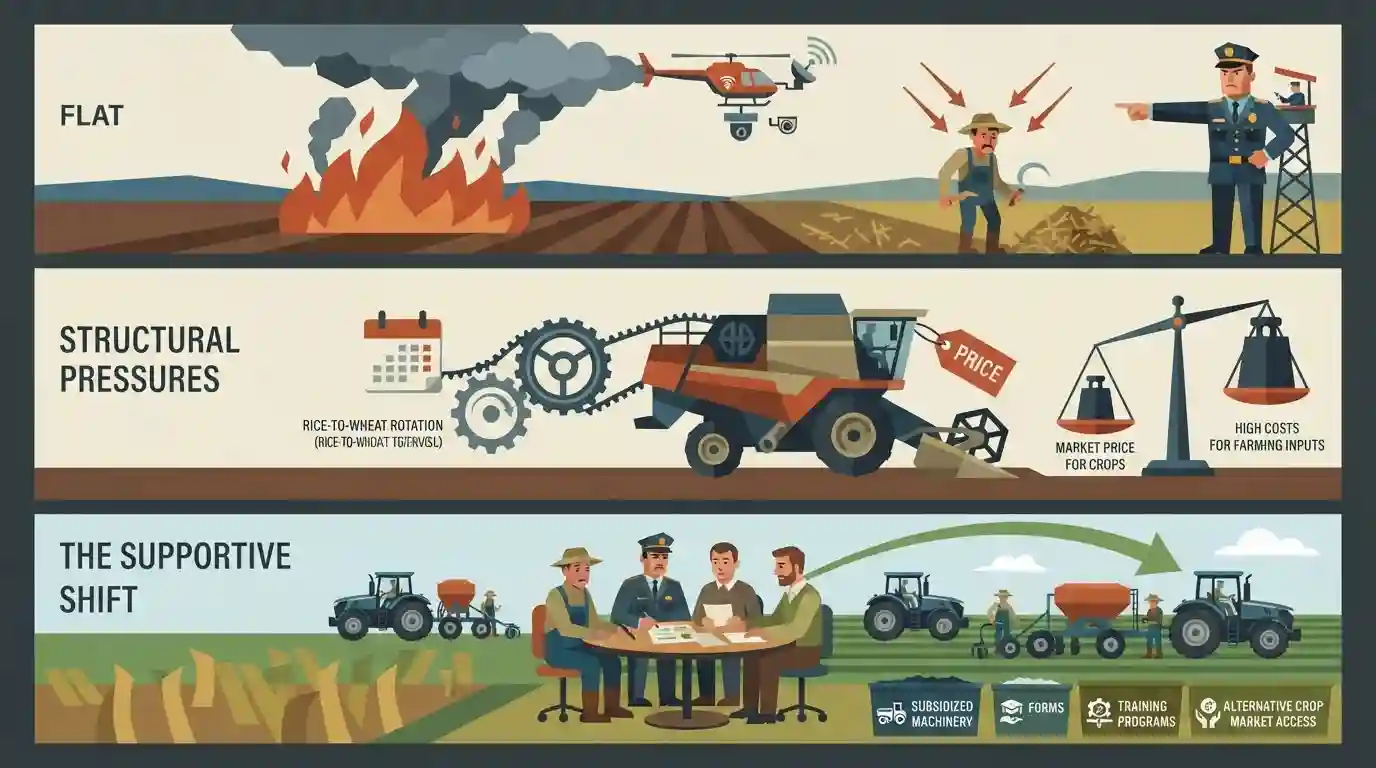
The article examines how state-led 'governmentality'—characterized by technocratic surveillance, penalties, and top-down punitive measures—fails to resolve the stubble-burning crisis in northern India. By framing the issue purely as a law-and-order or behavioral problem among farmers, the state overlooks structural pressures like tight cropping schedules, expensive residue management machinery, and distorted market incentives. Addressing stubble burning requires shifting from criminalization to collaborative socio-economic support systems.
Key Points
- Foucault's concept of 'governmentality' helps analyze how the state relies on disciplinary measures, penalties, and technocratic monitoring rather than addressing structural agricultural crises.
- Stubble burning persists despite punitive measures because of tight harvest-to-sowing windows, high costs of alternative machinery, and limited economic viability of paddy straw.
- Top-down techno-managerial interventions alienate farmers, treating them as lawbreakers instead of stakeholders in ecological restoration.
- Effective resolution requires inclusive policy frameworks that address the root causes of agrarian distress, such as groundwater conservation laws and skewed MSP incentives.
Static Concepts Connected
What are the key institutional mechanisms and statutory bodies governing air quality management in the National Capital Region?
- CAQM Establishment: Statutory Body established via the Commission for Air Quality Management in National Capital Region and Adjoining Areas Act, 2021.
- Supremacy & Powers: Supersedes all other state and central bodies in NCR on matters of air pollution, empowered to issue binding directions and penalize violators.
- Core Mandate: Tasked with coordinating cross-state actions including monitoring stubble burning, industrial emissions, and vehicular pollution.
Cross-Topic Patterns
Groundwater Acts + Stubble Burning Nexus
Groundwater conservation laws in Punjab inadvertently forced delayed paddy nurseries, compressing the wheat sowing window and triggering mass stubble burning.
Judicial Activism vs. Agrarian Ground Realities
The Supreme Court and CAQM directives illustrate how judicial and administrative mandates clash with socioeconomic realities of smallholder farmers.

Expect a multi-statement Prelims question linking the Punjab Preservation of Sub-Soil Water Act directly to the stubble burning timeline.
Linked PYQs · 3
Linked PYQs · 3
- 2020MainsGS3
What are the key features of the National Clean Air Programme (NCAP) initiated by the Government of India?
- 2021MainsGS3
Describe the key points of the revised Global Air Quality Guidelines (AQGs) recently released by the World Health Organisation (WHO). How are these different from its last update in 2005? What changes in India's National Clean Air Programme are required to achieve these revised standards?
- 2021MainsGS3
What are the present challenges before crop diversification? How do emerging technologies provide an opportunity for crop diversification?
