Gender Responsive Budgeting Frameworks for Inclusive Growth in India
Source:Indian Express ↗
Why It Matters
Gender Budgeting has been an explicit tool in India since 2005. Its conceptual depth is frequently tested by UPSC (e.g., GS-3 in 2016, GS-1 in 2024) to evaluate candidates' understanding of how fiscal policies can be leveraged for social equity and women's empowerment beyond mere welfare schemes.
Summary
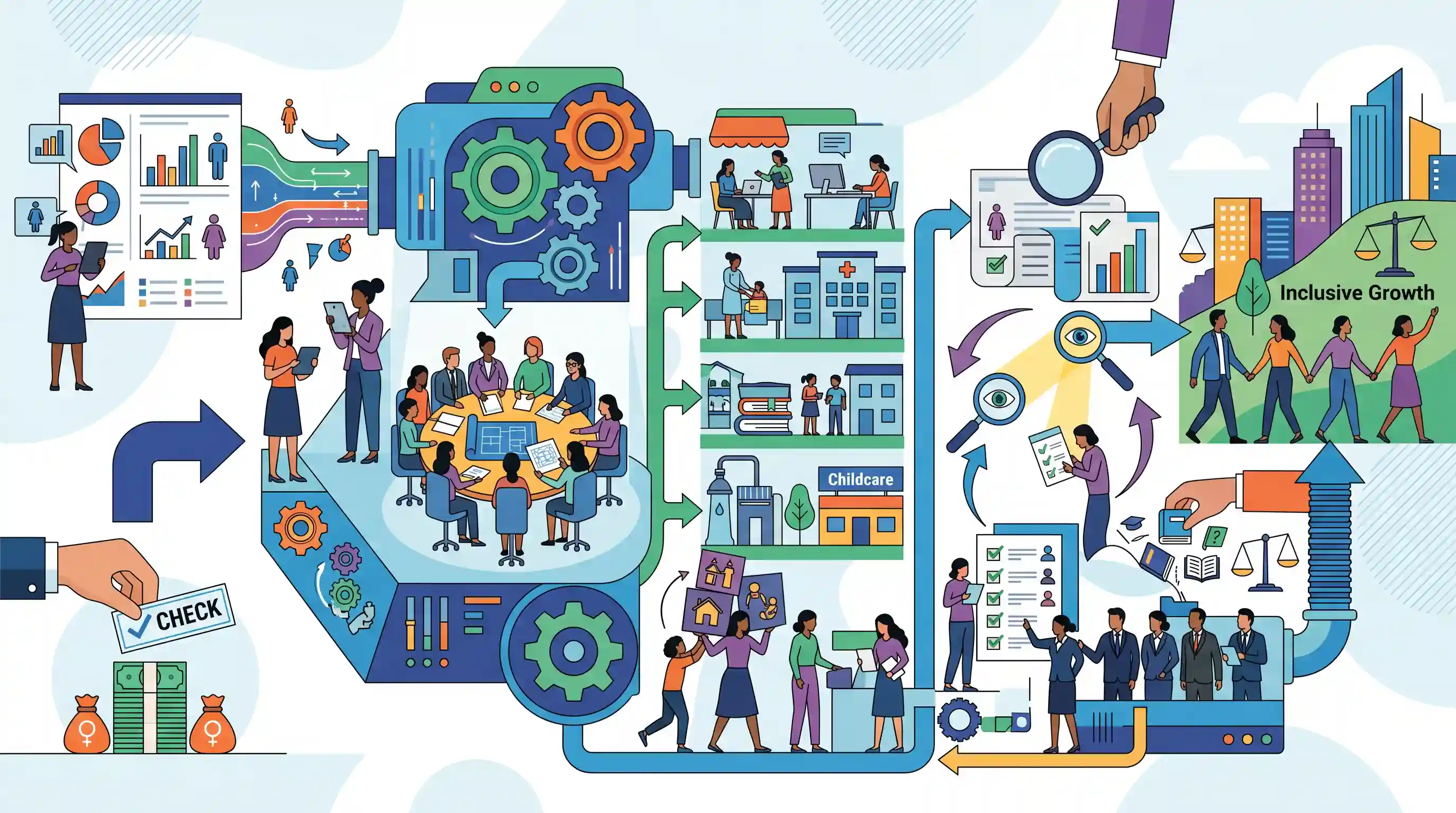
Gender Responsive Budgeting (GRB) must evolve beyond a mere accounting exercise of earmarking funds for women. The article emphasizes that true GRB requires mainstreaming gender perspectives across all stages of public policy—from formulation and execution to auditing and outcome assessment. By relying on sex-disaggregated data, conducting gender-based audits, and addressing structural barriers like unpaid care work, GRB can become a transformative tool for achieving gender equity and inclusive growth. Ultimately, capacity building across government departments is crucial to ensure that public expenditure systematically dismantles gender disparities rather than just meeting superficial allocation targets.
Key Points
- Gender Responsive Budgeting (GRB) is not simply setting aside a separate budget for women, but rather integrating a gender lens into the entire budget cycle (planning, execution, monitoring, and auditing).
- True GRB addresses structural inequalities like the disproportionate burden of unpaid care work and aims to increase Female Labor Force Participation.
- Effective implementation of GRB requires systematic collection and analysis of sex-disaggregated data to measure the actual impact of policies.
- Capacity building and sensitization among policymakers and government officials are essential to transition from token budgetary allocations to meaningful outcome-driven interventions.
Important Terms
Gender Budget Statement (GBS)

An annual reporting tool introduced in 2005-06 that categorizes Union Budget allocations for women into Parts A (100% specific), B (30-99% centric), and C (less than 30% provisioning).
UPSC context
GS-III (Budgeting); GS-II (Social Justice). Tests understanding of fiscal tools used to bridge gender-based resource gaps.
Nirbhaya Fund
A non-lapsable corpus fund established in 2013 following the Delhi gang-rape case to support initiatives focused on women's safety. MWCD is the nodal agency for its expenditure.
UPSC context
GS-II (Vulnerable Sections). Tests knowledge of dedicated safety funds and their utilization challenges in governance.
MGNREGA
A demand-driven rural employment guarantee scheme. In gender budgeting, it is a key Part B scheme, with women constituting over 50% of the workforce, ensuring rural economic empowerment.
UPSC context
GS-II (Welfare Schemes); GS-III (Inclusive Growth). Crucial for analyzing livelihood security and gender-disaggregated outcomes.
Ministry of Women and Child Development (MWCD)
The nodal ministry for Gender Responsive Budgeting in India. It coordinates with other departments to institutionalize gender perspectives and manages the Gender Budgeting Knowledge Hub.
UPSC context
GS-II (Governance/Institutions). Relevant for understanding the executive's role in advancing social justice and gender mainstreaming.
Ministry of Finance
The ministry that institutionalized gender budgeting in 2005-06. It issues the annual Budget Circular, mandating departments to prepare Gender Budget Statements for the Union Budget.
UPSC context
GS-III (Budgeting). Tests knowledge of fiscal policy formulation and the integration of social priorities into central budgets.
Prelims Trap
"Gender Responsive Budgeting refers to the preparation of a separate annual budget specifically for women."
GRB is not a separate budget document nor an isolated fund. It is an analytical tool and a specific statement within the general Union Budget dissecting gender-specific allocations.
Static Concepts Connected
What is the structure of India's Gender Budget Statement (GBS)?
- Part A: Schemes with 100% provision allocated exclusively for women (e.g., Mission Shakti, Nirbhaya Fund).
- Part B: Pro-women schemes where at least 30% of the allocation benefits women (e.g., MGNREGA, PM Awas Yojana).
- Origin & Purpose: Introduced in 2005-06 to translate gender commitments into budgetary commitments, assessing the differential impact of public expenditure.
How does the 'Care Economy' intersect with macroeconomics?
- Time Poverty: Disproportionate unpaid care work creates time poverty for women, severely limiting their participation in paid formal employment (FLFP).
- GDP Exclusion: Unpaid domestic and care work is not accounted for in traditional GDP calculations, keeping a vast segment of economic contribution invisible.
Cross-Topic Patterns
GRB, Care Economy and FLFP
Investing in the 'care economy' (creches, maternity benefits) through GRB is increasingly viewed as an economic multiplier to unlock Female Labour Force Participation, shifting GRB from welfare to macro-economic growth.
Fiscal Devolution and Local Gender Budgets
While the Union Budget leads GRB, successful outcome-driven gender budgeting relies heavily on grassroots implementation and financial devolution to Panchayati Raj Institutions (PRIs).

Expect a Mains GS3 question linking 20 years of Gender Budgeting to the Care Economy and Female Labour Force Participation stagnation.
Linked PYQs · 4
Linked PYQs · 4
- 2016MainsGS3
Women empowerment in India needs gender budgeting. What are the requirements and status of gender budgeting in the Indian context?
- 2024MainsGS1
Distinguish between gender equality, gender equity and women's empowerment. Why is it important to take gender concerns into account in programme design and implementation?
- 2024MainsGS3
Examine the pattern and trend of public expenditure on social services in the post-reforms period in India. To what extent this has been in consonance with achieving the objective of inclusive growth?
- 2021MainsGS2
Can the vicious cycle of gender inequality, poverty and malnutrition be broken through microfinancing of women SHGs? Explain with examples.
