Gandhian Swadeshi and India Trade Strategy against US Tariffs
Source:Indian Express ↗
Why It Matters
The intersection of historical Gandhian philosophy with modern international trade dynamics provides a unique analytical framework for UPSC aspirants. It connects GS1 (relevance of Gandhi's thoughts) with GS2 (Indo-US relations, global diplomacy) and GS3 (macroeconomic policy, protectionism, trade wars), enabling students to write multi-dimensional answers on how India should navigate a deglobalizing world order.
Summary
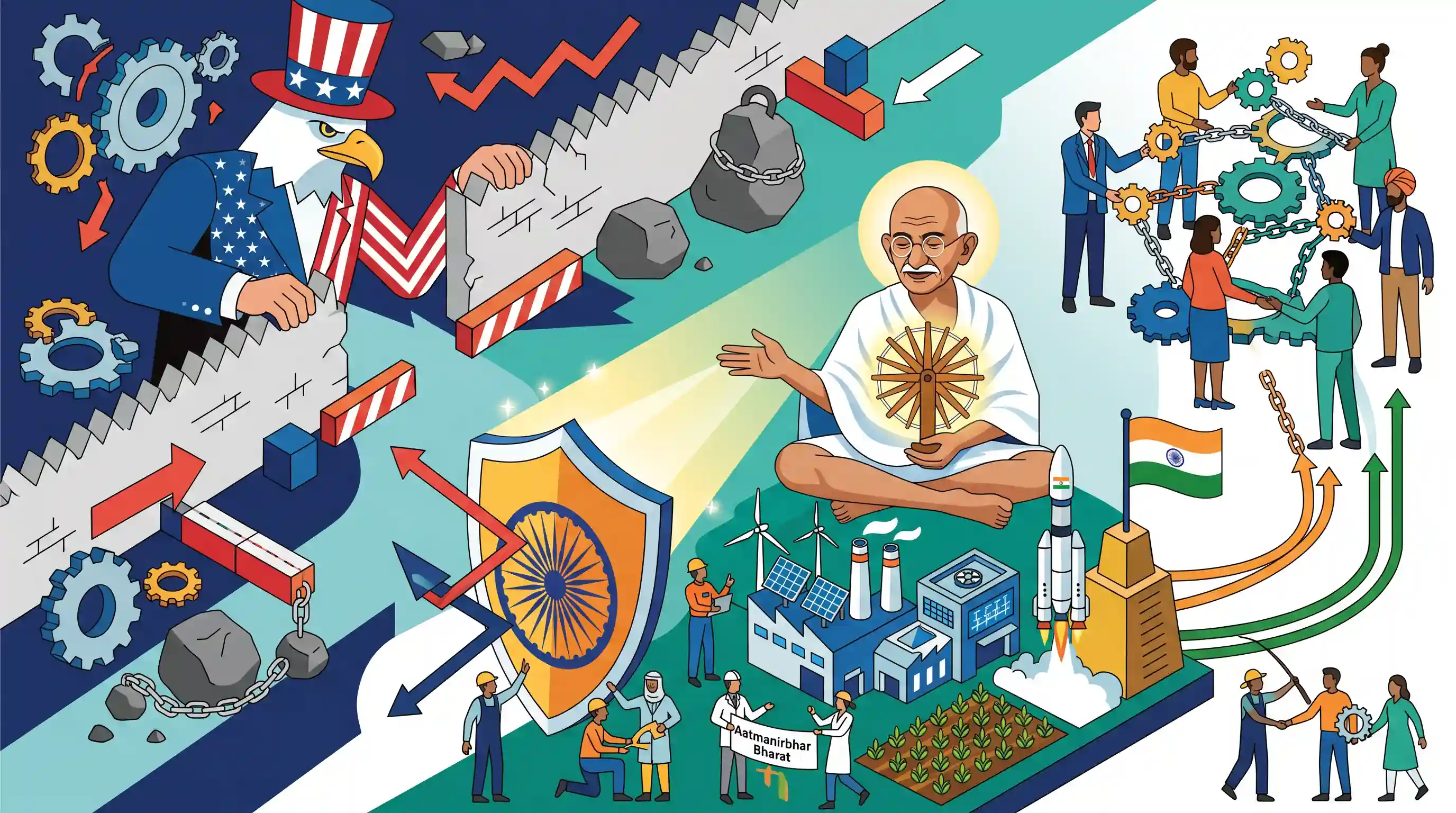
The article explores how India can formulate a strategic and resilient response to the protectionist trade policies and tariffs proposed by the US by drawing upon the economic and philosophical principles of Mahatma Gandhi. In an era marked by deglobalization and escalating trade wars, Gandhi's concept of Swadeshi (self-reliance) provides a blueprint for contemporary India to strengthen its domestic manufacturing capabilities. By focusing on initiatives like Aatmanirbhar Bharat, India can reduce its dependency on volatile global supply chains and insulate its economy from external shocks. The piece suggests that instead of engaging in retaliatory trade wars, India should leverage its growing economic independence and diplomatic tact to navigate US protectionism while advocating for an equitable global economic order.
Key Points
- The US administration's shift towards protectionist policies and reciprocal tariffs poses a significant challenge to Indian exports and the broader trajectory of Indo-US bilateral trade.
- Mahatma Gandhi's philosophy of Swadeshi (self-reliance) offers a historical and philosophical precedent for modern economic strategies like Aatmanirbhar Bharat, aiming to buffer the domestic economy against global trade volatility.
- By developing strong domestic markets and indigenous manufacturing capabilities, India can reduce its vulnerability to external geopolitical shocks and weaponized trade policies.
- Rather than engaging in a retaliatory, tit-for-tat trade war, India can adopt a principled diplomatic stance, advocating for a fair, rules-based global trade system that protects the interests of the Global South.
- Gandhian principles emphasize that true political strength is derived from economic independence, an idea highly relevant in the contemporary era of deglobalization and shifting global supply chains.
Important Terms
Swadeshi

The Gandhian principle of self-reliance, advocating for the use of locally produced goods to achieve economic independence and strengthen the village-level economy while reducing external dependency.
UPSC context
GS-I (History/Philosophy); GS-III (Economy); tests the linkage between historical self-sufficiency and modern economic resilience.
Aatmanirbhar Bharat
A comprehensive policy framework launched in 2020 to make India self-reliant through five pillars: Economy, Infrastructure, Systems, Vibrant Demography, and Demand, focusing on domestic manufacturing and resilience.
UPSC context
GS-III (Indian Economy); crucial for understanding import substitution, self-reliance, and response to global supply chain shocks.
Protectionism
Economic policy of shielding domestic industries from foreign competition using tariffs, quotas, and subsidies; it prioritizes local producers over free international trade.
UPSC context
GS-III (Economy); essential for analyzing trade barriers, global 'deglobalization' trends, and their impact on Indian consumers and exports.
Trade War
A retaliatory economic conflict where nations impose successive tariffs and trade barriers on each other, often leading to disrupted global supply chains and slowed economic growth.
UPSC context
GS-III (Economy/IR); relevant for studying India-US bilateral trade disputes and the impact of geopolitical tensions on the rupee.
World Trade Organization (WTO)
An international organization (est. 1995) that regulates global trade rules, facilitates negotiations, and settles trade disputes between its 164 member nations, including India.
UPSC context
GS-II (International Relations); vital for topics like multilateralism, dispute settlement mechanisms, and special treatment for developing nations.
Make in India
A flagship initiative launched in 2014 to transform India into a global manufacturing hub by facilitating investment, fostering innovation, and building world-class infrastructure.
UPSC context
GS-III (Economy); tests knowledge of industrial policy, Foreign Direct Investment (FDI), and India's role in global supply chains.
Prelims Trap
The Generalized System of Preferences (GSP) is a mandatory trade mechanism enforced by the WTO upon developed nations.
GSP operates under a WTO waiver (the Enabling Clause) allowing developed countries to grant unilateral tariff cuts to developing nations. It is voluntary, not a mandatory WTO enforcement.
Static Concepts Connected
What are the recognized exceptions to the WTO's Most Favored Nation (MFN) principle?
- Regional Trade Agreements: Free trade areas or customs unions allow members to trade on preferential terms without extending those benefits globally.
- GSP: Under the Enabling Clause, developed countries can offer unilateral tariff preferences to developing nations, like the US historically did for India.
- Trade Remedies: Nations can apply specific tariffs against individual countries to counter unfair subsidies or dumping practices, bypassing MFN rules.
What are the core tenets of Gandhian Economic Philosophy relevant to modern self-reliance?
- Swadeshi: Emphasis on local production and indigenous consumption, rejecting exploitative foreign goods to build self-sustaining rural economies.
- Decentralization: Focus on empowering cottage industries and MSMEs rather than relying solely on large-scale, capital-intensive mass production.
- Trusteeship: The ethical framework where the wealthy hold their surplus wealth in trust for the welfare and upliftment of the broader society.
Cross-Topic Patterns
Aatmanirbhar Bharat vs. Autarky
Unlike pre-1991 import substitution, modern self-reliance (PLI schemes) integrates India into global value chains while retaining strategic autonomy over critical sectors, echoing pragmatic Swadeshi.
WTO paralysis & reciprocal tariffs
US reciprocal tariffs highlight the functional breakdown of the WTO's dispute settlement mechanism, forcing the Global South to pivot toward bilateral FTAs and domestic resilience.

Expect a GS1/GS3 Mains question asking to evaluate Aatmanirbhar Bharat as a modern manifestation of Gandhian Swadeshi in a deglobalizing era.
Linked PYQs · 4
Linked PYQs · 4
- 2025MainsGS3
What are the challenges before the Indian economy when the world is moving away from free trade and multilateralism to protectionism and bilateralism? How can these challenges be met?
- 2018MainsGS2
What are the key areas of reform if the WTO has to survive in the present context of "Trade War', especially keeping in mind the interest of India?
- 2018MainsGS1
Throw light on the significance of the thoughts of Mahatma Gandhi in the present times.
- 2012MainsGS2
Discuss the likely negative impact of the protectionist measures proposed by the US on India's software industry.
