El Nino Impact on Indian Monsoon and Agricultural Food Security
Source:Indian Express ↗
Why It Matters
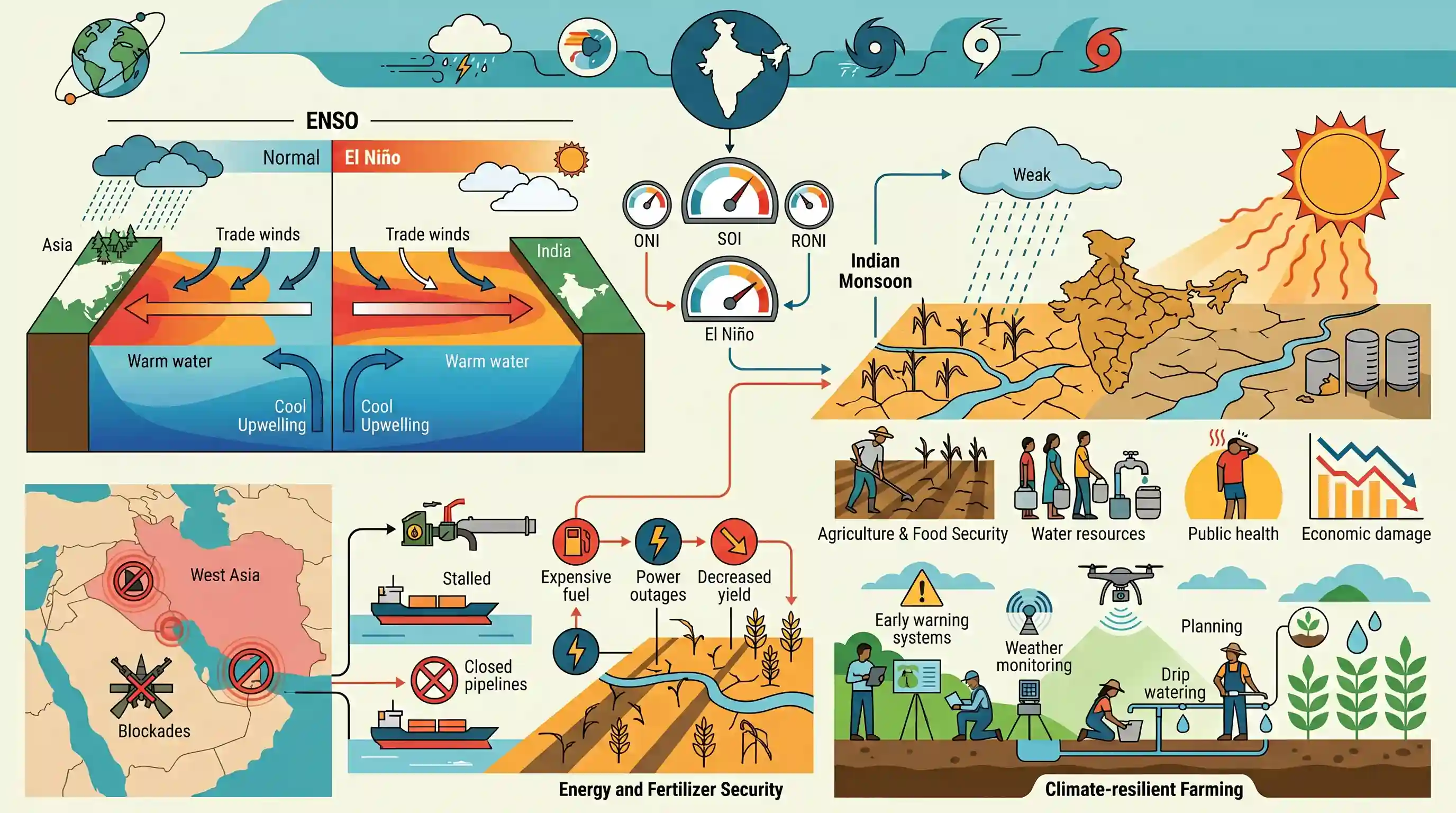
Understanding the El Niño Southern Oscillation (ENSO) and its direct implications on the Indian monsoon is crucial for geographic and economic analysis. Predicting these patterns aids in anticipating agricultural yields, food security, and inflation, and enables the mitigation of disaster risks like droughts and heatwaves, forming a core component of the GS1 and GS3 syllabi.
Summary
The article details the mechanics of the El Niño Southern Oscillation (ENSO) and its profound implications for India's 2026 monsoon season. With NOAA warning of a strong El Niño and IMD forecasting below-normal rainfall (92% of LPA), India faces potential challenges in agriculture, water resources, and public health due to anticipated heatwaves and droughts. The piece also explains how trade wind reversals alter ocean temperatures (monitored via ONI, SOI, and RONI indices) and emphasizes that proactive disaster preparedness and climate-resilient farming are necessary to mitigate economic damage. Furthermore, intersecting geopolitical issues like the West Asia crisis and Strait of Hormuz disruptions could worsen the impact on India's energy and fertilizer security.
Key Points
- ENSO is a periodic fluctuation in sea surface temperatures (SST) and air pressure across the equatorial Pacific Ocean with three phases: Neutral, El Niño (warm phase), and La Niña (cool phase).
- El Niño occurs when trade winds weaken or reverse, causing warm water to accumulate in the central and eastern Pacific, which typically suppresses the Indian monsoon.
- ENSO conditions are tracked using indices like the Oceanic Niño Index (ONI), Southern Oscillation Index (SOI), and Relative Oceanic Niño Index (RONI).
- The IMD has forecast the 2026 monsoon at 92% of the Long Period Average (LPA), classifying it as below normal due to the likely development of a strong El Niño.
- A weak monsoon negatively impacts Indian agriculture, heightens risks of food shortages and inflation, and exacerbates water stress, heatwaves, and forest fires.
- Secondary disruptions, such as energy and fertilizer supply issues stemming from the West Asia crisis and potential closure of the Strait of Hormuz, could compound the economic fallout.
- Early forecasting enables proactive climate resilience measures such as the promotion of drought-resistant crops, revised sowing windows, and enhanced groundwater recharge efforts.
Important Terms
ENSO (El Niño Southern Oscillation)

A cyclical climate pattern in the tropical Pacific involving sea surface temperature and atmospheric pressure changes, significantly impacting global weather and the Indian monsoon's reliability.
UPSC context
GS Paper I (Climatology) and GS Paper III (Agriculture). Crucial for questions on monsoon variability and food security.
India Meteorological Department (IMD)
Established in 1875, it is India’s principal agency under the Ministry of Earth Sciences responsible for weather forecasting, monsoon predictions, and issuing disaster warnings.
UPSC context
GS Paper I & III. Relevant for national disaster management and agricultural planning frameworks.
Long Period Average (LPA)
The benchmark rainfall average recorded over 50 years (currently 1971-2020) used by IMD to categorize monsoon performance as normal, below-normal, or deficient.
UPSC context
GS Paper I (Prelims/Mains). A standard metric for interpreting monsoon forecasts and agricultural risk assessments.
Oceanic Niño Index (ONI)
The primary indicator used to monitor the ocean part of ENSO, tracking 3-month running average sea surface temperature anomalies in the east-central tropical Pacific.
UPSC context
GS Paper I (Geography). A technical parameter often tested in Prelims to identify ENSO phases.
Relative Oceanic Niño Index (RONI)
A modern ENSO index measuring temperature anomalies relative to the broader tropical mean (20°N–20°S) to isolate ENSO signals from general global warming trends.
UPSC context
GS Paper I & III (Environment). Reflects evolving scientific standards for tracking climate patterns in a warming world.
Strait of Hormuz
A strategic maritime chokepoint between the Persian Gulf and Gulf of Oman, critical for global oil trade and India’s energy and fertilizer security.
UPSC context
GS Paper II (International Relations). Vital for understanding energy security and geopolitical stability in West Asia.
Southern Oscillation Index (SOI)
An index based on surface air pressure differences between Tahiti and Darwin, used to monitor the atmospheric component of the ENSO cycle.
UPSC context
GS Paper I (Geography). Essential for explaining the atmospheric mechanics behind trade wind reversals and monsoon failure.
Prelims Trap
"El Niño occurs due to the accumulation of abnormally warm water in the Western Equatorial Pacific Ocean."
Normal conditions pool warm water in the Western Pacific. El Niño reverses/weakens trade winds, dragging warm water to the Eastern/Central Pacific. Aspirants frequently swap East and West in exam pressure.
Static Concepts Connected
How is the Southern Oscillation Index (SOI) calculated for ENSO?
- Pressure difference: Measures the atmospheric pressure difference between Tahiti (eastern/central Pacific) and Darwin (western Pacific).
- Negative SOI: A sustained negative SOI indicates El Niño conditions (lower pressure over Tahiti, higher over Darwin).
What defines the Long Period Average (LPA) for the Indian Monsoon?
- 50-year baseline: It is the average rainfall recorded over a 50-year period (currently 1971-2020), roughly 87 cm.
- Below Normal: The IMD officially classifies monsoon rainfall between 90% and 95% of the LPA as 'below normal'.
Cross-Topic Patterns
Climate + Geopolitics Nexus
El Niño droughts increase groundwater pumping and fertilizer needs, exacerbating India's vulnerability to LNG and Urea supply shocks from West Asian chokepoints like the Strait of Hormuz.
Monsoon deficit + Monetary Policy
Food supply shocks caused by poor Kharif yields directly drive up retail inflation, complicating the RBI's inflation-targeting mandate and often prompting abrupt export bans by the government.

Expect a 2026 multi-statement question interlinking ENSO oceanic mechanics with India's fertilizer import dependency and CPI inflation.
Linked PYQs · 4
Linked PYQs · 4
- 2011PrelimsGS1
La Nina is suspected to have caused recent floods in Australia. How is La Nina different from El Nino? 1. La Nina is characterised by unusually cold ocean temperature in equatorial Indian Ocean whereas El Nino is characterised by unusually warm ocean temperature in the equatorial Pacific Ocean. 2. El Nino has adverse effect on south-west monsoon of India, but La Nina has no effect on monsoon climate. Which of the statements given above is/are correct?
- 2017PrelimsGS1
With reference to 'Indian Ocean Dipole (IOD)' sometimes mentioned in the news while forecasting Indian monsoon, which of the following statements is/are correct? 1. IOD phenomenon is characterised by a difference in sea surface temperature between tropical Western Indian Ocean and tropical Eastern Pacific Ocean. 2. An IOD phenomenon can influence an El Nino's impact on the monsoon. Select the correct answer using the code given below:
- 2014MainsGS1
Most of the unusual climatic happenings are explained as an outcome of the El-Nino effect. Do you agree?
- 2017MainsGS2
The question of India's Energy Security constitutes the most important part of India's economic progress. Analyze India's energy policy cooperation with West Asian countries.
