E-Governance and State Technology Citizen Relationship
Source:Indian Express ↗
Why It Matters
E-governance is a core component of the GS Paper II syllabus under Governance. Questions frequently examine the shift toward citizen-centric administration, the role of digital infrastructure, transparency, and structural bottlenecks like the digital divide.
Summary
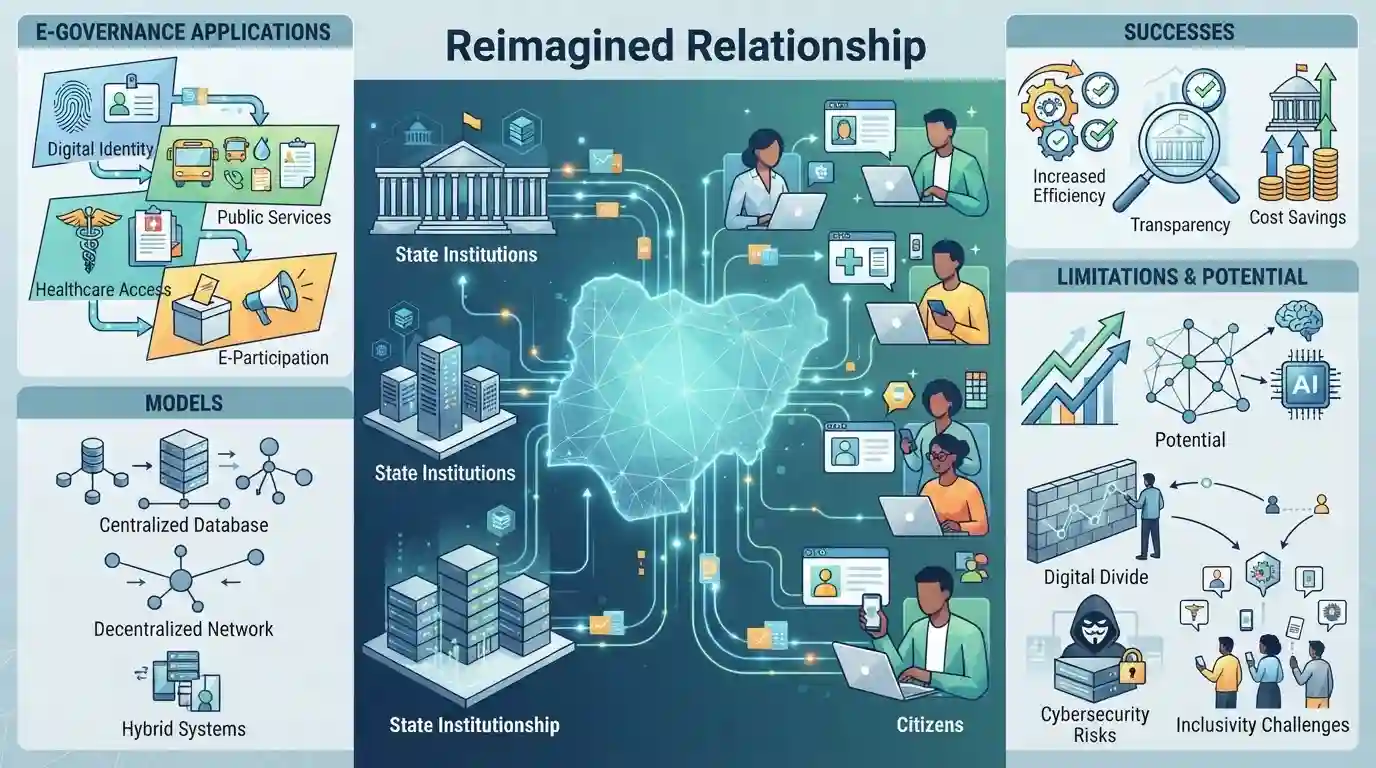
The article explores how e-governance reimagines the relationship between the state, technology, and citizens. It highlights how digital infrastructure and public digital platforms transform service delivery, strengthen transparency and accountability, and foster citizen-centric administration while addressing critical challenges like the digital divide and inclusivity.
Key Points
- E-governance transforms the traditional bureaucratic relationship between the state and citizens by leveraging digital tools for public service delivery.
- It enhances transparency, accountability, and accessibility while reducing intermediaries and administrative bottlenecks.
- Key challenges include the digital divide, data privacy concerns, digital literacy gaps, and structural exclusion.
- Shift from mere computerization to user-centric, interactive models of governance that empower citizens.
Important Terms
Digital India

Flagship program launched by the Government of India to transform the country into a digitally empowered society and knowledge economy through robust digital infrastructure and universal digital literacy.
UPSC context
GS Paper II (Governance - E-governance applications, models, successes, limitations, and potential). Tests knowledge of digital infrastructure and citizen-centric governance.
Government of India
The apex executive body of the Indian Union responsible for formulating national policies, administering laws, and implementing welfare programs including digital transformation initiatives.
UPSC context
GS Paper II (Constitution, Polity, and Governance). Tests understanding of institutional frameworks, policy formulation, and administrative accountability.
Prelims Trap
Public digital platforms and e-governance portals ensure universal accessibility and completely eliminate administrative exclusion errors across rural and urban demographics.
Aspirants often assume e-governance initiatives are inherently inclusive; however, structural issues like biometric failures and linguistic gaps routinely cause systematic exclusion errors.
Static Concepts Connected
What are the four pillars and key phases of the National e-Governance Plan (NeGP) in India?
- Four Pillars: Four pillars comprise people, process, technology, and resources to build an integrated digital architecture.
- Evolution Phases: Phases transitioned from initial computerization of government departments to core infrastructure and citizen-centric service delivery.
- MMPs: Mission Mode Projects (MMPs) focus on specific domains like PAN, MCA21, passports, and e-courts.
Cross-Topic Patterns
E-Governance Welfare Delivery vs. Right to Food
Examine how deploying biometric and database verification in welfare delivery creates exclusion errors, balancing fiscal efficiency with constitutional right to food.
Digital Public Infrastructure and Data Privacy Concerns
Analyze the tensions between massive state-level data collection for service delivery and the constitutional right to privacy under Article 21.

E-governance challenges like exclusion errors and digital divide are favorite multi-statement UPSC GS-II themes. Watch for balanced traps.
Linked PYQs · 3
Linked PYQs · 3
- 2023MainsGS2
e-governance, as a critical tool of governance, has ushered in effectiveness, transparency and accountability in governments. What inadequacies hamper the enhancement of these features ?
- 2025MainsGS2
e-governance projects have a built-in bias towards technology and back-end integration than user-centric designs. Examine.
- 2024MainsGS2
e-governance is not just about the routine application of digital technology in service delivery process. It is as much about multifarious interactions for ensuring transparency and accountability. In this context evaluate the role of the 'Interactive Service Model' of e-governance.
