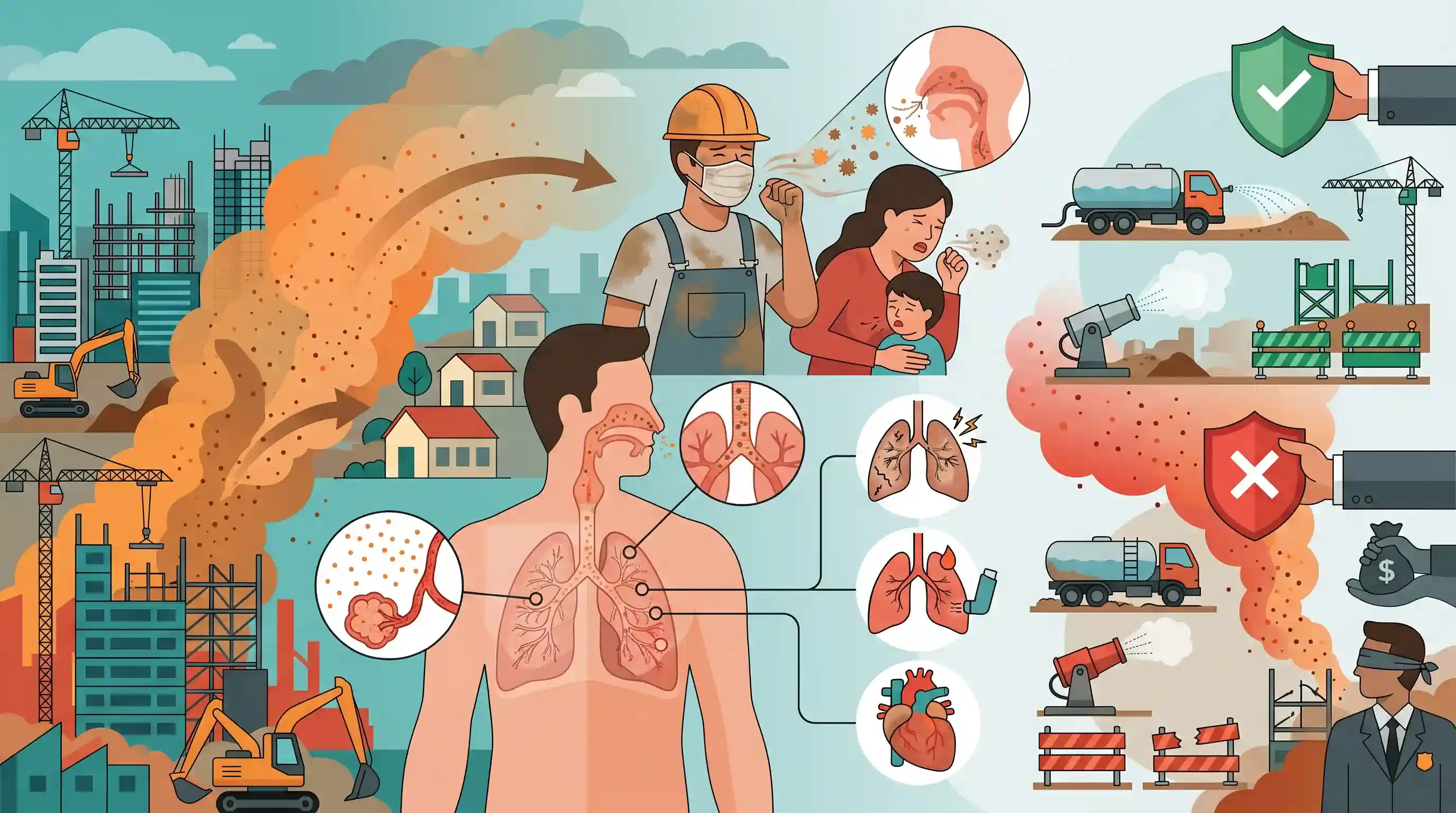
Construction dust pollution severely impacts urban public health
Source:The Hindu ↗
Why It Matters
Air pollution from construction dust is a critical policy issue at the intersection of rapid urbanization (GS1) and environmental health (GS3). Understanding particulate matter impacts and evaluating regulatory frameworks like NCAP and GRAP are vital for UPSC questions on sustainable development and public health.
Summary
The rapid expansion of India's construction sector, driven by urbanization and infrastructure development, has significantly escalated dust pollution, leading to profound public health crises. Construction sites are substantial sources of particulate matter (PM10 and PM2.5), which can bypass respiratory defenses, penetrating deep into the lungs and the bloodstream. Chronic exposure to this fugitive dust causes severe respiratory conditions such as silicosis, asthma, and chronic obstructive pulmonary disease (COPD), alongside cardiovascular complications. Construction workers, who often lack sufficient protective gear, and local communities are at maximum risk. Although frameworks like the National Clean Air Programme (NCAP) and the Graded Response Action Plan (GRAP) mandate dust control measures like misting, barricades, and water sprinkling, poor on-ground implementation and regulatory enforcement loopholes severely undermine these efforts, necessitating stricter compliance to safeguard public health.
Key Points
- India's rapid urbanization and real estate boom have triggered an unprecedented increase in construction activities, turning them into major sources of fugitive dust.
- Construction and demolition (C&D) sites emit significant amounts of particulate matter, primarily PM10 and PM2.5, exacerbating the ambient air pollution crisis.
- Inhalation of fine dust particles leads to severe health consequences, including asthma, COPD, silicosis, and cardiovascular diseases, as fine particles can penetrate deep into the lungs and enter the bloodstream.
- Construction workers, who frequently operate without adequate personal protective equipment (PPE), and residents living near active sites face disproportionate health risks due to prolonged exposure.
- Despite regulations mandating dust mitigation measures such as green netting, anti-smog guns, and water sprinkling, weak enforcement and compliance gaps render these interventions largely ineffective.
Important Terms
National Clean Air Programme (NCAP)

A national strategy launched in 2019 targeting a 20-40% reduction in particulate matter concentrations by 2026 across 131 'non-attainment' cities in India.
UPSC context
GS Paper III/Environment; focuses on multi-sectoral pollution mitigation and performance-linked funding for urban local bodies.
Graded Response Action Plan (GRAP)
A set of emergency measures implemented in Delhi-NCR that trigger specific restrictions (like construction bans) as air quality drops through Poor, Very Poor, and Severe categories.
UPSC context
GS Paper III/Environment; relevant for crisis management frameworks and judicial mandates on air quality in the capital.
Commission for Air Quality Management (CAQM)
A powerful statutory body established in 2021 to oversee air quality management in Delhi-NCR, possessing the authority to override state-level pollution control boards.
UPSC context
GS Paper II/Governance; important for statutory bodies and centralized institutional responses to regional environmental challenges.
Central Pollution Control Board (CPCB)
India's apex statutory body for pollution control, established in 1974 to monitor air/water quality and advise the government on environmental standards and compliance.
UPSC context
GS Paper II & III; key institution for environmental laws (Water/Air Acts) and technical pollution monitoring.
World Health Organization (WHO)
The UN agency for public health that issues Global Air Quality Guidelines (AQGs), setting scientifically safe limits for pollutants like PM2.5 and PM10.
UPSC context
GS Paper II/International Relations; tests comparison between global health standards and India's National Ambient Air Quality Standards.
Prelims Trap
"GRAP is a pan-India statutory framework invoked by the CPCB to curb construction dust."
While NCAP is a national-level strategy for non-attainment cities, GRAP is a regional emergency response mechanism specifically tailored and implemented by the CAQM for the Delhi-NCR region.
Static Concepts Connected
What is the National Clean Air Programme (NCAP) and its mandate?
- Target Reduction: It aims to reduce PM10 and PM2.5 concentrations by 40% by 2026, taking 2017 as the base year.
- Non-attainment Cities: It is implemented in 131 'non-attainment cities' that consistently failed to meet the National Ambient Air Quality Standards (NAAQS) over five years.
- City-specific Approach: It relies on city-specific action plans, avoiding a one-size-fits-all approach, integrating local urban bodies, state pollution boards, and the CPCB.
What is Silicosis and how does it relate to occupational health?
- Disease Mechanism: An incurable, progressive lung disease (a type of pneumoconiosis) caused by the prolonged inhalation of crystalline silica dust from construction and mining activities.
- Health Impact: Silica dust scars lung tissue (fibrosis), drastically reducing lung capacity and increasing vulnerability to secondary infections like tuberculosis (Silicotuberculosis).
- Statutory Recognition: It is classified as a notified occupational disease under both the Mines Act, 1952, and the Factories Act, 1948.
Cross-Topic Patterns
Urban infrastructure vs. Informal labor health
The rapid infrastructure push (e.g., PM Gati Shakti) heavily relies on informal labor, exposing a critical blind spot in occupational health enforcement under the new Occupational Safety, Health and Working Conditions Code.
Statutory evolution of environmental enforcement
The shift from ad-hoc judicial panels (like EPCA) to permanent statutory bodies (CAQM) reflects an evolving environmental jurisprudence aimed at strictly enforcing measures like GRAP during high-AQI emergencies.

Expect a multi-statement question in 2026 comparing NCAP (national targets) and GRAP (Delhi-NCR emergency response) statutory backings.
Linked PYQs · 3
Linked PYQs · 3
- 2022PrelimsGS1
In the context of WHO Air Quality Guidelines, consider the following statements: 1. The 24-hour mean of PM2.5 should not exceed 15 µg/m³ and annual mean of PM2.5 should not exceed 5 µg/m³. 2. In a year, the highest levels of ozone pollution occur during the periods of inclement weather. 3. PM10 can penetrate the lung barrier and enter the bloodstream. 4. Excessive ozone in the air can trigger asthma. Which of the statements given above are correct?
- 2020MainsGS3
What are the key features of the National Clean Air Programme (NCAP) initiated by the Government of India?
- 2021MainsGS3
Describe the key points of the revised Global Air Quality Guidelines (AQGs) recently released by the World Health Organisation (WHO). How are these different from its last update in 2005? What changes in India's National Clean Air Programme are required to achieve these revised standards?
