Microplastics and Endocrine Disrupting Health Hazards
Source:The Hindu ↗
Why It Matters
As global plastic production surges, the resulting microplastic pollution and chemical leaching present an escalating public health crisis. Understanding these mechanisms is essential for UPSC aspirants in the context of environmental conservation (GS3) and global health governance, particularly amid ongoing negotiations for a UN Global Plastics Treaty.
Summary
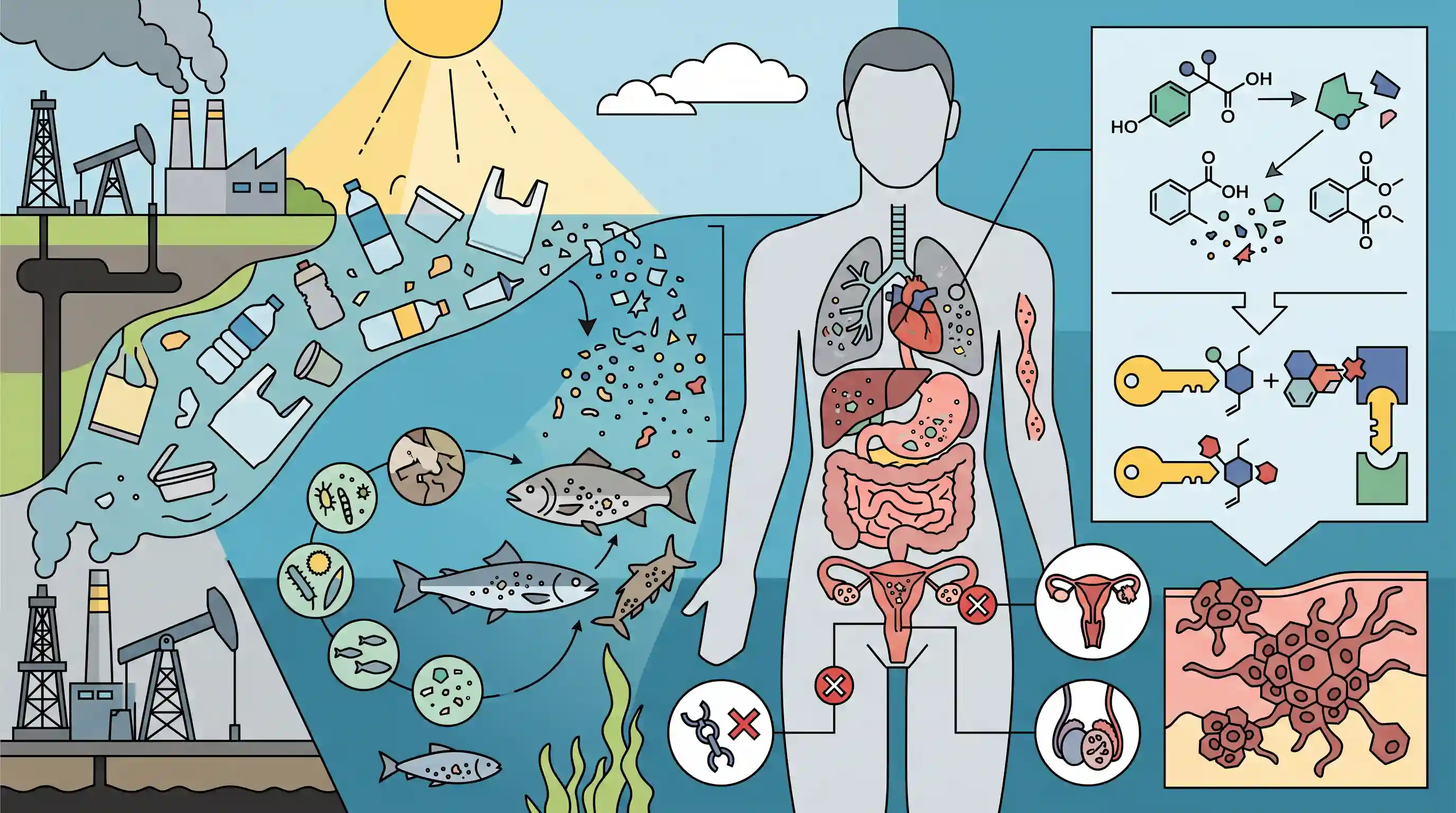
The article highlights the profound and multi-layered health impacts of plastic pollution. It explains how macro-plastics degrade into microplastics and nanoplastics, easily infiltrating the human body and accumulating in tissues. The primary danger stems from toxic chemical additives, particularly Endocrine-Disrupting Chemicals (EDCs) like BPA and phthalates, which interfere with hormonal systems and lead to severe conditions including reproductive disorders and cancer. Furthermore, the article underscores the bioaccumulation of these toxins and emphasizes that the health hazards of plastics span their entire lifecycle, from fossil fuel extraction to waste disposal.
Key Points
- Plastic pollution poses severe health risks as it breaks down into ubiquitous microplastics and nanoplastics that enter the human body via ingestion (food/water), inhalation, and dermal contact.
- Plastics often contain hazardous chemical additives, notably Endocrine-Disrupting Chemicals (EDCs) such as Bisphenol A (BPA), phthalates, and PFAS (forever chemicals).
- EDCs leach into the environment and food chain, mimicking natural hormones and causing reproductive issues, developmental defects in children, metabolic disorders, and cancers.
- Toxic chemicals undergo bioaccumulation and biomagnification, leading to high concentrations in top predators and humans.
- The entire lifecycle of plastic—from fossil fuel extraction and refining to disposal (incineration or landfills)—releases toxic emissions, disproportionately affecting frontline and marginalized communities.
Important Terms
Global Plastics Treaty

A proposed international legally binding agreement aimed at ending plastic pollution by addressing its entire lifecycle, from production and design to waste disposal.
UPSC context
GS Paper III: Environmental Governance. Tests knowledge of international efforts and negotiations to regulate plastic pollution globally.
Plastic Waste Management Rules
India’s regulatory framework, amended in 2024, that mandates stricter standards for biodegradable plastics, defines microplastics, and strengthens Extended Producer Responsibility (EPR) targets.
UPSC context
GS Paper III: Environmental Pollution. Relevant for understanding India's legislative measures to manage plastic waste and circular economy goals.
UN Environment Programme (UNEP)
The leading global environmental authority within the UN that coordinates international responses, sets the environmental agenda, and hosts the treaty negotiations for plastic pollution.
UPSC context
GS Paper II: International Organizations. Important for analyzing the role of UN bodies in global environmental policy-making.
World Health Organization (WHO)
The UN’s specialized agency for health that monitors the public health impacts of plastic pollution, including the risks posed by microplastics and endocrine-disrupting chemicals.
UPSC context
GS Paper II: Public Health. Tests understanding of health-related international institutions and their response to emerging environmental health threats.
Extended Producer Responsibility (EPR)
A policy approach where producers bear financial and physical responsibility for the treatment or disposal of post-consumer products, incentivizing sustainable product design.
UPSC context
GS Paper III: Environmental Pollution. Key for questions on waste management strategies and corporate accountability in environmental protection.
Microplastics & Nanoplastics
Tiny plastic particles (under 5mm and 100nm respectively) that result from plastic degradation, capable of infiltrating human tissues and carrying toxic chemical additives.
UPSC context
GS Paper III: Science and Environment. Tests knowledge of emerging pollutants and their biological impact on human health and ecosystems.
Prelims Trap
Microplastics are universally defined as plastic fragments and particles smaller than 1 mm in diameter.
The standard UNEP definition categorizes microplastics as particles less than 5 mm in diameter, not 1 mm. Nanoplastics are defined as less than 100 nm.
Static Concepts Connected
What is the difference between Bioaccumulation and Biomagnification?
- Bioaccumulation: The gradual accumulation of toxic substances in an individual organism over its lifetime, occurring when absorption exceeds excretion.
- Biomagnification: The increasing concentration of toxic substances at successive trophic levels in a food chain, peaking in apex predators (like humans).
- Pre-requisites: To biomagnify, pollutants must be long-lived, highly mobile, and soluble in fats (lipophilic) rather than water.
What are Persistent Organic Pollutants (POPs) and the Stockholm Convention?
- POPs: Toxic chemical substances that resist environmental degradation, bioaccumulate through the food web, and pose severe risks to human health and ecosystems.
- Stockholm Convention: A legally binding global treaty adopted in 2001 aimed at eliminating or restricting the production and use of POPs.
- Link to Plastics: Microplastics act as 'sponges' in marine environments, absorbing POPs and serving as a vector to transport these toxins into the human food chain.
Cross-Topic Patterns
EDCs and Non-Communicable Diseases
Endocrine disruptors link environmental pollution directly to India's rising burden of metabolic disorders and cancers, bridging ecological degradation with the GS2 public health syllabus.
Global Treaty & Extended Producer Responsibility
The ongoing UN Global Plastics Treaty negotiations strongly align with India's domestic push for a Circular Economy and strict Extended Producer Responsibility (EPR) mandates under the Plastic Waste Management Rules.

Expect a paired matching question in 2026 linking specific EDCs (BPA, PFAS, Phthalates) to their primary consumer product sources.
Linked PYQs · 4
Linked PYQs · 4
- 2019PrelimsGS1
Why is there a great concern about the 'microbeads' that are released into environment?
- 2021PrelimsGS1
Bisphenol A (BPA), a cause of concern, is a structural/key component in the manufacture of which of the following kinds of plastics?
- 2024PrelimsGS1
With reference to perfluoroalkyl and polyfluoroalkyl substances (PFAS) that are used in making many consumer products, consider the following statements : 1. PFAS are found to be widespread in drinking water, food and food packaging materials. 2. PFAS are not easily degraded in the environment. 3. Persistent exposure to PFAS can lead to bioaccumulation in animal bodies. Which of the statements given above are correct?
- 2024PrelimsGS1
Consider the following statements : Statement-I: Many chewing gums found in the market are considered a source of environmental pollution. Statement-II : Many chewing gums contain plastic as gum base. Which one of the following is correct in respect of the above statements?
