Pharmacological Mechanisms of General Anaesthesia
Source:The Hindu ↗
Why It Matters
A foundational understanding of how pharmaceutical drugs interact with the human nervous system is essential for the UPSC Prelims 'General Science' syllabus. Furthermore, the evolution of medical technology and its applications in healthcare are recurring themes in GS Paper 3.
Summary
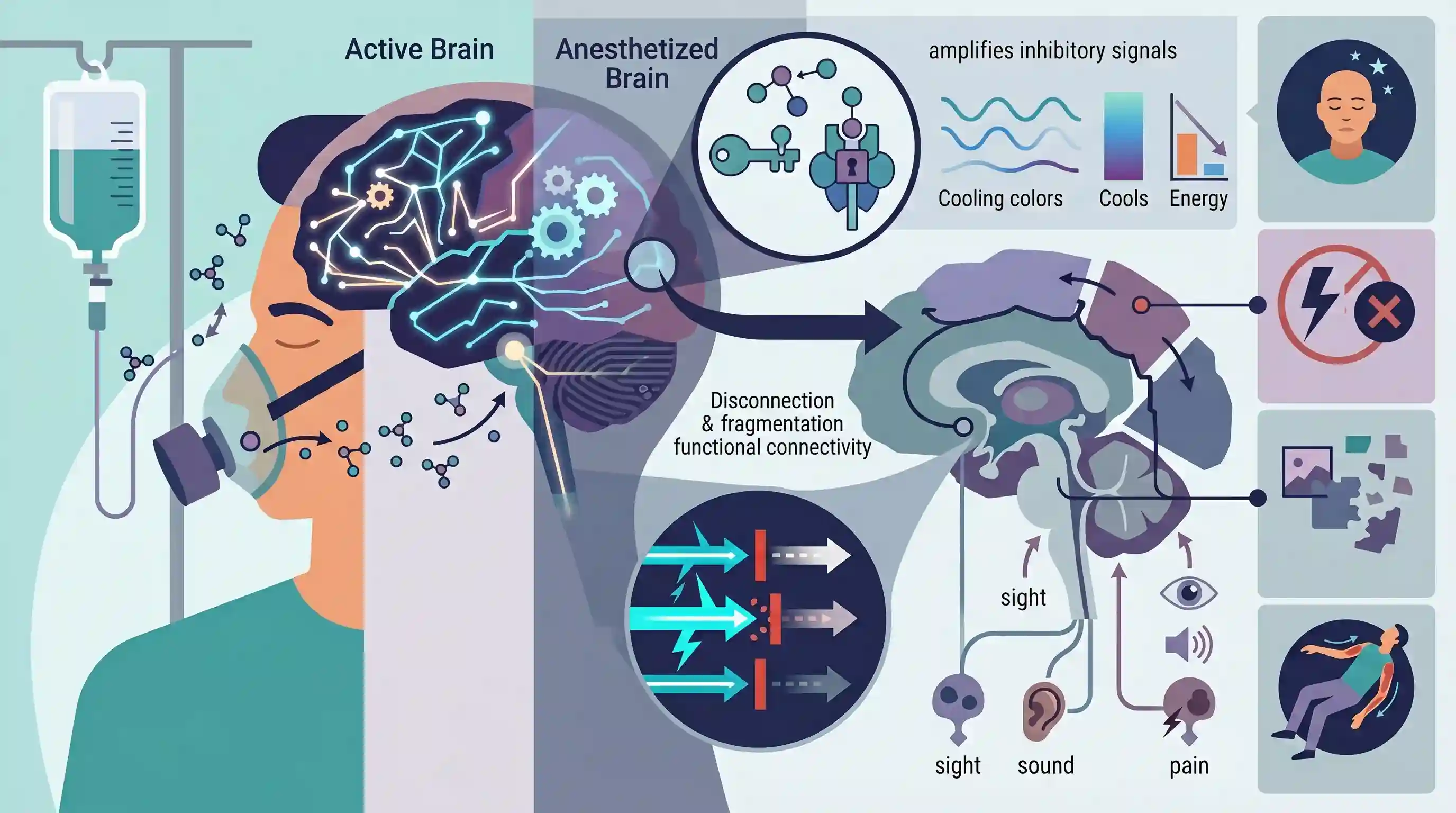
The article explains the pharmacological and neurological mechanisms behind general anaesthesia, a critical medical intervention used to induce a temporary and reversible state of unconsciousness during surgery. It details how anaesthetic agents interact with the central nervous system—primarily by amplifying inhibitory signals through GABA receptors or blocking excitatory pathways—to achieve analgesia, amnesia, and immobility. By disrupting the functional connectivity across different brain regions, anaesthesia effectively halts the brain's ability to integrate sensory information, showcasing a vital application of biochemical science in modern healthcare.
Key Points
- General anaesthesia is a medically induced, reversible state characterized by unconsciousness, amnesia (memory loss), analgesia (pain relief), and akinesia (muscle relaxation), distinct from regular sleep.
- Anaesthetic drugs primarily work by acting on the central nervous system, often enhancing the activity of inhibitory neurotransmitters like gamma-aminobutyric acid (GABA) to depress brain function.
- Certain anaesthetics also function by blocking excitatory pathways, such as the N-methyl-D-aspartate (NMDA) receptors, preventing the brain from registering pain and sensory input.
- The administration of these drugs disrupts large-scale neural network communication, particularly between the cerebral cortex and the thalamus, which prevents the integration of information required for conscious awareness.
- Advancements in medical science and real-time neuro-monitoring have improved the precision of anaesthesia delivery, minimizing risks and facilitating complex surgical interventions.
Prelims Trap
"Anaesthetics achieve pain relief by primarily enhancing the excitatory pathways of the brain."
It is the exact opposite. Anaesthetics work by blocking excitatory pathways (like NMDA receptors) and enhancing inhibitory pathways (like GABA) to suppress brain activity.
Static Concepts Connected
What are the distinct roles of the cerebrum and thalamus in the brain?
- Cerebral Cortex: The largest part of the brain, responsible for voluntary actions, memory, conscious thought, and processing complex sensory information.
- Thalamus: Acts as the brain's main relay station, directing incoming sensory and motor signals to the correct areas of the cerebral cortex.
- Integration loop: Conscious awareness relies on the continuous feedback loop and communication between the thalamus and the cortex, which anaesthesia disrupts.
How do excitatory and inhibitory neurotransmitters differ?
- Inhibitory Neurotransmitters: Chemicals like GABA decrease the likelihood of a neuron firing an action potential, effectively calming or depressing overall central nervous system activity.
- Excitatory Neurotransmitters: Chemicals like glutamate (which bind to NMDA receptors) increase the likelihood of neuronal firing, promoting brain alertness, pain registration, and active sensory transmission.
Cross-Topic Patterns
Anaesthetics and the NDPS Act
Drugs like Ketamine—which block NMDA receptors for anaesthesia—are heavily regulated under India's NDPS Act due to their high potential for recreational abuse and hallucinogenic effects.
AI integration in surgical pharmacology
Modern neuro-monitoring integrates AI algorithms to track brain wave activity in real-time, creating 'closed-loop' systems that can automatically titrate anaesthetic drug delivery to prevent over-dosing.

Questions on basic neuroanatomy (GABA/Glutamate functions; Thalamus vs Hypothalamus) are highly probable in 2026 General Science prelims.
Linked PYQs · 4
Linked PYQs · 4
- 2022PrelimsGS1
Which one of the following statements best describes the role of B cells and T cells in the human body?
- 2020PrelimsGS1
With reference to carbon nanotubes, consider the following statements: 1. They can be used as carriers of drugs and antigens in the human body. 2. They can be made into artificial blood capillaries for an injured part of human body. 3. They can be used in biochemical sensors. 4. Carbon nanotubes are biodegradable. Which of the statements given above are correct?
- 2020MainsGS3
What do you understand by nanotechnology and how is it helping in health sector?
- 2023MainsGS3
Introduce the concept of Artificial Intelligence (AI). How does Al help clinical diagnosis? Do you perceive any threat to privacy of the individual in the use of Al in healthcare?
