Neurological Impacts of Air Pollution and Public Health Risks
Source:The Hindu ↗
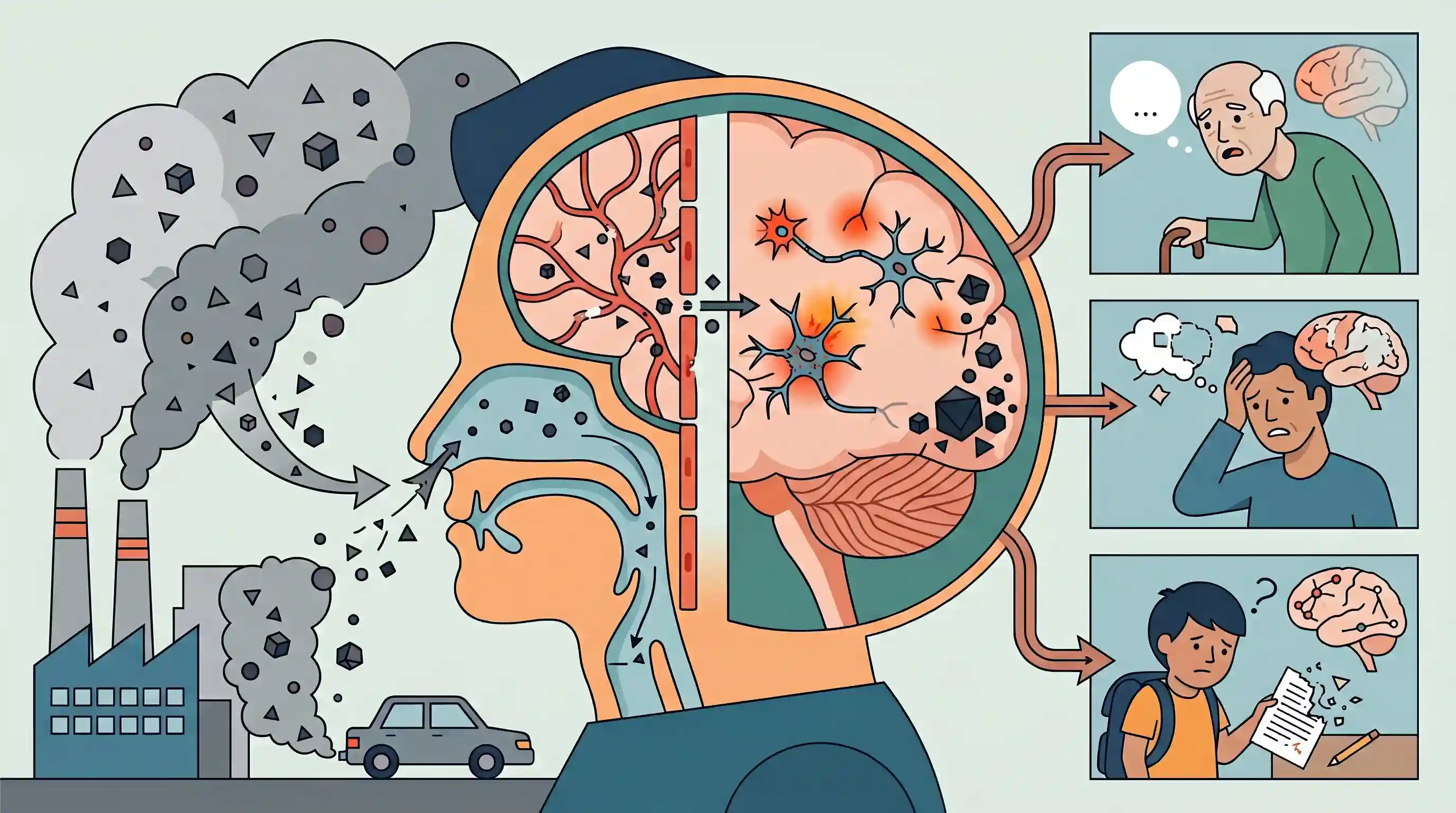
Why It Matters
Understanding the neurological impacts of air pollution is crucial for UPSC aspirants as it broadens the scope of environmental health issues beyond respiratory diseases. This multidisciplinary topic intersects environment (GS3) and public health (GS2), making it highly relevant for questions on the socio-economic burden of pollution, the necessity of stringent air quality standards, and the goals of initiatives like the National Clean Air Programme.
Summary
The article highlights the profound and often overlooked impact of air pollution on human brain health. Beyond its well-documented respiratory and cardiovascular effects, fine particulate matter (PM2.5) and ultrafine pollutants can breach the blood-brain barrier, triggering neuro-inflammation and oxidative stress. The presence of environmental pollutants like magnetite in the brain has been linked to severe neurological consequences. Long-term exposure poses serious risks across all age groups, contributing to impaired cognitive development in children, accelerated cognitive decline in adults, and an increased vulnerability to neurodegenerative conditions such as Alzheimer's and Parkinson's disease.
Key Points
- While traditionally associated with respiratory and cardiovascular issues, air pollution is increasingly recognized as a major threat to neurological health.
- Fine particulate matter (PM2.5) and ultrafine particles can bypass the lung barrier, enter the bloodstream, and cross the blood-brain barrier. Some particles can also enter the brain directly through the olfactory nerve.
- Pollutants trigger neuro-inflammation, oxidative stress, and the activation of microglia (the brain's immune cells), which can damage healthy neurons over time.
- Airborne magnetite particles, generated by motor vehicles and industrial processes, have been detected in human brains and are strongly linked to neurodegenerative diseases.
- Chronic exposure to polluted air is associated with neurodevelopmental delays in children, accelerated cognitive decline in adults, and an increased risk of Alzheimer's and Parkinson's diseases.
Important Terms
Particulate Matter (PM2.5)

Fine inhalable particles with diameters 2.5 micrometers or less. They penetrate deep into lungs and the bloodstream, causing systemic inflammation and neurological damage.
UPSC context
GS Paper 3: Environment and Health. Crucial for understanding pollutant-specific health impacts and NAAQS/AQI parameters.
National Clean Air Programme (NCAP)
Launched in 2019, India's national-level strategy aims for a 40% reduction in particulate matter concentration by 2026 across 131 identified cities.
UPSC context
GS Paper 3: Environment/Govt Policies. Key flagship scheme for urban air quality management.
National Air Quality Index (AQI)
A communication tool launched in 2014 to report daily air quality using 'One Number-One Color-One Description,' monitoring eight major pollutants.
UPSC context
GS Paper 3: Environment. Tests knowledge of the 8 pollutants (PM10, PM2.5, NO2, SO2, CO, O3, NH3, Pb).
WHO Air Quality Guidelines (2021)
Tightened standards released in 2021 by the WHO, lowering the recommended annual PM2.5 limit from 10 to 5 micrograms per cubic meter.
UPSC context
GS Paper 2/3: International Orgs/Environment. Compares global standards with India's NAAQS (40 μg/m3).
Blood-Brain Barrier (BBB)
A highly selective semi-permeable membrane that protects brain tissue from circulating toxins. Fine pollutants (PM2.5) can breach this barrier, triggering neuro-inflammation.
UPSC context
GS Paper 3: Science & Technology. Significant for understanding the biological pathway of environmental toxins affecting human health.
Non-attainment Cities
Specific Indian cities that consistently fail to meet National Ambient Air Quality Standards (NAAQS) for five consecutive years.
UPSC context
GS Paper 3: Environment/Urban Development. Defines the geographical focus of NCAP implementation.
Neurodegenerative Diseases
Progressive conditions (e.g., Alzheimer’s, Parkinson’s) involving the decay of neurons. Long-term exposure to air pollution is a recognized risk factor.
UPSC context
GS Paper 3: Health. Focuses on the burden of non-communicable diseases linked to environmental degradation.
Prelims Trap
The Blood-Brain Barrier effectively blocks all environmental particulate matter from entering the human brain.
Ultrafine particles (<200 nm) and PM2.5 can actually penetrate the BBB. Furthermore, pollutants can bypass the barrier entirely by traveling via the olfactory nerve.
Static Concepts Connected
What is the Blood-Brain Barrier (BBB) and what is the role of Microglia?
- Blood-Brain Barrier: A highly selective, semi-permeable membrane of endothelial cells that protects the brain from circulating pathogens and fluctuating plasma levels in the blood.
- Microglia: The primary immune cells (macrophages) of the central nervous system. They clear cellular debris but can cause harmful neuro-inflammation if chronically activated by pollutants.
What are the anthropogenic sources of airborne magnetite nanoparticles?
- Friction and Combustion: Generated primarily by high-temperature friction from motor vehicle brakes, internal engine combustion, and emissions from coal-fired power plants.
- Health Impact: Unlike naturally occurring trace magnetite in the brain, airborne magnetite particles exhibit strong redox activity, causing oxidative stress that damages nerve cells.
Cross-Topic Patterns
Nanoparticle pollution + Neuro-health
Airborne magnetite bridges environmental pollution with nanoparticle hazards, akin to past UPSC questions on the ecological and health toxicity of nanoparticles in cosmetics and consumer products.
NCAP targets + Non-Communicable Diseases (NCDs)
Expanding air pollution's impact to neurodegenerative diseases (Alzheimer's) reinforces the economic and public health urgency behind the National Clean Air Programme (NCAP) beyond just respiratory diseases.

Expect a 2026 hybrid Science-Environment MCQ combining Microglia function, Blood-Brain Barrier permeability, and magnetite nanoparticles.
Linked PYQs · 2
Linked PYQs · 2
- 2021PrelimsGS1
Magnetite particles, suspected to cause neurodegenerative problems, are generated as environmental pollutants from which of the following? 1. Brakes of motor vehicles 2. Engines of motor vehicles 3. Microwave stoves within homes 4. Power plants 5. Telephone lines Select the correct answer using the code given below.
- 2022PrelimsGS1
In the context of WHO Air Quality Guidelines, consider the following statements: 1. The 24-hour mean of PM2.5 should not exceed 15 µg/m³ and annual mean of PM2.5 should not exceed 5 µg/m³. 2. In a year, the highest levels of ozone pollution occur during the periods of inclement weather. 3. PM10 can penetrate the lung barrier and enter the bloodstream. 4. Excessive ozone in the air can trigger asthma. Which of the statements given above are correct?
