Climate Science Validation and Empirical Evidence Frameworks
Source:The Hindu ↗
Why It Matters
Understanding how climate science is validated is critical for evaluating environmental policies, countering misinformation, and answering questions on climate change evidence, modeling, and IPCC reports in GS3 and Prelims.
Summary
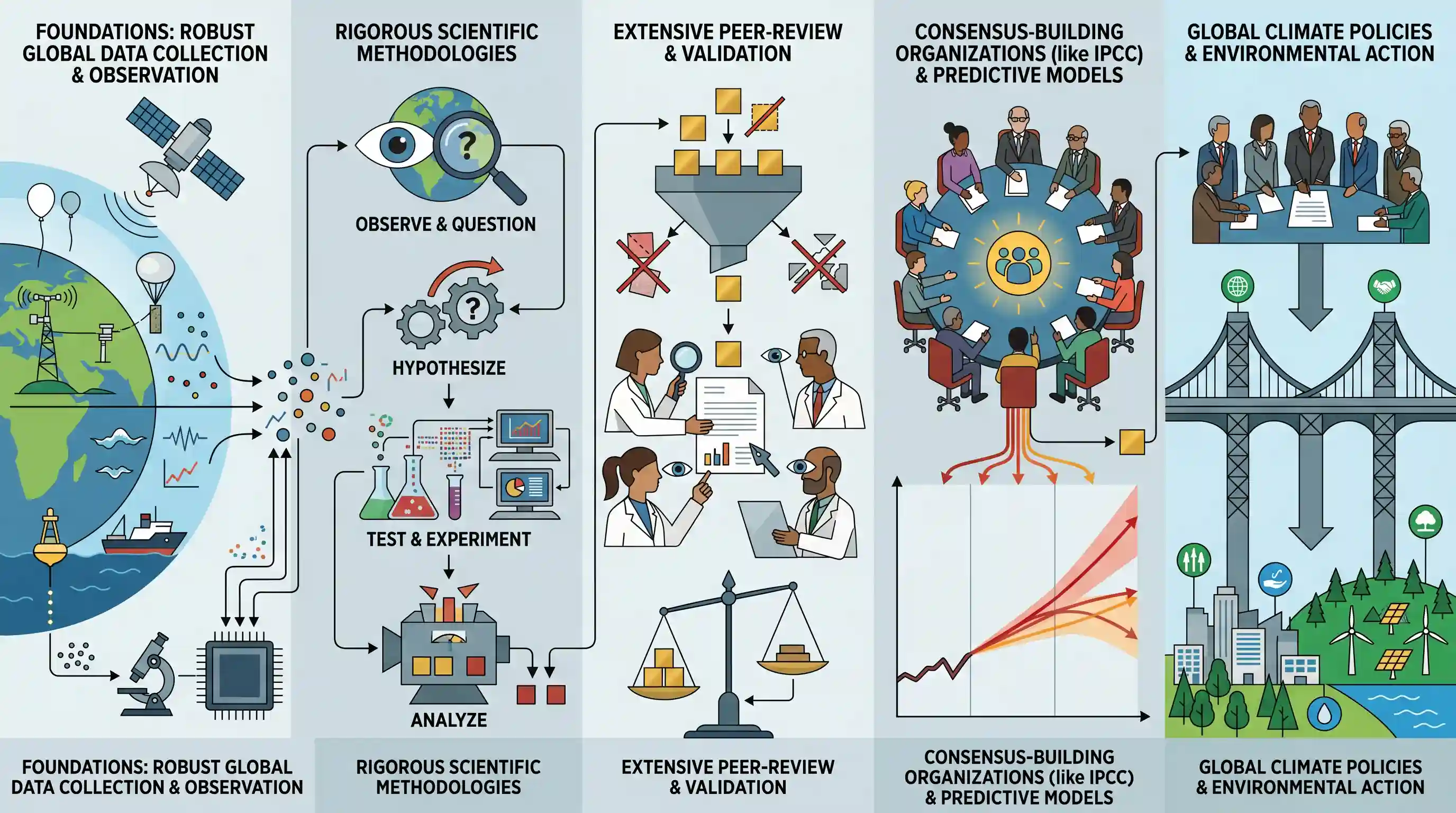
The article explores the fundamental foundations that establish the reliability and credibility of climate science. It highlights how the discipline relies on rigorous scientific methodologies, robust global data collection, and extensive peer-review processes to validate findings on global warming. By detailing the role of predictive models and consensus-building organizations like the Intergovernmental Panel on Climate Change (IPCC), the piece counters climate skepticism and underscores how empirical evidence forms the basis for global climate policies and environmental action.
Key Points
- Climate science is built on a foundation of extensive empirical data collected globally from diverse sources like satellites, ice cores, and weather stations.
- Predictive climate models are rigorously tested against historical data to ensure their accuracy and reliability in projecting future climate scenarios.
- The Intergovernmental Panel on Climate Change (IPCC) plays a crucial role by synthesizing vast amounts of peer-reviewed scientific literature into comprehensive assessment reports.
- The overwhelming scientific consensus on human-induced global warming is the result of converging evidence from multiple independent studies across various disciplines.
- Transparency, continuous peer review, and the constant updating of models as new data emerges form the bedrock of scientific credibility, effectively countering climate skepticism.
Important Terms
Intergovernmental Panel on Climate Change (IPCC)

The United Nations body for assessing the science related to climate change, providing regular assessments of its impacts, future risks, and options for adaptation and mitigation.
UPSC context
GS III (Environment); key for international negotiations (Paris Agreement) and assessing scientific basis for global climate policy.
Climate Modeling
Mathematical simulations of the Earth's climate system used to predict future changes based on greenhouse gas emissions and other variables.
UPSC context
GS III (Science & Tech/Environment); critical for risk assessment and long-term planning against chronic climate risks.
Environmental Governance
The processes of decision-making and implementation involved in the control and management of the environment and natural resources via laws, policies, and institutions.
UPSC context
GS II (Governance) & GS III (Environment); involves international conventions (UNFCCC) and national frameworks (National Action Plan on Climate Change).
Peer-Review Process
A quality-control process in which independent experts evaluate a study's methodology, data, and conclusions before publication to ensure scientific accuracy and credibility.
UPSC context
GS III (Science & Technology); fundamental to understanding scientific integrity and the "scientific temper" mentioned in Article 51A.
Scientific Consensus
The collective judgment and agreement of the scientific community in a particular field, such as the consensus that humans cause global warming.
UPSC context
GS III (Environment); counters climate skepticism and provides the "unequivocal" evidence needed for high-stakes international environmental diplomacy.
Empirical Evidence
Information and data acquired by means of observation or experimentation, which serve as the foundation for scientific findings and evidence-based policy.
UPSC context
GS III (Science & Technology); tests the validity of scientific claims versus misinformation in policy discourse.
Prelims Trap
The IPCC conducts original scientific research and maintains global weather stations.
The IPCC does not conduct independent research or monitor climate data. It systematically reviews and synthesizes already published scientific literature.
Static Concepts Connected
How does the Intergovernmental Panel on Climate Change (IPCC) function?
- Genesis: Established in 1988 by the World Meteorological Organization (WMO) and the UN Environment Programme (UNEP).
- Mandate: It does not conduct primary research or measure data, but rather assesses published peer-reviewed scientific literature to inform policy.
- Key Outputs: Produces comprehensive Assessment Reports (AR) and Special Reports (e.g., Global Warming of 1.5°C) that guide UNFCCC negotiations.
What are 'proxy data' sources used in paleoclimatology?
- Ice Cores: Drilled from glaciers and ice sheets; trapped air bubbles reveal historical greenhouse gas concentrations and isotopic temperatures.
- Tree Rings: Dendrochronology uses tree ring width and density to reconstruct past rainfall, droughts, and temperature patterns over centuries.
- Ocean Sediments: Analysis of deep-sea microfossils (like foraminifera) provides data on ancient ocean temperatures, salinity, and ice volume.
Cross-Topic Patterns
Paleoclimatology + UNFCCC targets
Historical baselines derived from ice cores directly define the 'pre-industrial levels' that anchor Paris Agreement temperature targets and modern Loss & Damage fund negotiations.
Precautionary Principle in governance
Questions on environmental governance often test the 'precautionary principle', contrasting scientific skepticism with the legal mandate for statutory action under treaties like the CBD or UNFCCC.

A statement-based question testing the IPCC's exact mandate vs primary climate data trackers (like WMO) is highly likely for 2026.
Linked PYQs · 4
Linked PYQs · 4
- 2023MainsGS3
The Intergovernmental Panel on Climate Change (IPCC) has predicted a global sea level rise of about one metre by AD 2100. What would be its impact in India and the other countries in the Indian Ocean region?
- 2022MainsGS3
Discuss global warming and mention its effects on the global climate. Explain the control measures to bring down the level of greenhouse gases which cause global warming, in the light of the Kyoto Protocol, 1997.
- 2022PrelimsGS1
"Climate Action Tracker" which monitors the emission reduction pledges of different countries is a :
- 2015MainsGS4
What is meant by 'environmental ethics'? Why is it important to study? Discuss any one environmental issue from the viewpoint of environmental ethics.
