Tokamaks and magnetic confinement physics in nuclear fusion technology
Source:The Hindu ↗
Why It Matters
Understanding nuclear fusion and tokamak technology is critical for UPSC aspirants studying futuristic clean energy sources, India's energy security, and international scientific collaborations like ITER.
Summary
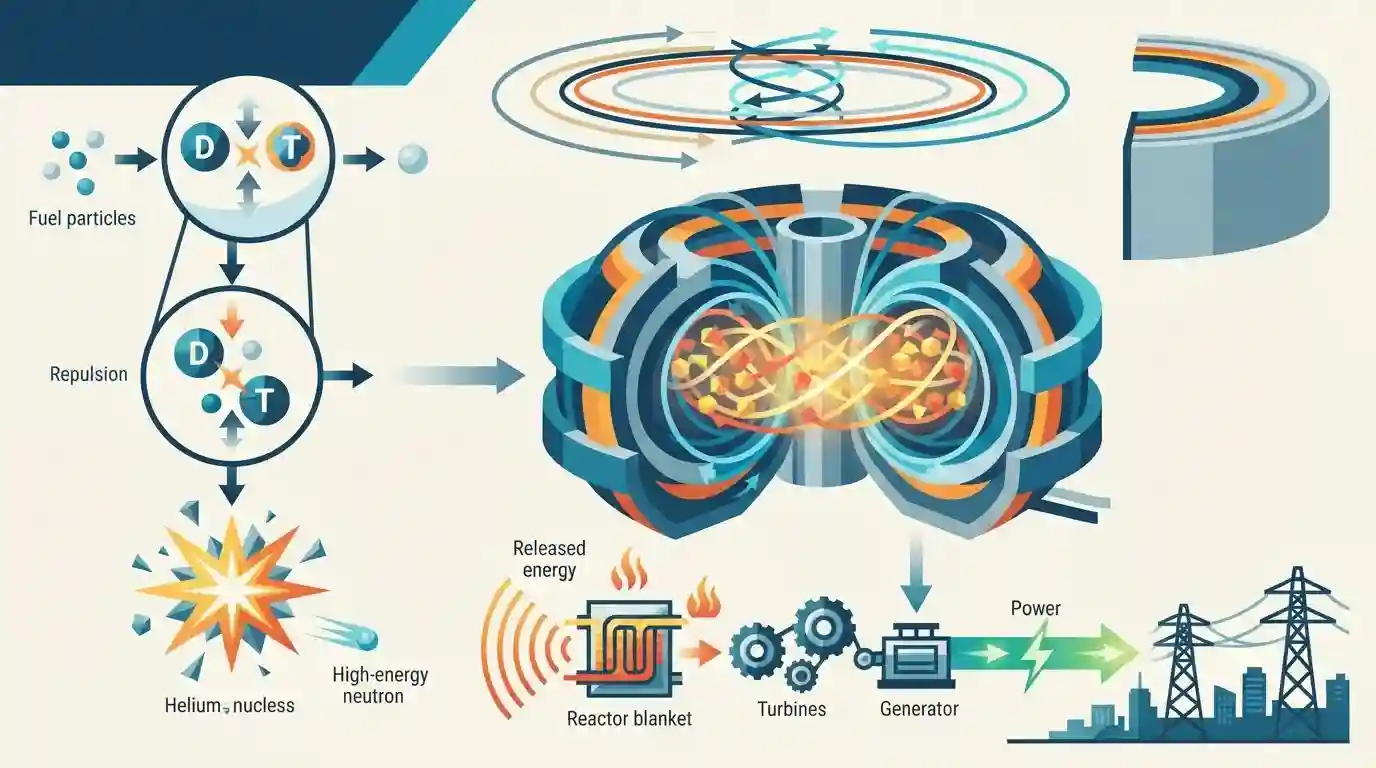
The article explains the physics and engineering behind tokamaks, which are doughnut-shaped magnetic confinement devices used to achieve nuclear fusion. It details how magnetic fields contain extremely hot plasma, allowing atoms to fuse and release clean energy. It highlights the principles of nuclear fusion, plasma physics, and its importance as a futuristic energy alternative.
Key Points
- Tokamaks are magnetic confinement devices designed to harness nuclear fusion, the process that powers the sun, by heating plasma to extreme temperatures.
- A tokamak uses powerful magnetic fields shaped like a torus (doughnut) to trap and isolate superheated plasma so it doesn't melt the reactor walls.
- Nuclear fusion offers a virtually limitless, clean source of energy with minimal radioactive waste compared to nuclear fission.
- India is a key participant in the international collaborative project ITER, contributing to advancements in fusion energy technology.
Important Terms
International Thermonuclear Experimental Reactor (ITER)

An international nuclear fusion mega-project located in France aiming to build the world's largest magnetic confinement plasma physics experiment (tokamak) to prove the commercial feasibility of fusion energy.
UPSC context
GS Paper III (Science & Technology - Developments and Applications, Clean Energy). Tests knowledge of global collaborative scientific ventures and futuristic energy alternatives.
Prelims Trap
ITER is a commercial electricity-generating power plant fully funded by international grants.
Aspirants often confuse ITER with a commercial power plant or assume India is only a financial donor, whereas India contributes major in-kind hardware like the giant cryostat through ITER-India.
Static Concepts Connected
What is the difference between nuclear fission and nuclear fusion?
- Mechanism: Reaction mechanism: Fission splits heavy atoms (uranium/plutonium), whereas fusion combines light atoms (isotopes of hydrogen like deuterium and tritium).
- Waste & Safety: Waste profile: Fusion produces minimal long-lived radioactive waste and no risk of runaway chain reactions, unlike fission.
- Engineering Challenge: Engineering challenge: Fusion requires extreme temperatures (>100 million °C) and magnetic/inertial confinement, making controlled power generation harder.
Cross-Topic Patterns
Big Science Diplomacy and Global Governance
India's participation in mega-science projects like ITER and CERN highlights its transition from a technology recipient to a crucial in-kind hardware contributor in global scientific governance.

Expect a statement-based prelims question on ITER membership, India's in-kind contributions (cryostat), and fusion vs fission differences.
Linked PYQs · 3
Linked PYQs · 3
- 2024PrelimsGS1
With reference to radioisotope thermoelectric generators (RTGs), consider the following statements: 1. RTGs are miniature fission reactors. 2. RTGs are used for powering the onboard systems of spacecrafts. 3. RTGs can use Plutonium-238, which is a by-product of weapons development. Which of the statements given above are correct?
- 2016PrelimsGS1
India is an important member of the 'International Thermonuclear Experimental Reactor'. If this experiment succeeds, what is the immediate advantage for India?
- 2025MainsGS3
The fusion energy programme in India has steadily evolved over the past few decades. Mention India's contributions to the international fusion energy project International Thermonuclear Experimental Reactor (ITER). What will be the implications of the success of this project for the future of global energy?
