District Cooling Systems for Urban Heat and Energy Efficiency
Source:The Hindu ↗
Why It Matters
Space cooling is projected to be the largest contributor to India's peak electricity demand over the coming decades. Transitioning to centralized, energy-efficient solutions like District Cooling Systems is critical for achieving net-zero climate targets, ensuring energy security, and building climate-resilient cities amidst dangerous increases in global wet-bulb temperatures.
Summary
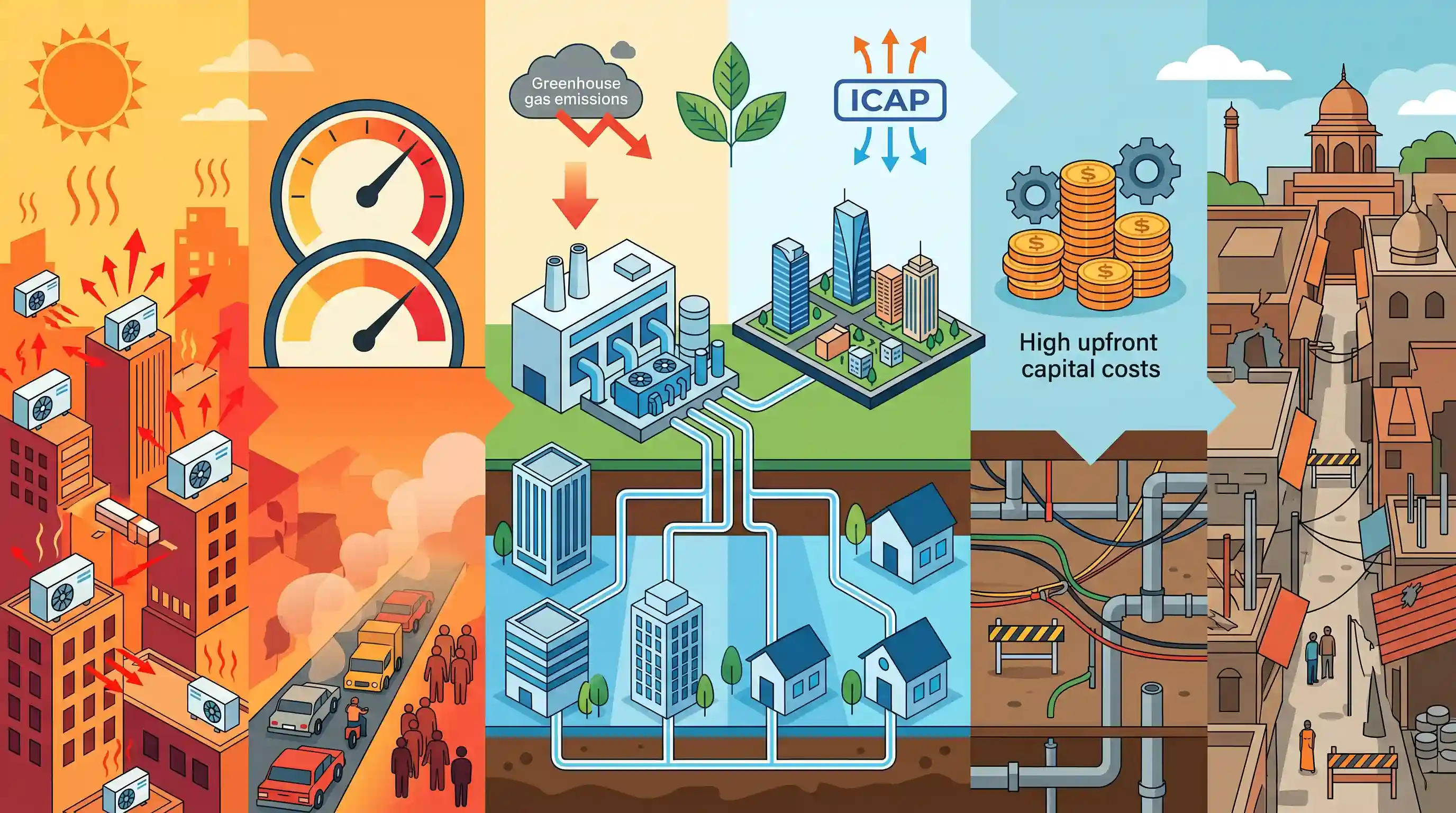
The escalating need for space cooling in India presents a dual challenge of skyrocketing peak energy demand and exacerbated urban heat. District Cooling Systems (DCS), which centralize chilled water production for multiple buildings, offer a highly energy-efficient alternative to standalone air conditioners. By integrating DCS into urban planning—as demonstrated in GIFT City—India can significantly lower greenhouse gas emissions, mitigate the Urban Heat Island (UHI) effect, and align with the India Cooling Action Plan (ICAP). Despite its potential for energy savings and climate resilience, widespread adoption faces hurdles like high upfront capital costs, complex right-of-way issues, and difficulties in retrofitting existing urban infrastructure.
Key Points
- A District Cooling System (DCS) produces chilled water at a central plant and distributes it through insulated underground pipes to cool multiple buildings within an urban area, eliminating the need for individual building chillers.
- DCS consumes 30% to 40% less energy compared to conventional decentralized cooling systems, which significantly reduces strain on the electrical grid during peak summer demand.
- The centralized system effectively reduces the Urban Heat Island (UHI) effect by minimizing the ambient exhaust heat typically generated by thousands of localized air conditioning units.
- DCS adoption supports the overarching objectives of the India Cooling Action Plan (ICAP) to lower cooling demand by 20-25% and aligns with India’s climate mitigation goals under the Kigali Amendment.
- Implementation challenges include high initial capital expenditure, the necessity for robust urban planning from the outset (e.g., greenfield projects like GIFT City), and complex right-of-way issues that make retrofitting difficult in dense, existing cities.
Important Terms
India Cooling Action Plan (ICAP)

A 20-year roadmap (2018-2038) launched by the MoEFCC to reduce cooling demand (20-25%) and refrigerant demand (25-30%) across sectors like buildings and cold chains.
UPSC context
GS Paper 3 (Environment/Infrastructure); tests knowledge of sustainable urban development and India's proactive climate-mitigation strategies.
District Cooling System (DCS)
A centralized infrastructure that produces chilled water at a central plant and distributes it to multiple buildings for space cooling, offering higher efficiency than individual units.
UPSC context
GS Paper 3 (Science & Technology/Infrastructure); relevant for energy security, urbanization, and sustainable building technologies.
Kigali Amendment to the Montreal Protocol
A 2016 legally binding agreement to phase down hydrofluorocarbons (HFCs), which are potent greenhouse gases. India aims for an 85% reduction from its baseline by 2047.
UPSC context
GS Paper 3 (Environment); focuses on international protocols and India's commitments to reducing global warming potential.
Bureau of Energy Efficiency (BEE)
A statutory body under the Ministry of Power (est. 2002) responsible for spearheading energy efficiency through policies like the Star Labeling and Energy Conservation Building Codes.
UPSC context
GS Paper 3 (Economy/Infrastructure); tests understanding of regulatory frameworks for energy conservation and industrial efficiency.
Urban Heat Island (UHI) Effect
An urban phenomenon where metropolitan areas experience significantly higher temperatures than surrounding rural areas due to human activity, dense infrastructure, and lack of vegetation.
UPSC context
GS Paper 1 (Urbanization/Geography); critical for questions on urban planning, climate change impacts, and city liveability.
GIFT City (Gujarat International Finance Tec-City)
India's first operational smart city and International Financial Services Centre (IFSC), featuring the country’s first large-scale district cooling system and integrated utility tunnels.
UPSC context
GS Paper 3 (Infrastructure/Economy); relevant for modern urban models and specialized economic/financial zones in India.
Smart Cities Mission
A 2015 centrally sponsored scheme by the Ministry of Housing and Urban Affairs aimed at developing 100 sustainable, citizen-friendly cities through technology and infrastructure innovation.
UPSC context
GS Paper 2/GS Paper 1 (Governance/Urbanization); evaluates knowledge of urban renewal and the integration of technology in public services.
Prelims Trap
District Cooling Systems (DCS) mitigate the Urban Heat Island effect by releasing chilled air directly into the urban atmosphere.
DCS pipes chilled water into buildings to replace individual ACs. It mitigates urban heat indirectly by eliminating localized exhaust heat from split ACs, not by chilling ambient outside air.
Static Concepts Connected
What are the key targets of the India Cooling Action Plan (ICAP)?
- Demand Reduction: Reduce aggregate cooling demand across various sectors by 20-25% by the year 2037-38.
- Energy & Refrigerants: Reduce refrigerant demand by 25-30% and overall cooling energy requirements by 25-40% by 2037-38.
- Skill Development: Train and certify 100,000 servicing sector technicians under Skill India Mission to ensure safe handling of refrigerants.
What is the Kigali Amendment to the Montreal Protocol?
- Core Mandate: It mandates the phase-down (not complete phase-out) of Hydrofluorocarbons (HFCs). HFCs are potent greenhouse gases, but they do not deplete the ozone layer.
- India's Commitment: India will phase down HFCs in four steps from 2032 onwards, with a cumulative reduction target of 85% by 2047.
Cross-Topic Patterns
Smart Cities + Climate Resilience
Greenfield projects like GIFT City integrate DCS right-of-way into foundational urban planning, shifting the focus of urbanization from mere infrastructure and digital governance to active climate adaptation.
Kigali Amendment + ICAP Synergy
Phasing down HFCs requires not just chemical substitution but systemic energy efficiency, making centralized cooling a dual-tool for UNFCCC emission goals and Montreal Protocol mandates.

ICAP targets, Urban Heat Island mitigation, and Kigali Amendment phase-down schedules are prime for a paired 2026 Prelims question.
Linked PYQs · 4
Linked PYQs · 4
- 2013MainsGS1
Bring out the causes for the formation of heat islands in the urban habitat of the world.
- 2016MainsGS1
With a brief background of quality of urban life in India, introduce the objectives and strategy of the 'Smart City Programme'.
- 2025PrelimsGS1
The World Bank warned that India could become one of the first places where wet-bulb temperatures routinely exceed 35 °C. Which of the following statements best reflect(s) the implication of the above-said report? I. Peninsular India will most likely suffer from flooding, tropical cyclones and droughts. II. The survival of animals including humans will be affected as shedding of their body heat through perspiration becomes difficult. Select the correct answer using the code given below.
- 2025PrelimsGS1
Consider the following statements : I. Carbon dioxide (CO2) emissions in India are less than 0.5 t CO2/ capita. II. In terms of CO2 emissions from fuel combustion, India ranks second in Asia-Pacific region. III. Electricity and heat producers are the largest sources of CO2 emissions in India. Which of the statements given above is/are correct?
