District Cooling Systems and Urban Energy Efficiency
Source:The Hindu ↗
Why It Matters
Cooling demand in India is rising rapidly due to climate change and urbanization. District Cooling is a highly relevant technological and infrastructural solution linking energy efficiency, India's international climate commitments (like phasing down HFCs), and the mitigation of Urban Heat Islands, making it a high-yield topic for GS1 (Urban Geography) and GS3 (Environment/Infrastructure).
Summary
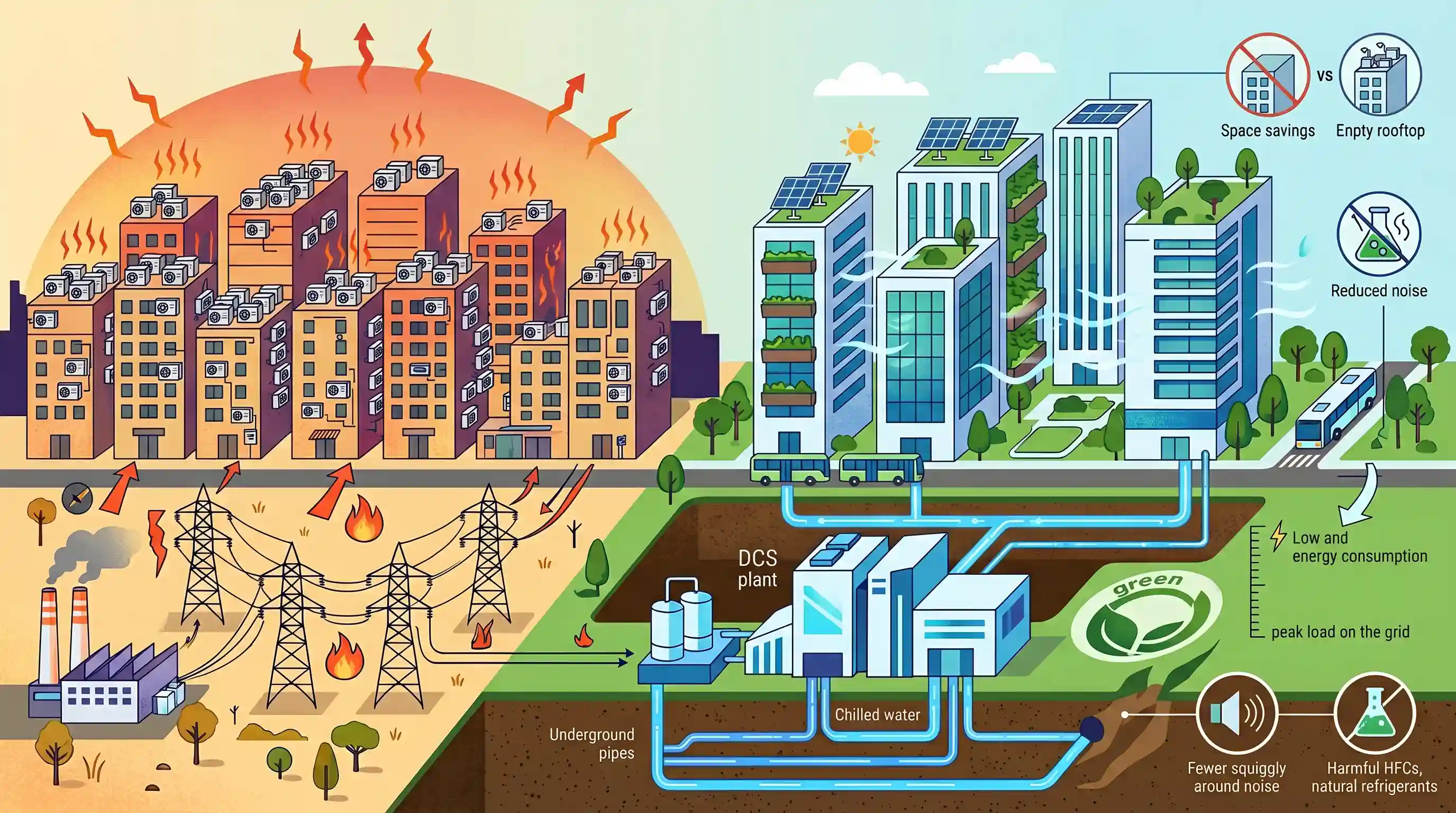
The article emphasizes the transformative potential of District Cooling Systems (DCS) in addressing India's escalating cooling demands alongside its climate and urban planning challenges. Unlike conventional individual air conditioners, a DCS produces chilled water in a centralized plant and circulates it through underground pipes to multiple buildings. This centralized approach reduces energy consumption by 40-50%, significantly lowering greenhouse gas emissions and easing peak loads on urban electricity grids. Environmentally, DCS supports the India Cooling Action Plan (ICAP) by enabling the organized phase-out of harmful refrigerants like HFCs. Furthermore, the absence of individual AC condenser units prevents localized heat rejection, mitigating the Urban Heat Island (UHI) effect. From an urban planning perspective, DCS frees up building space, reduces noise pollution, and offers a highly sustainable infrastructural solution for developing Smart Cities.
Key Points
- A District Cooling System (DCS) produces chilled water centrally and distributes it to buildings via underground pipes, eliminating the need for individual air-conditioning units.
- DCS is highly energy-efficient, consuming 40-50% less energy than conventional cooling, which substantially curtails greenhouse gas emissions and peak electricity demand.
- By centralizing cooling infrastructure, DCS facilitates the phase-out of harmful hydro-fluorocarbon (HFC) refrigerants, aligning with the objectives of the India Cooling Action Plan (ICAP).
- DCS mitigates the Urban Heat Island (UHI) effect by preventing localized heat rejection from decentralized AC units, while also freeing up valuable real estate in urban buildings.
Important Terms
District Cooling Systems (DCS)

A centralized cooling infrastructure that produces chilled water in a single plant and distributes it through underground pipes to multiple buildings, significantly reducing energy use compared to individual units.
UPSC context
GS Paper 3 (Infrastructure/Energy); tests sustainable urban planning and energy efficiency strategies for climate mitigation.
India Cooling Action Plan (ICAP)
A 20-year roadmap (2017–2038) launched in 2019 to address India's cooling demand across sectors, aiming to reduce energy consumption and phase out harmful refrigerants sustainably.
UPSC context
GS Paper 3 (Environment); tests awareness of national climate policies and commitments under the Montreal Protocol.
Urban Heat Island (UHI) effect
A phenomenon where cities experience significantly higher temperatures than surrounding rural areas due to heat-trapping materials like concrete, lack of vegetation, and waste heat from human activity.
UPSC context
GS Paper 1 (Urbanization) and GS Paper 3 (Environment); tests understanding of anthropogenic impacts on local climates.
Kigali Amendment
A 2016 legally binding amendment to the Montreal Protocol that aims to phase down the production and consumption of hydrofluorocarbons (HFCs), which are potent greenhouse gases.
UPSC context
GS Paper 3 (Environment); tests knowledge of international environmental treaties and India’s global climate obligations.
Smart Cities Mission
A centrally sponsored scheme launched in 2015 to develop 100 cities into sustainable urban centers using technology-driven "Smart Solutions" to improve infrastructure and quality of life.
UPSC context
GS Paper 2 (Governance) and GS Paper 3 (Urban Development); tests knowledge of initiatives for sustainable urbanization.
Prelims Trap
District Cooling Systems (DCS) completely eliminate the need for chemical refrigerants by replacing them with chilled water networks.
DCS centralizes cooling. While it distributes chilled water to buildings, the central plant still uses refrigerants. It reduces their volume and enables low-GWP alternatives, but does not completely eliminate them.
Static Concepts Connected
What causes the Urban Heat Island (UHI) effect?
- Surface materials: Concrete and asphalt absorb and retain significant solar radiation compared to natural ground cover.
- Reduced evapotranspiration: A severe lack of urban vegetation diminishes the natural cooling process of evapotranspiration.
- Anthropogenic heat: Waste heat rejected locally by decentralized AC condenser units, vehicles, and industrial activity exacerbates localized warming.
How does the Kigali Amendment regulate HFCs?
- Phase-down target: It mandates the gradual reduction (phase-down) of Hydrofluorocarbons (HFCs), rather than an immediate or complete phase-out like CFCs.
- Climate focus: HFCs are targeted not for ozone depletion, but because they possess an exceptionally high Global Warming Potential (GWP).
- India's timeline: India is classified under Group 3 of the amendment, aiming for an 85% reduction in HFC use by 2047.
Cross-Topic Patterns
Urban Heat & Smart Cities integration
DCS perfectly links GS1 urbanization challenges (Urban Heat Islands) with GS3 energy infrastructure. Expect Mains questions blending urban planning with specific climate mitigation strategies.
ICAP's dual focus on demand and emissions
The India Cooling Action Plan uniquely targets a 20-25% reduction in overall cooling demand alongside phasing down refrigerants, a crucial distinction often tested in Prelims.

Expect a multi-statement Prelims question linking the India Cooling Action Plan's demand-reduction targets with the Kigali Amendment.
Linked PYQs · 3
Linked PYQs · 3
- 2022MainsGS3
Discuss global warming and mention its effects on the global climate. Explain the control measures to bring down the level of greenhouse gases which cause global warming, in the light of the Kyoto Protocol, 1997.
- 2013MainsGS1
Bring out the causes for the formation of heat islands in the urban habitat of the world.
- 2024PrelimsGS1
What is the common characteristic of the chemical substances generally known as CL-20, HMX and LLM-105, which are sometimes talked about in media?
