WHO And Nations Reach Historic Global Pandemic Treaty Consensus
Source:The Hindu ↗
Why It Matters
The WHO Pandemic Agreement represents the most significant reform in global health architecture since the adoption of the IHR in 2005. It is directly relevant for GS2 questions assessing WHO's efficacy, the structural inequities in global governance, and for GS3 questions concerning intellectual property rights versus public health emergencies.
Summary
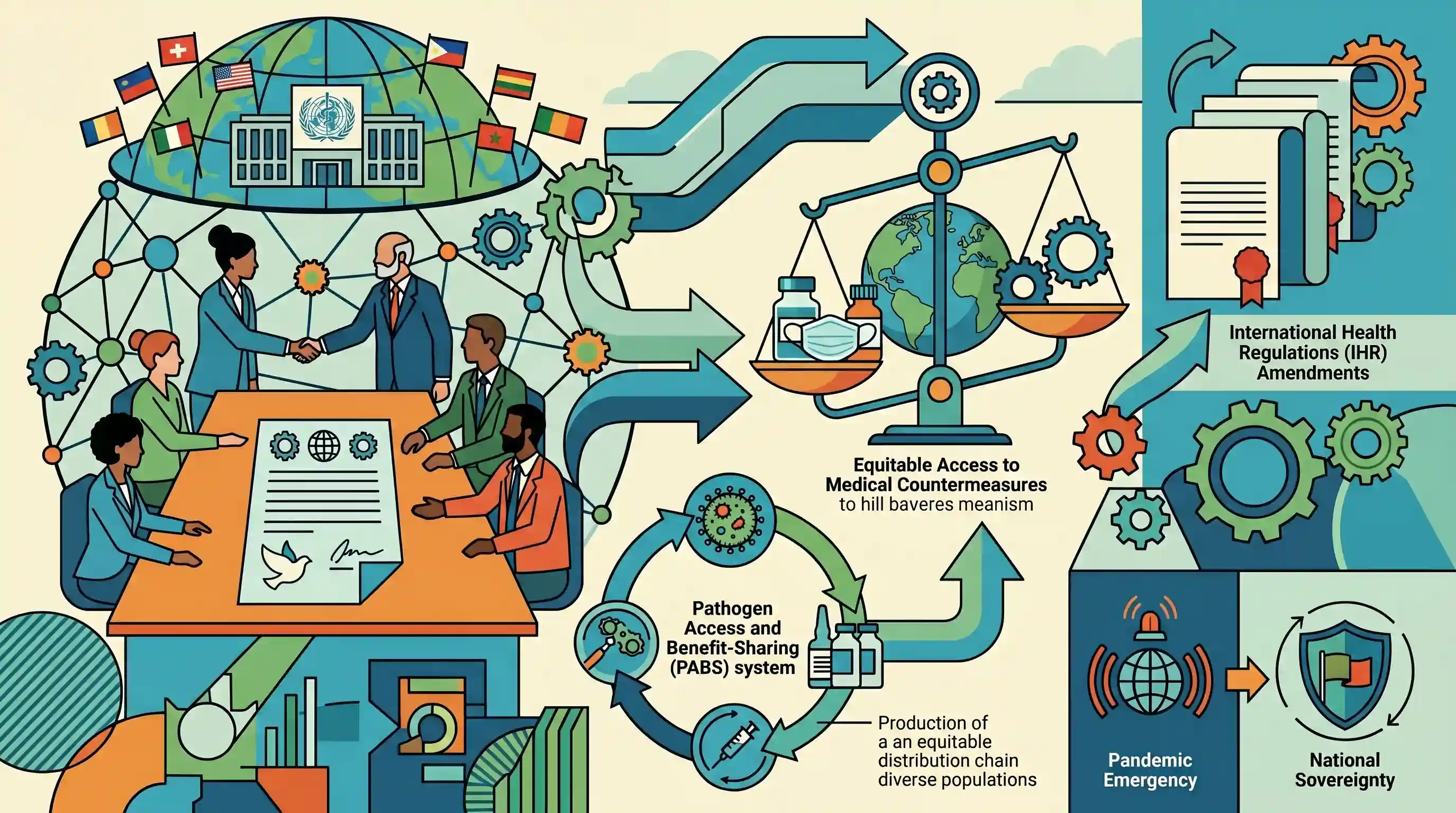
The article details the complex negotiations and the resulting consensus among World Health Organization (WHO) member states to strike a comprehensive pandemic deal. Driven by the stark inequities exposed during COVID-19, the Intergovernmental Negotiating Body (INB) navigated a historic global health governance overhaul. The agreement is centered on ensuring equitable access to medical countermeasures through the Pathogen Access and Benefit-Sharing (PABS) system, balancing pharmaceutical intellectual property rights with the needs of developing nations. Alongside the treaty, vital amendments to the International Health Regulations (IHR) were formalized to better define and manage future 'pandemic emergencies' while strictly respecting the national sovereignty of member states.
Key Points
- The WHO pandemic agreement was negotiated by the Intergovernmental Negotiating Body (INB) to establish a binding global framework for pandemic prevention, preparedness, and response (PPPR).
- A central component is the Pathogen Access and Benefit-Sharing (PABS) system, ensuring that countries sharing pathogen data receive equitable, timely access to resulting vaccines and therapeutics.
- Parallel to the treaty, nations agreed to amend the International Health Regulations (IHR, 2005) to introduce a clear definition of a "pandemic emergency" for triggering faster global responses.
- The negotiations highlighted a strong North-South divide, particularly concerning Intellectual Property (IP) waivers, technology transfer, and the financing of health system capacities in developing nations.
- The framework integrates the 'One Health' approach, emphasizing the crucial link between human, animal, and environmental health to mitigate the risk of zoonotic spillovers.
Important Terms
WHO Pandemic Agreement

A legally binding international treaty adopted by WHO member states in May 2025 to strengthen global prevention, preparedness, and response to future pandemics.
UPSC context
GS Paper 2: International Relations/Health. Tests knowledge of global health governance and legally binding multilateral instruments.
International Health Regulations (IHR, 2005)
A near-universal legal framework updated in 2024 to manage international health risks while minimizing interference with global trade and travel.
UPSC context
GS Paper 2: Governance/Health. Important for understanding the distinction between technical regulations and political treaties.
Pathogen Access and Benefit-Sharing (PABS) System
The mechanism within the Pandemic Agreement mandating the rapid sharing of pathogen data in exchange for equitable access to resulting vaccines and treatments.
UPSC context
GS Paper 3: Intellectual Property Rights/Science. Tests the 'Benefit Sharing' concept and North-South equity in pharmaceutical innovation.
Intergovernmental Negotiating Body (INB)
The specific body established by the World Health Assembly in 2021 to negotiate the first-ever global pandemic treaty.
UPSC context
GS Paper 2: Important International Institutions. Relevant for tracing the origins and process of multilateral negotiations.
Pandemic Emergency
A new high-level global alert introduced in the 2024 IHR amendments to trigger stronger collaboration for risks exceeding a standard public health emergency.
UPSC context
GS Paper 2: Issues relating to Health. Tests understanding of WHO’s emergency classification and early warning systems.
Prelims Trap
The Pathogen Access and Benefit-Sharing (PABS) system operates under the UN Convention on Biological Diversity.
PABS is established under the new WHO Pandemic Agreement specifically for pathogens, distinct from the broader Nagoya Protocol on ABS under the UN Convention on Biological Diversity.
Static Concepts Connected
What are the International Health Regulations (IHR, 2005) and a PHEIC?
- Legally binding framework: A legally binding international instrument applying to 196 countries, designed to prevent and respond to the international spread of disease.
- PHEIC declaration: Public Health Emergency of International Concern (PHEIC) is the highest level of alarm under the IHR, triggering global coordinated responses.
- National sovereignty: The WHO relies on state cooperation; it cannot enforce mandates, border closures, or override domestic health policies.
How do IP waivers and Compulsory Licensing work in public health emergencies?
- TRIPS Agreement: The WTO TRIPS agreement sets minimum standards for intellectual property regulation globally, including patent protections for pharmaceuticals.
- Compulsory Licensing: Allows governments to authorize the domestic production of a patented product without the patent owner's consent during national emergencies.
- Doha Declaration: Reaffirmed that TRIPS should not prevent member states from taking necessary measures to protect public health and promote access to medicines.
Cross-Topic Patterns
One Health and Zoonosis linkages
The treaty's reliance on 'One Health' bridges GS2 global governance with GS3 environmental ecology, linking wildlife habitat destruction directly to zoonotic spillover risks and pandemic prevention.
Genetic Resources: Nagoya Protocol vs PABS
Both frameworks use Access and Benefit-Sharing. Nagoya covers general biological diversity under the CBD, while the new PABS creates a specialized carve-out specifically for pandemic-potential pathogens under the WHO.
Global South solidarity in IP negotiations
The North-South divide in pandemic negotiations mirrors WTO TRIPS waiver debates, highlighting India and South Africa's recurring diplomatic roles as leaders demanding equitable pharmaceutical tech-transfer.

Expect a Prelims trap swapping PABS (WHO) with the Nagoya Protocol (CBD), or a GS2 Mains question linking One Health to global governance.
Linked PYQs · 4
Linked PYQs · 4
- 2020MainsGS2
Critically examine the role of WHO in providing global health security during the Covid-19 pandemic.
- 2020PrelimsGS1
Consider the following pairs: International agreement/set-up Subject 1. Alma-Ata Declaration : Healthcare of the people 2. Hague Convention : Biological and chemical weapons 3. Talanoa Dialogue : Global climate change 4. Under2 Coalition : Child rights Which of the pairs given above is/are correctly matched?
- 2024MainsGS3
What is the present world scenario of intellectual property rights with respect to life materials? Although, India is second in the world to file patents, still only a few have been commercialized. Explain the reasons behind this less commercialization.
- 2022MainsGS3
What is the basic principle behind vaccine development ? How do vaccines work? What approaches were adopted by the Indian vaccine manufacturers to produce COVID-19 vaccines ?
