Digital Device Overuse Triggers New Mental Health Concerns in Youth
Source:The Hindu ↗
Why It Matters
Highlights the unseen psychological and public health costs of India's rapid digital penetration on its youth, presenting new governance challenges in balancing technology and child welfare.
Summary
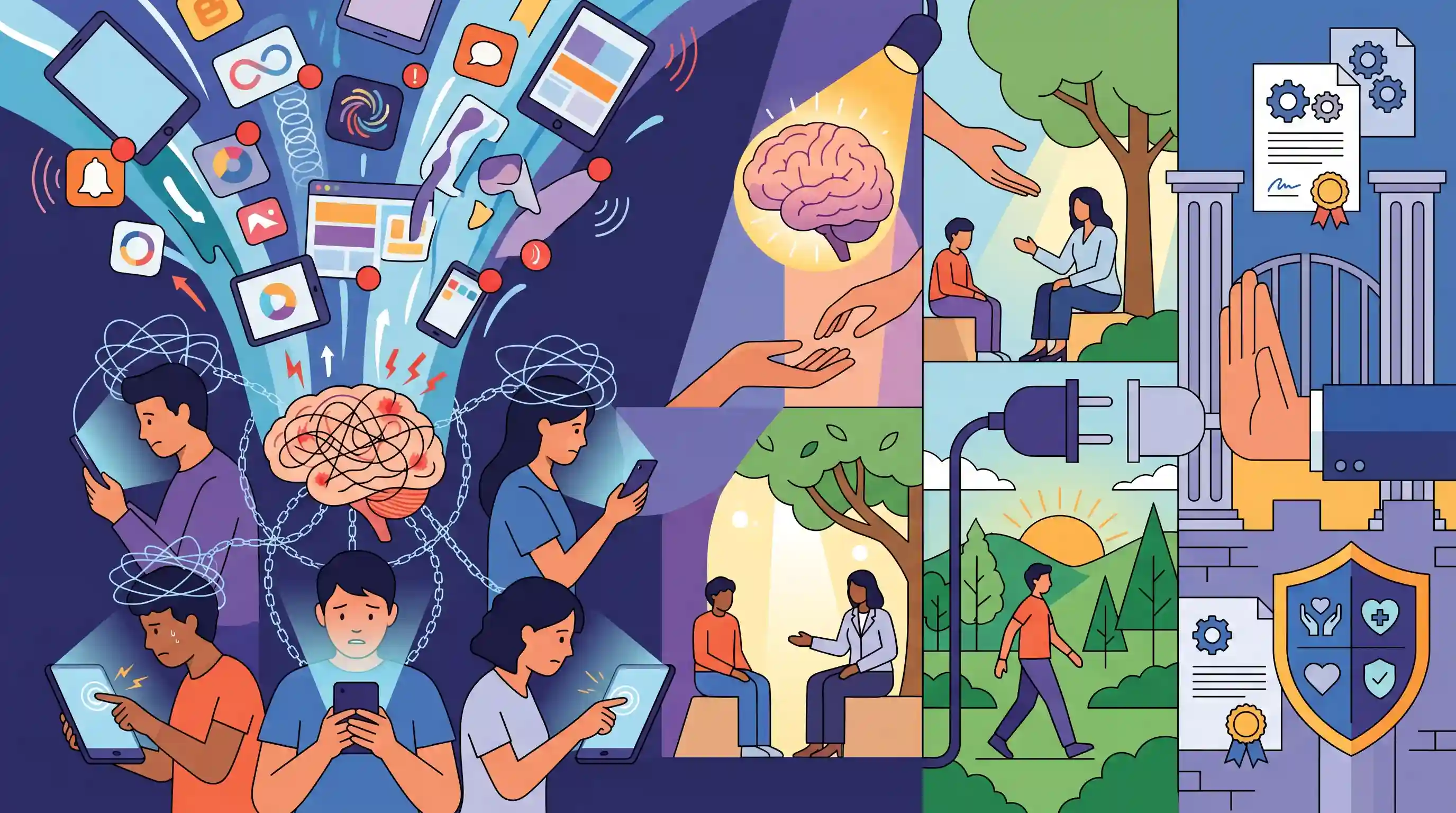
The rapid proliferation of digital devices and social media is triggering new forms of obsessive-compulsive disorder (OCD) and anxiety among young people in India. Driven by addictive algorithms, infinite scrolling, and constant notification alerts, youth are increasingly exhibiting compulsive digital behaviors that alter their mental health and social interactions. Mitigating this crisis requires greater awareness, clinical mental health support, digital detox measures, and robust regulatory frameworks to protect vulnerable youth from predatory digital architectures.
Key Points
- The pervasive use of digital devices and social media is leading to new forms of obsessive-compulsive behaviors (OCD) and anxiety among young people in India.
- Addictive platform designs, such as infinite scrolling and variable rewards, exploit psychological vulnerabilities and encourage compulsive digital habits.
- These digital compulsions disrupt real-world socialization, sleep patterns, and emotional regulation, posing significant mental health challenges for adolescents.
- Addressing these emerging mental health issues requires a combination of clinical interventions, digital literacy, and regulatory mechanisms to ensure a safer digital environment for children.
Prelims Trap
Digital addiction is formally classified and recognized as a distinct mental illness under the Mental Healthcare Act, 2017.
While WHO's ICD-11 recognizes "gaming disorder", India's Mental Healthcare Act, 2017 currently lacks formal statutory recognition of "digital addiction" as a clinical disorder.
Static Concepts Connected
How does the DPDP Act, 2023 legally protect children's digital data?
- Verifiable Consent: Requires verifiable consent from a parent or lawful guardian before processing personal data of anyone under 18.
- No Targeted Ads: Strictly prohibits data fiduciaries from undertaking behavioral monitoring or directing targeted advertisements at children.
- Harm Prevention: Bans any data processing that is likely to cause any detrimental effect on the well-being of a child.
What are the core statutory guarantees of the Mental Healthcare Act, 2017?
- Right to Access: Guarantees every person the right to access mental healthcare and treatment from state-funded services.
- Advance Directive: Empowers adults to make an advance directive stipulating how they wish to be treated for mental illness.
- Decriminalizes Suicide: Presumes severe stress for suicide attempts, effectively decriminalizing them by restricting the use of IPC Section 309.
Cross-Topic Patterns
Algorithmic Harm vs. DPDP Act
The intersection of behavioral psychology (dopamine loops) and tech regulation makes DPDP Act's ban on targeted ads for minors a major GS-2 governance case study.
Australia's Social Media Age Cap
India frequently evaluates global digital frameworks; Australia's 2024 law mandating a minimum age of 16 for social media could inspire future amendments to India's IT Rules.

Expect a mains question on the inadequacy of India's IT Rules and Mental Healthcare Act to handle algorithm-driven behavioral addictions.
Linked PYQs · 2
Linked PYQs · 2
- 2023MainsGS1
Child cuddling is now being replaced by mobile phones. Discuss its impact on the socialization of children.
- 2025MainsGS2
The National Commission for Protection of Child Rights has to address the challenges faced by children in the digital era. Examine the existing policies and suggest measures the Commission can initiate to tackle the issue.
