Enhanced Rock Weathering Offers Carbon Sequestration Potential
Source:The Hindu ↗
Why It Matters
As the global push for net-zero emissions intensifies, understanding novel Carbon Dioxide Removal (CDR) technologies like ERW is crucial. It bridges fundamental geographical concepts (chemical weathering) with contemporary environmental science and climate finance mechanisms (carbon credits), making it highly relevant for UPSC Environment and Science & Technology sections.
Summary
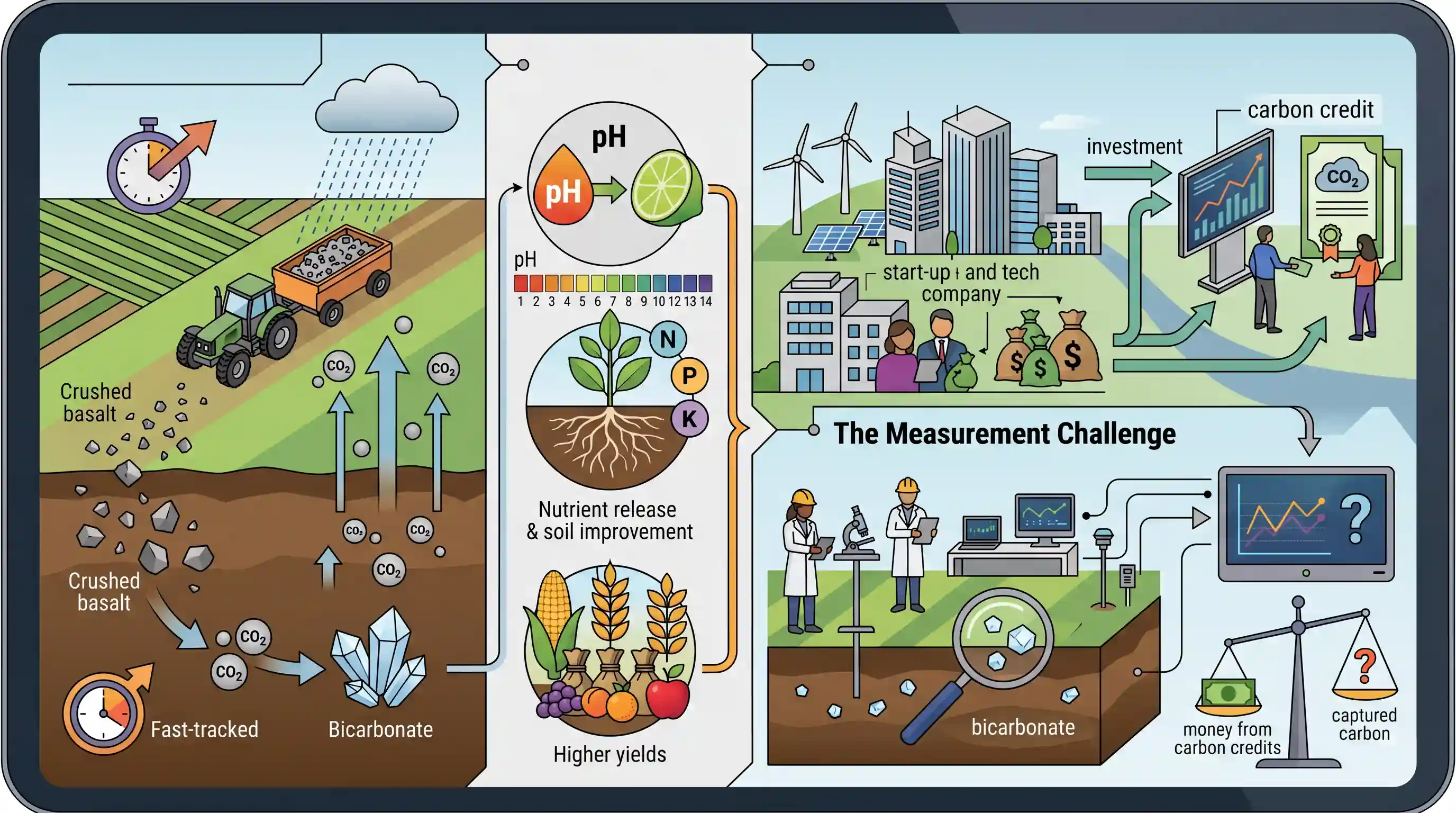
Enhanced Rock Weathering (ERW) is gaining traction as a promising method to combat climate change by spreading crushed rock, like basalt, on agricultural lands. This accelerates the natural process of weathering, where rocks absorb atmospheric carbon dioxide and safely store it as bicarbonate. Beyond carbon sequestration, ERW offers co-benefits such as neutralizing soil acidity, providing essential nutrients, and increasing crop yields. While start-ups and tech companies are increasingly investing in ERW for carbon credits, the primary challenge remains accurately measuring the exact amount of carbon captured to ensure the integrity of climate financing.
Key Points
- Enhanced Rock Weathering (ERW) is an emerging climate tech utilizing finely ground crushed rock, such as basalt, spread over farmlands to accelerate natural CO2 sequestration.
- The process mimics natural chemical weathering: atmospheric CO2 dissolves in rainwater to form carbonic acid, which then reacts with rocks to form stable bicarbonates that eventually wash into oceans.
- In addition to capturing CO2, ERW helps increase soil alkalinity, releases essential nutrients (like phosphorus and potassium), reverses soil degradation, and boosts crop yields.
- The main bottleneck is accurately Measuring, Reporting, and Verifying (MRV) the exact amount of carbon sequestered, creating risks of overestimating the value of resulting carbon credits.
- Start-ups like Mati Carbon (active in Indian paddy fields) and Terradot are commercializing ERW, with tech giants like Google already purchasing carbon credits generated via this process.
Important Terms
Enhanced Rock Weathering (ERW)

A nature-based climate solution that accelerates the geological process of rock breakdown by spreading finely crushed silicate rocks (like basalt) on soil to chemically absorb atmospheric carbon dioxide.
UPSC context
GS Paper III (Environment): A key carbon dioxide removal (CDR) technology for achieving net-zero targets and improving agricultural soil health.
Mati Carbon
An India-focused startup and $50 million grand prize winner of the XPRIZE Carbon Removal, which applies crushed basalt to smallholder rice paddies to sequester carbon and boost crop yields.
UPSC context
GS Paper III (Environment & Agriculture): Demonstrates practical application of climate-smart agriculture and the use of global climate finance for Indian smallholder farmers.
UN Intergovernmental Panel on Climate Change (IPCC)
The United Nations body responsible for assessing the science related to climate change; it synthesizes global research to provide policymakers with mitigation and adaptation strategies.
UPSC context
GS Paper III: Primary source for climate science; its Assessment Reports (e.g., AR6) guide global climate negotiations and India's National Action Plan on Climate Change.
Carbon Credits
A tradable permit or certificate representing the right to emit one tonne of carbon dioxide or an equivalent amount of different greenhouse gases.
UPSC context
GS Paper III (Environment & Economy): Central to India's Carbon Credit Trading Scheme (CCTS) and international climate finance mechanisms like the Paris Agreement's Article 6.
Carbon Sequestration
The process of capturing atmospheric carbon dioxide and storing it in long-term reservoirs like forests (biological), oceans, or underground geological formations to mitigate global warming.
UPSC context
GS Paper III: A critical strategy for balancing the carbon cycle and achieving 'Net Zero' commitments under the UNFCCC.
X Prize
A global incentive competition designed to solve humanity's greatest challenges; its $100 million 'Carbon Removal' prize was the largest in history, aimed at scaling gigaton-level CO2 removal solutions.
UPSC context
GS Paper III (Science & Technology): Illustrates how global innovation prizes catalyze private investment and technological breakthroughs in climate change mitigation.
Climate Finance
Local or international funding—from public, private, or alternative sources—that seeks to support mitigation and adaptation actions that will address climate change.
UPSC context
GS Paper III: A major point of contention in COP negotiations regarding the responsibility of developed nations to support developing countries like India.
Prelims Trap
"Enhanced Rock Weathering increases soil acidity and sequesters CO2 as soil organic carbon."
ERW does the exact opposite: it neutralizes soil acidity (increases alkalinity) and stores carbon as stable, inorganic bicarbonates, not organic carbon.
Static Concepts Connected
How does rock weathering drive the global Phosphorus Cycle?
- Primary Reservoir: Unlike the carbon or nitrogen cycles, phosphorus has no major atmospheric component; its primary reservoir is in Earth's crustal rocks.
- Weathering Release: Natural chemical and physical weathering of rocks slowly releases inorganic phosphate ions into the soil, making them available for plant uptake.
What are the primary modes of geological carbon sequestration?
- Mineral Carbonation: Atmospheric or captured CO2 reacts with metal oxides (like calcium and magnesium in silicate rocks) to form permanently stable, solid carbonates or bicarbonates.
- Direct Injection: Captured industrial CO2 is compressed and injected deep underground into depleted oil and gas fields, or deep saline aquifers.
Cross-Topic Patterns
ERW + Carbon Market Integrity
The MRV (Measuring, Reporting, Verifying) bottleneck in ERW highlights the exact regulatory challenges India faces in establishing a credible domestic Carbon Credit Trading Scheme (CCTS) free of greenwashing.
Basalt Weathering + Soil Chemistry
Applying crushed basalt acts like traditional agricultural liming. It connects climate mitigation directly to soil reclamation, mirroring how Deccan Trap weathering naturally formed India's fertile black soils.

Expect a 2026 Prelims question linking Enhanced Rock Weathering to soil alkalinity changes, stable bicarbonates, and the Phosphorus Cycle.
Linked PYQs · 4
Linked PYQs · 4
- 2023PrelimsGS1
Consider the following activities: 1. Spreading finely ground basalt rock on farmlands extensively 2. Increasing the alkalinity of oceans by adding lime 3. Capturing carbon dioxide released by various industries and pumping it into abandoned subterranean mines in the form of carbonated waters How many of the above activities are often considered and discussed for carbon capture and sequestration?
- 2025MainsGS3
What is Carbon Capture, Utilization and Storage (CCUS)? What is the potential role of CCUS in tackling climate change?
- 2014MainsGS3
Should the pursuit of carbon credits and clean development mechanisms set up under UNFCCC be maintained even though there has been a massive slide in the value of a carbon credit? Discuss with respect to India's energy needs for economic growth.
- 2024PrelimsGS1
Consider the following statements : Statement-I : Rainfall is one of the reasons for weathering of rocks. Statement-II : Rain water contains carbon dioxide in solution. Statement-III : Rain water contains atmospheric oxygen. Which one of the following is correct in respect of the above statements?
