Environmental Degradation and Ecological Costs of Armed Conflicts
Source:Indian Express ↗
Why It Matters
The intersection of armed conflict and environmental degradation is a crucial dimension of contemporary climate change and international relations. For UPSC candidates, this topic bridges GS-3 (Environment and Security) and GS-2 (International Treaties and Governance), emphasizing the need for comprehensive climate accounting (like military emissions) and the evolution of international laws such as the ENMOD Convention and the proposed crime of ecocide.
Summary
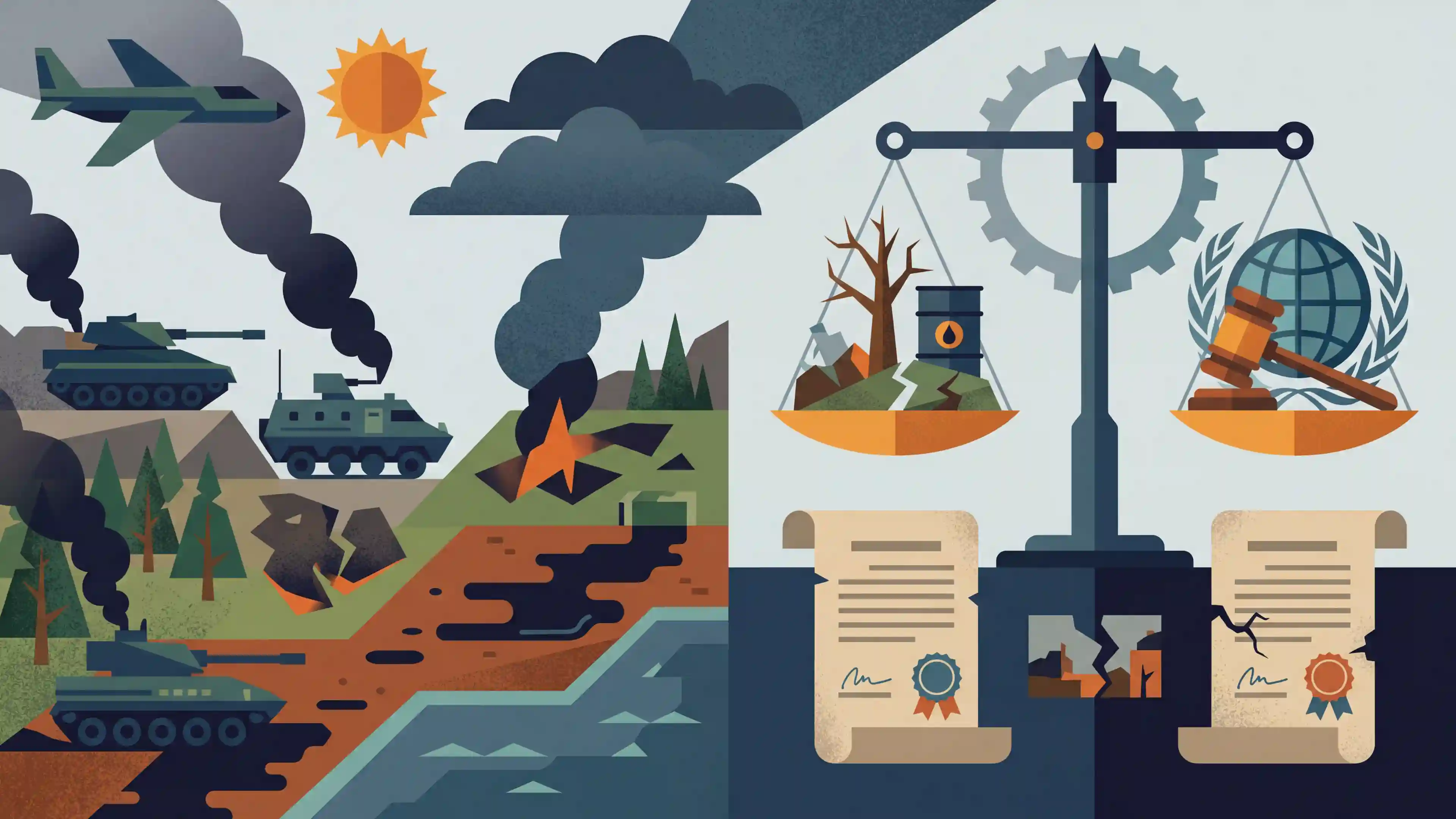
The article highlights the profound and often overlooked environmental costs of armed conflicts and wars. Beyond the tragic human toll, warfare causes immense ecological destruction through pollution, habitat loss, and vast greenhouse gas emissions, which are frequently excluded from international climate agreements. Existing legal frameworks, such as the ENMOD Convention and Geneva Conventions, have struggled to effectively deter environmental damage in conflict zones. The rising environmental footprint of modern warfare has sparked calls for stronger international accountability, including the push to recognize 'ecocide' as a formal international crime.
Key Points
- Armed conflicts lead to severe direct and indirect environmental degradation, including habitat destruction, soil and water contamination from munitions, and loss of biodiversity.
- Military operations are responsible for massive greenhouse gas (GHG) emissions, which have historically been underreported or excluded from major climate treaties like the Kyoto Protocol and Paris Agreement due to national security exemptions.
- Long-term ecological damage extends beyond active warfare, as unexploded ordnance and destroyed civilian infrastructure create lasting pollution and secondary environmental hazards.
- While international frameworks like the Geneva Conventions and the ENMOD Convention restrict deliberate environmental modification and excessive damage during war, enforcement remains challenging.
- There is a growing global movement to codify 'ecocide' as a recognized crime under international law (via the Rome Statute) to hold state and non-state actors accountable for severe environmental destruction.
Important Terms
ENMOD Convention

A 1976 treaty prohibiting the military or hostile use of environmental modification techniques—such as weather manipulation—having widespread, long-lasting, or severe effects.
UPSC context
GS Paper 3 (Environment/Security); tests knowledge of international laws governing environmental warfare and disarmament.
Geneva Conventions
Treaties establishing legal standards for humanitarian treatment in war; Additional Protocol I (1977) specifically prohibits warfare intended to cause widespread, long-term, and severe environmental damage.
UPSC context
GS Paper 2 (IR) and GS Paper 3 (Security); tests understanding of International Humanitarian Law (IHL).
Rome Statute
The 1998 treaty establishing the International Criminal Court (ICC); it classifies intentional, severe environmental destruction during war as a war crime.
UPSC context
GS Paper 2 (International Institutions); tests knowledge of global legal frameworks and the proposed criminalization of "ecocide."
International Criminal Court (ICC)
A permanent international tribunal that prosecutes individuals for genocide and war crimes; it is the proposed venue for prosecuting "ecocide" as a standalone international crime.
UPSC context
GS Paper 2 (Global Governance); tests awareness of international judicial bodies and their jurisdiction over environmental atrocities.
UNFCCC
The 1992 framework treaty for global climate action; while it requires emissions inventories, military and conflict-related greenhouse gas reporting remains largely voluntary and inconsistent.
UPSC context
GS Paper 3 (Climate Change); tests understanding of global climate governance and gaps in emissions accounting.
Paris Agreement
A 2015 legally binding climate treaty aiming to limit warming to 1.5°C; military emissions are often exempted from its primary reporting mechanism, the Nationally Determined Contributions (NDCs).
UPSC context
GS Paper 3 (Environment); tests knowledge of climate targets and the "military emissions gap" in international agreements.
Prelims Trap
Ecocide is officially recognized as the fifth international crime under the Rome Statute of the ICC.
Ecocide is currently only a proposed amendment. The ICC currently recognizes exactly four core crimes: genocide, crimes against humanity, war crimes, and the crime of aggression.
Static Concepts Connected
What are the four core international crimes currently recognized under the Rome Statute?
- Genocide: Acts committed with intent to destroy, in whole or in part, a national, ethnical, racial or religious group.
- Crimes against humanity: Widespread or systematic attacks directed against any civilian population, with knowledge of the attack.
- War crimes: Grave breaches of the Geneva Conventions, including intentional targeting of civilians or disproportionate destruction.
- Crime of aggression: The use of armed force by a State against the sovereignty, integrity or independence of another State.
How does the ENMOD Convention differ from the Geneva Conventions regarding environmental protection?
- ENMOD Convention: Strictly prohibits deliberately using environmental modification techniques (like weather manipulation or triggering earthquakes) as weapons of war.
- Geneva Conventions: Additional Protocol I prohibits conventional methods of warfare that are expected to cause widespread, long-term, and severe collateral damage to the natural environment.
Cross-Topic Patterns
Military emissions climate loophole
Military GHG emissions (approx 5.5% globally) were exempted under Kyoto and remain voluntary under Paris, linking climate governance failures to sovereign security exemptions.
Ecocide and Rights of Nature jurisprudence
The push to criminalize ecocide at the ICC parallels domestic legal movements granting legal personhood to rivers and ecosystems (e.g., in India and Ecuador) to establish ecological rights.

Expect a multi-statement Prelims question testing the ENMOD Convention's scope alongside the proposed inclusion of 'ecocide' at the ICC.
Linked PYQs · 4
Linked PYQs · 4
- 2022MainsGS3
Discuss global warming and mention its effects on the global climate. Explain the control measures to bring down the level of greenhouse gases which cause global warming, in the light of the Kyoto Protocol, 1997.
- 2024PrelimsGS1
One of the following regions has the world's largest tropical peatland, which holds about three years worth of global carbon emissions from fossil fuels; and the possible destruction of which can exert detrimental effect on the global climate. Which one of the following denotes that region?
- 2023MainsGS2
‘Sea is an important Component of the Cosmos’ Discuss in the light of the above statement the role of the IMO (International Maritime Organisation) in protecting environment and enhancing maritime safety and security.
- 2018MainsGS2
“Policy contradictions among various competing sectors and stakeholders have resulted in inadequate 'protection and prevention of degradation' to environment.” Comment with relevant illustrations.
