Giant viruses in permafrost and their ecological significance
Source:The Hindu ↗
Why It Matters
Understanding giant viruses is crucial for the UPSC syllabus across Science & Technology and Environment. It touches upon the fundamental classification of microorganisms, the ecological significance of marine viruses, and the emerging environmental threats posed by ancient pathogens released from melting permafrost due to global warming.
Summary
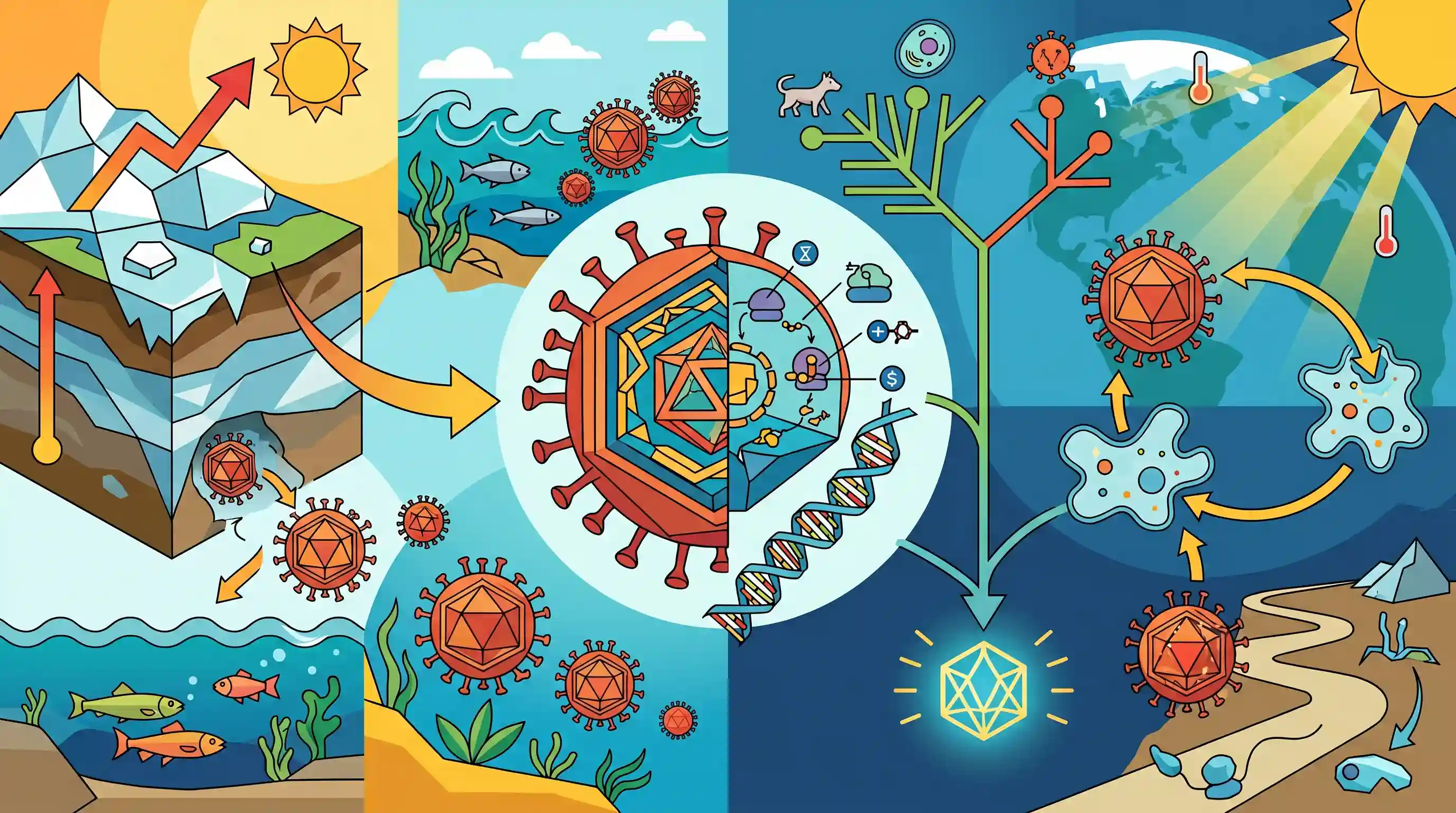
The article explores the fascinating biological domain of 'giant viruses,' which challenge conventional definitions of viral life due to their immense physical size and highly complex DNA genomes. Discovered in environments ranging from aquatic ecosystems to ancient thawing permafrost, these viruses possess genes for cellular processes like translation, an attribute once thought exclusive to cellular organisms. Primarily infecting single-celled hosts like amoebas, giant viruses play a critical role in ecological regulation and nutrient cycling. Furthermore, their discovery in Siberian permafrost raises important questions for environmental science and evolutionary biology, particularly regarding the ecological impacts of climate change and the origins of life itself.
Key Points
- Giant viruses (Nucleocytoviricota) are unusually large, visible under light microscopes, and possess complex DNA genomes that rival some bacteria in size.
- Unlike typical viruses, their genomes encode machinery for translation and other cellular processes, blurring the traditional lines between viruses and living cells.
- They are commonly found in extreme environments like thawing permafrost (often dubbed 'zombie viruses') and aquatic ecosystems, primarily infecting amoebas and phytoplankton.
- By regulating microbial populations and influencing nutrient cycling in oceans, giant viruses play a crucial, yet underappreciated, role in global ecosystems.
- The study of these viruses offers vital clues into evolutionary biology and the potential emergence of ancient pathogens due to climate change.
Prelims Trap
All viruses are strictly sub-microscopic and completely lack genetic machinery for protein synthesis.
Giant viruses (Nucleocytoviricota) are major exceptions. They are physically enormous, visible under standard light microscopes, and uniquely possess complex DNA encoding translation machinery.
Static Concepts Connected
What strictly distinguishes traditional viruses from bacteria in biological classification?
- Cellular nature: Bacteria are single-celled organisms; viruses are acellular entities consisting only of genetic material (DNA or RNA) enclosed in a protein coat.
- Reproduction: Bacteria reproduce independently via binary fission. Viruses require a host cell's machinery to replicate.
- Metabolic machinery: Traditional viruses lack metabolic enzymes and protein synthesis machinery, whereas bacteria are fully equipped for independent metabolism.
What is the 'viral shunt' in marine ecosystems?
- Microbial lysis: Marine viruses infect and lyse (burst open) oceanic microbes like phytoplankton and heterotrophic bacteria.
- Carbon diversion: Instead of moving up the food web to larger predators, the ruptured cells release dissolved organic matter (DOM) back into the water.
- Nutrient recycling: This released organic matter feeds other bacteria, short-circuiting the food web and actively regulating the marine carbon cycle.
Cross-Topic Patterns
Permafrost thawing and emerging bio-risks
Global warming in the Arctic risks unlocking dormant ancient pathogens from permafrost, linking climate change impacts directly to epidemiology and global health security.
Viroplankton and the biological carbon pump
Marine viruses regulate primary producers (phytoplankton) via lysis. This connects basic virology to UPSC's favorite environment topics: oceanic carbon sinks and nutrient recycling.

Expect a 2026 Prelims question mixing 'zombie viruses' from permafrost with static statements on viral translation machinery and size.
Linked PYQs · 3
Linked PYQs · 3
- 2025PrelimsGS1
Consider the following statements : I. No virus can survive in ocean waters. II. No virus can infect bacteria. III. No virus can change the cellular transcriptional activity in host cells. How many of the statements given above are correct?
- 2023PrelimsGS1
Consider the following statements: 1. Some microorganisms can grow in environments with temperature above the boiling point of water. 2. Some microorganisms can grow in environments with temperature below the freezing point of water. 3. Some microorganisms can grow in highly acidic environment with a pH below 3. How many of the above statements are correct?
- 2023PrelimsGS1
'Aerial metagenomics' best refers to which one of the following situations?
