Climate Resilient Architecture and Passive Cooling in India
Source:The Hindu ↗
Why It Matters
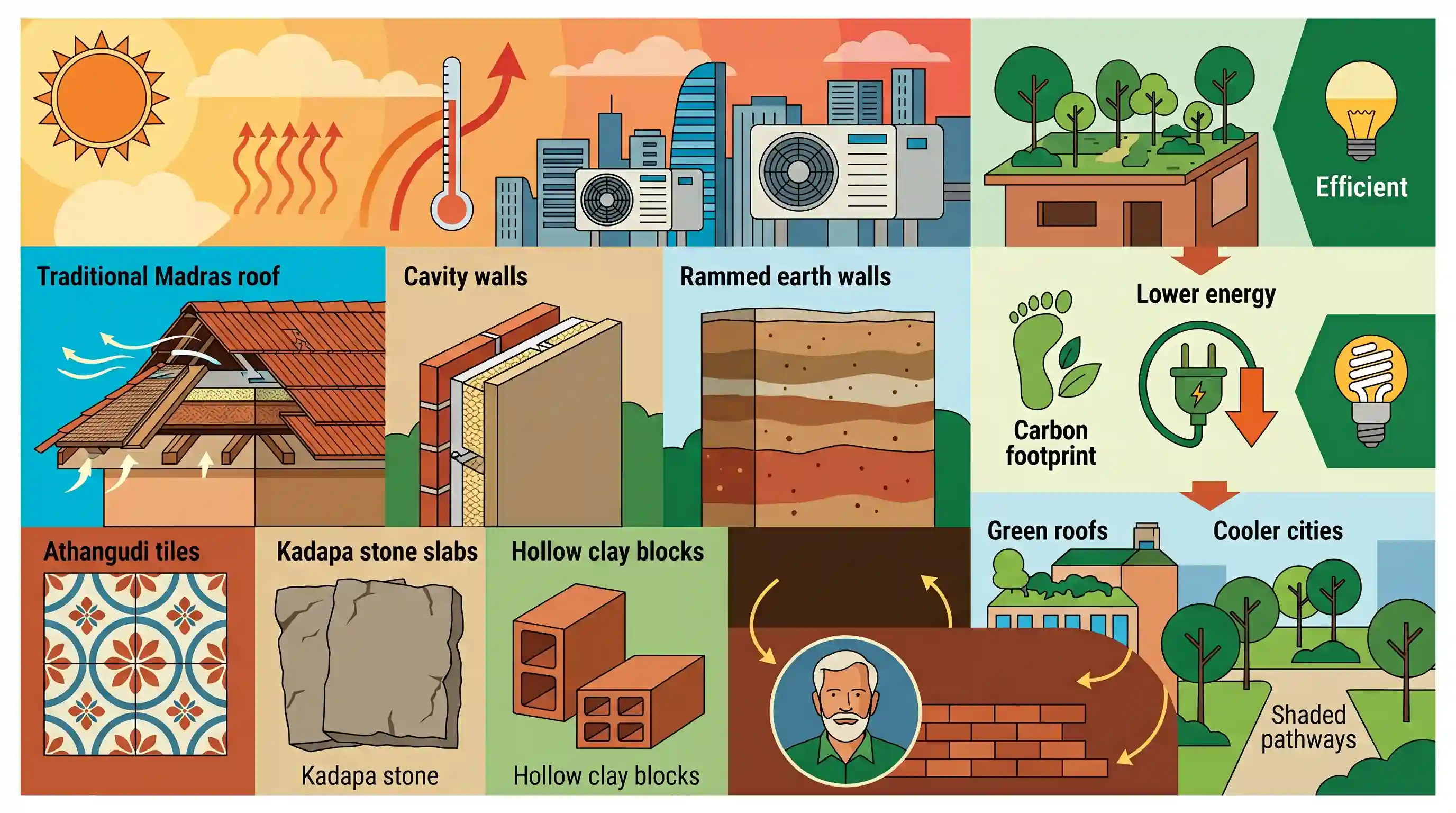
With urbanization and global warming increasing the severity of heatwaves in India, transitioning to climate-resilient, energy-efficient buildings is essential. It helps mitigate the urban heat island effect, cuts carbon footprints, and reduces the immense power demand generated by heavy air conditioning usage.
Summary
The article highlights the growing trend in India of constructing climate-resilient homes that minimize reliance on air conditioners amid rising temperatures and frequent heatwaves. By leveraging indigenous architectural techniques—such as Madras roofs, cavity walls, and rammed earth walls—and eco-friendly materials like Athangudi tiles, Kadapa stone, and hollow clay blocks, modern architects are reviving traditional knowledge. This sustainable approach reduces the carbon footprint and energy consumption of buildings, providing effective mitigation against urban heat islands while championing the energy-efficient philosophies pioneered by architects like Laurie Baker.
Key Points
- Rising heatwaves and urban temperatures in India are driving the adoption of climate-resilient architecture to naturally cool homes and minimize AC dependence.
- Architects are reviving traditional, eco-friendly materials such as Athangudi tiles (sun-dried, unbaked), Kadapa stone (black limestone), and terracotta hollow blocks for superior thermal insulation.
- Indigenous techniques like the 'Madras roof'—which uses lime mortar, fermented jaggery, and aloe vera extracts—and 'cavity walls' create effective thermal breaks against outside heat.
- Using excavated soil for 'rammed earth walls' significantly cuts down the carbon footprint by avoiding the high-energy manufacturing processes of standard cement bricks.
- Repurposing structural elements from demolished heritage structures, such as wooden pillars and Mangalore tiles, reduces material waste and promotes circularity in construction.
- The sustainable building philosophy of architect Laurie Baker, focusing on cost-effective and energy-efficient designs, is experiencing a major revival.
- Innovations like Ant Studio's 'CoolAnt' system utilize terracotta tubes and water to provide zero-emission evaporative cooling at an industrial scale.
Important Terms
Urban Heat Island (UHI) Effect

The phenomenon where urban regions experience significantly higher temperatures than surrounding rural areas due to heat-trapping surfaces like concrete and asphalt.
UPSC context
GS Paper I (Geography) and III (Environment); crucial for questions on sustainable urbanization and climate adaptation.
Laurie Baker
A British-born Indian architect known as the 'Gandhi of Architecture' for pioneering cost-effective, energy-efficient, and sustainable vernacular building techniques in India.
UPSC context
GS Paper I (Art & Culture/Modern Architecture) and GS III (Infrastructure); tests knowledge of indigenous sustainable design.
Vernacular Architecture
An architectural approach that uses locally available materials and traditional techniques to create buildings adapted to the local climate and environment.
UPSC context
GS Paper I (Heritage and Culture); relevant for discussing India's traditional ecological knowledge and sustainable living.
Ant Studio
A New Delhi-based architectural firm led by Monish Siripurapu, known for 'Beehive'—a nature-inspired evaporative cooling system using terracotta cones and water.
UPSC context
GS Paper III (Science & Technology/Environment); represents modern innovations in biomimicry and energy-efficient cooling.
Rat-trap Bond
A brick masonry method where bricks are placed on edge to create a cavity, providing thermal insulation and reducing material cost.
UPSC context
GS Paper III (Infrastructure/Environment); a specific technical example of low-cost, climate-resilient construction.
Sathya Consultants
A Bengaluru-based firm founded by Sathya Prakash Varanashi that specializes in eco-friendly, cost-effective residential architecture rooted in vernacular traditions.
UPSC context
GS Paper III (Environment); illustrates the practical application of sustainable urban design in modern India.
Iki Builds
A Hyderabad-based architecture firm led by Vamshidhar Reddy that focuses on circular design and climate-resilient homes using salvaged and traditional materials.
UPSC context
GS Paper III (Environment/Disaster Management); highlights regional efforts to mitigate extreme heat through architectural adaptation.
Prelims Trap
"Athangudi tiles are kiln-baked at high temperatures to provide superior thermal insulation for climate-resilient homes."
Athangudi tiles are actually sun-dried and unbaked. This eliminates the high-energy kiln firing process entirely, which is the primary reason for their low carbon footprint.
Static Concepts Connected
What are the primary factors driving the Urban Heat Island (UHI) effect?
- Low Albedo Surfaces: Concrete, asphalt, and brick have lower albedo than natural ground, absorbing and trapping solar radiation.
- Anthropogenic Heat: Waste heat expelled by vehicle exhausts, industrial facilities, and air conditioning units warms the local air.
- Loss of Evapotranspiration: Replacing vegetation with impermeable surfaces drastically reduces natural cooling caused by plant transpiration and water evaporation.
What are India's primary frameworks and rating systems for green buildings?
- GRIHA: Green Rating for Integrated Habitat Assessment, the national rating system jointly developed by TERI and MNRE.
- IGBC: Part of the Confederation of Indian Industry (CII), it offers various green rating programs for buildings and cities.
- Eco-Niwas Samhita: The Energy Conservation Building Code for residential buildings launched by the Bureau of Energy Efficiency (BEE).
Cross-Topic Patterns
Vernacular Architecture + Indigenous Crafts
Athangudi tiles and indigenous building materials reflect a trend of utilizing traditional knowledge for climate action. This connects GS1 Art & Culture directly with GS3 Climate Change mitigation.
Urban Heat Islands + Energy Security
Passive cooling techniques mitigate localized UHI warming while simultaneously reducing peak grid power demand from ACs, bridging GS1 urban geography with GS3 energy security.

Expect a GS1 or GS3 question linking indigenous building techniques (Athangudi tiles, Madras roofs) to UHI mitigation and energy security.
Linked PYQs · 4
Linked PYQs · 4
- 2013MainsGS1
Bring out the causes for the formation of heat islands in the urban habitat of the world.
- 2012MainsGS1
Why is Laurie Baker called 'the conscience keeper of Indian architecture'?
- 2022MainsGS3
Discuss global warming and mention its effects on the global climate. Explain the control measures to bring down the level of greenhouse gases which cause global warming, in the light of the Kyoto Protocol, 1997.
- 2018MainsGS1
The ideal solution of depleting ground water resources in India is water harvesting system." How can it be made effective in urban areas?
