Mineral Governance and Clean Energy Transition Strategies for India
Source:Indian Express ↗
Why It Matters
Critical minerals are essential for achieving India's ambitious climate goals (like the net-zero target by 2070) and advancing self-reliance in emerging technologies. Understanding the legislative reforms (MMDR Act) and geopolitical strategies to secure these resources is vital for both Prelims (properties and uses of minerals) and Mains (resource security, IR, and environmental impact of mining).
Summary
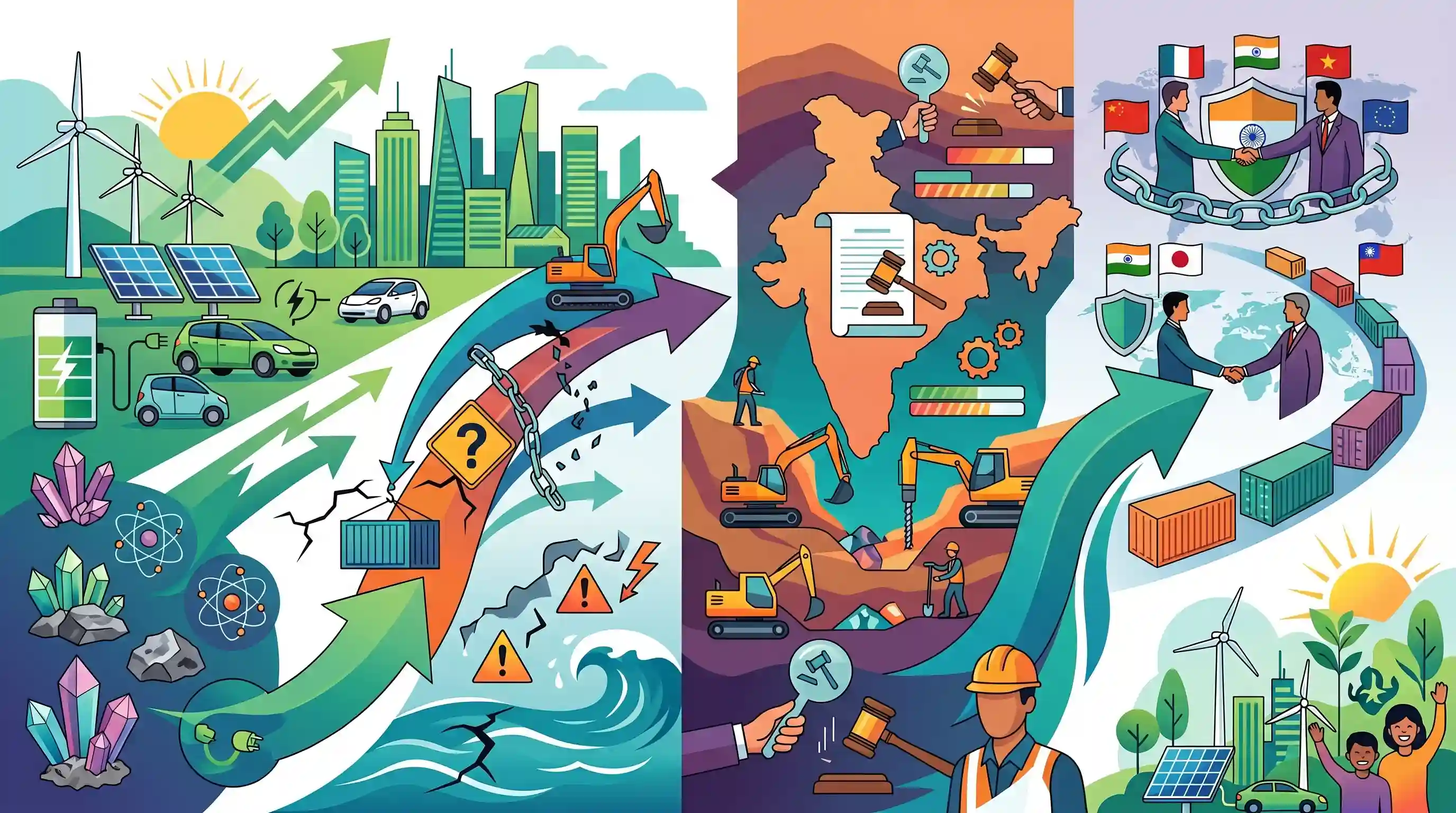
The article explores the intersection of clean energy requirements, emerging technologies, and the evolving landscape of mineral governance in India. It underscores the strategic imperative of securing critical minerals like lithium and rare earths to fuel the transition to a low-carbon economy. To reduce import dependencies and vulnerability to geopolitical supply chain disruptions—particularly concerning China—India has introduced key amendments to the MMDR Act to spur domestic exploration and auctioning of critical minerals. Additionally, strategic international alliances, such as the Mineral Security Partnership, are highlighted as essential steps to ensure a resilient and sustainable supply chain for the future.
Key Points
- Critical minerals, including lithium, cobalt, and rare earth elements, are foundational for manufacturing clean energy technologies such as electric vehicle batteries and renewable energy storage systems.
- India's clean energy transition and technological sovereignty require secure supply chains for critical minerals to mitigate risks associated with heavy reliance on dominant global suppliers like China.
- The government has amended the Mines and Minerals (Development and Regulation) Act to facilitate the exploration and auction of deep-seated and critical minerals by encouraging private sector participation.
- International collaborations, such as India's entry into the US-led Mineral Security Partnership (MSP), play a vital role in diversifying supply sources and building resilient global mineral value chains.
- Effective mineral governance must balance aggressive exploration and extraction targets with environmental sustainability and the adoption of new, cleaner mining technologies.
Important Terms
Mines and Minerals (Development and Regulation) Act (MMDR Act)

An Act regulating India's mining sector, recently amended in 2023 to allow private sector exploration of 24 'critical and strategic' minerals and introduce central auctioning for these resources.
UPSC context
GS Paper 2 (Legislation) and GS Paper 3 (Mining Sector Reforms). Tests understanding of regulatory shifts and private sector participation.
Mineral Security Partnership (MSP)
A US-led alliance of 14 countries and the EU that India joined in 2023 to secure sustainable critical mineral supply chains and reduce global dependency on China.
UPSC context
GS Paper 2 (International Relations) and GS Paper 3 (Energy Security). Tests knowledge of strategic alliances and resource diplomacy.
Critical Minerals
Metallic or non-metallic elements (e.g., Lithium, Rare Earths) essential for modern technologies and national security, characterized by high supply risk and significant economic impact.
UPSC context
GS Paper 1 (World Resources) and GS Paper 3 (Economy/Environment). Vital for topics on the green energy transition and high-tech manufacturing.
National Critical Mineral Mission (NCMM)
A mission approved in 2025 to achieve self-reliance in critical minerals through a framework encompassing domestic production, recycling, and the acquisition of overseas mineral assets.
UPSC context
GS Paper 3 (Economic Development/Energy). Relevant for questions on Atmanirbhar Bharat and India's 2070 Net Zero targets.
Exploration Licence (EL)
A new mineral concession introduced via the 2023 MMDR amendment to encourage private sector and foreign investment in exploring deep-seated minerals like gold, silver, and copper.
UPSC context
GS Paper 3 (Investment Models/Mining). Focuses on ease of doing business and technological infusion in the extractive industries.
Khanij Bidesh India Ltd. (KABIL)
A joint venture company of three Indian PSUs (NALCO, HCL, MECL) mandated to identify, acquire, and develop strategic mineral assets abroad to ensure domestic supply security.
UPSC context
GS Paper 3 (Resource Security). Tests knowledge of institutional mechanisms for securing energy and manufacturing inputs internationally.
Prelims Trap
Lithium and Niobium are classified as atomic minerals and reserved exclusively for public sector mining.
The 2023 MMDR Amendment explicitly removed six minerals, including Lithium and Niobium, from the 'atomic minerals' list, allowing commercial mining and private sector exploration.
Static Concepts Connected
How is mineral ownership and regulation divided in India?
- State vs Centre: State governments own onshore minerals and conduct auctions, while the Centre owns offshore minerals (EEZ) and prescribes rules for major, atomic, and critical minerals.
- Allocation Mechanism: Since the 2015 MMDR amendment, mineral concessions are granted transparently through competitive e-auctions rather than discretionary government allocations.
- Welfare & Exploration: The Act mandates District Mineral Foundations (DMF) for mining-affected community welfare and the National Mineral Exploration Trust (NMET) for regional exploration.
What defines Rare Earth Elements (REEs) in the UPSC syllabus?
- Composition: REEs comprise 17 elements (15 lanthanides plus Scandium and Yttrium) crucial for manufacturing high-tech electronics, permanent magnets, and defense systems.
- The Misnomer: They are relatively abundant in Earth's crust but are deemed 'rare' because they are highly dispersed and rarely found in concentrated, economically mineable ore deposits.
- Indian Reserves: In India, REEs are primarily extracted from monazite sand deposits found predominantly along the beaches of Kerala, Tamil Nadu, and Odisha.
Cross-Topic Patterns
EV vs Fuel Cell Geopolitics
Critical mineral dependencies for EV batteries (Lithium, Cobalt) shift geopolitical leverage to South America/China, whereas Hydrogen Fuel Cells rely heavily on Platinum Group Metals concentrated elsewhere.
KABIL and Latin American Diplomacy
Securing lithium brine blocks in Argentina physically connects India's domestic MMDR reforms to its evolving 'Global South' resource diplomacy in the Lithium Triangle (Chile, Argentina, Bolivia).
The Paradox of Green Mining
India's transition to renewables involves severe environmental trade-offs, particularly water depletion from lithium brine extraction and radioactive hazards from domestic monazite processing.

Expect a 2026 multi-statement question linking MMDR Act private-sector reforms, KABIL overseas acquisitions, and the 14-nation MSP.
Linked PYQs · 5
Linked PYQs · 5
- 2025PrelimsGS1
In the context of electric vehicle batteries, consider the following elements : I. Cobalt II. Graphite III. Lithium IV. Nickel How many of the above usually make up battery cathodes?
- 2025PrelimsGS1
Consider the following statements : Statement I: Some rare earth elements are used in the manufacture of flat television screens and computer monitors. Statement II : Some rare earth elements have phosphorescent properties. Which one of the following is correct in respect of the above statements?
- 2025MainsGS3
Mineral resources are fundamental to the country's economy and these are exploited by mining. Why is mining considered an environmental hazard? Explain the remedial measures required to reduce the environmental hazard due to mining.
- 2024MainsGS2
‘The West is fostering India as an alternative to reduce dependence on China's supply chain and as a strategic ally to counter China's political and economic dominance.’ Explain this statement with examples.
- 2022MainsGS2
‘Clean energy is the order of the day.’ Describe briefly India's changing policy towards climate change in various international fora in the context of geopolitics.
