Community Led Groundwater Recharge and Desertification Mitigation
Source:The Hindu ↗
Why It Matters
Provides an excellent international case study of grassroots innovation in climate change adaptation. The 'water guardians' model can be cited in Mains answers regarding strategies to combat desertification, groundwater recharge techniques, and the role of local communities in environmental conservation.
Summary
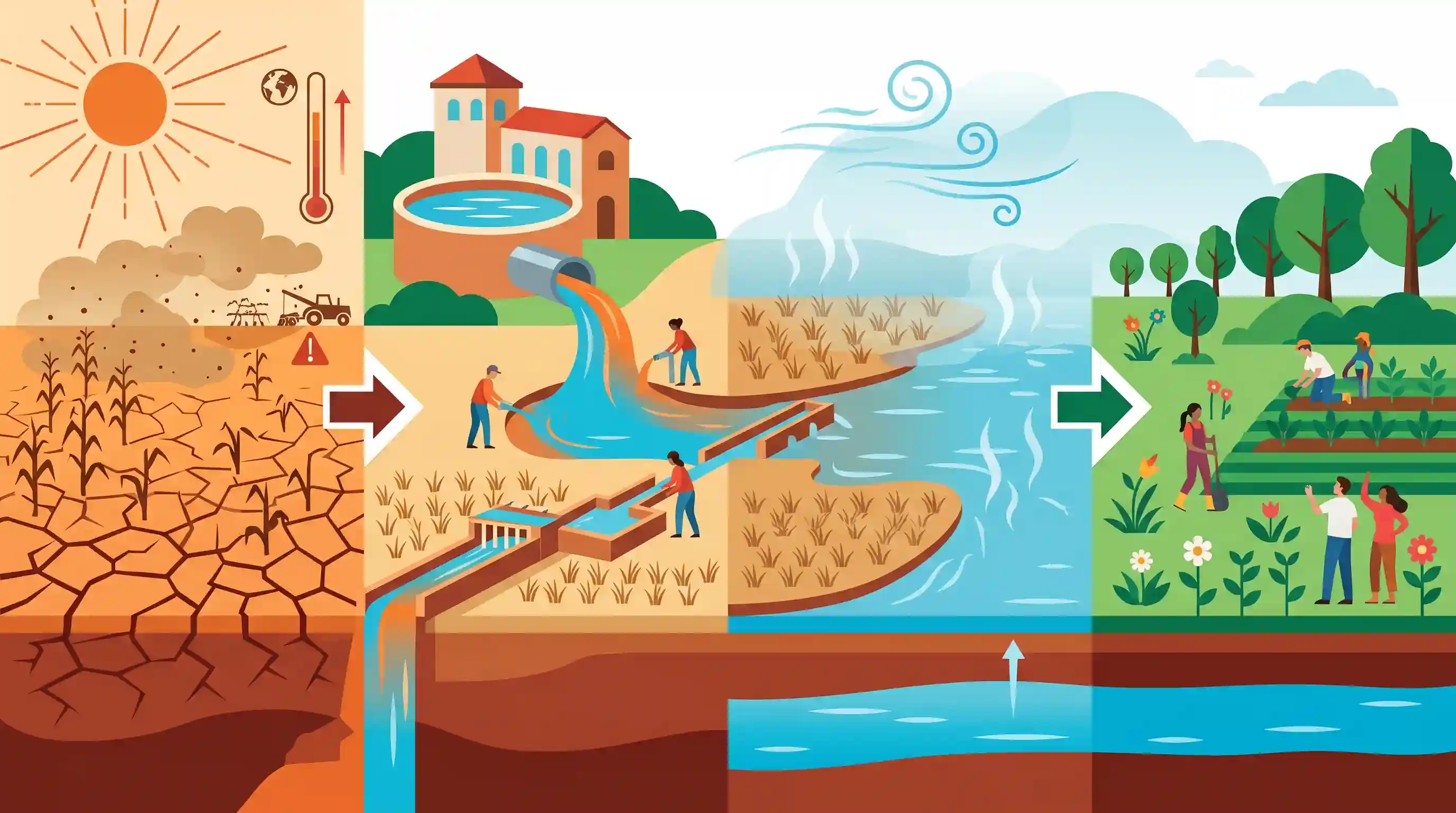
The Homokhátság region in Hungary's Great Hungarian Plain is experiencing severe aridification due to climate change and poor land management. In response, local community volunteers known as 'water guardians' have pioneered a method to combat desertification by using overflow thermal water from local spas to artificially flood low-lying fields. This initiative mimics natural flooding, raises the depleted groundwater levels, and creates a moist microclimate through surface evaporation. The resulting increase in humidity and reduction in temperatures and dust levels have facilitated the revival of local vegetation, offering a successful model for community-driven environmental restoration and water management.
Key Points
- The Homokhátság region in Hungary is facing severe aridification and desertification driven by a combination of climate change and historically inappropriate land use.
- Local volunteers known as 'water guardians' have launched a grassroots initiative to combat the drying up of the land by utilizing overflow thermal water from nearby spas.
- They artificially flood low-lying fields, which mimics natural flood events and helps recharge the severely depleted groundwater table.
- The standing water creates a localized microclimate through surface evaporation, which increases humidity, lowers ambient temperatures, and reduces airborne dust.
- This community-led, low-cost environmental management model successfully supports the revival of local vegetation and enhances regional climate resilience.
Important Terms
Desertification

Land degradation in arid, semi-arid, and dry sub-humid areas resulting from factors like climatic variations and human activities.
UPSC context
GS Paper I (Geography) and Paper III (Environment); key for UNCCD and land degradation topics.
Aridification
The long-term trend of a region becoming increasingly dry, marked by a decline in soil moisture and water availability.
UPSC context
GS Paper III (Climate Change); tests precision in describing permanent climatic shifts versus temporary droughts.
Nature-based Solutions (NbS)
Actions to protect and restore ecosystems to address societal challenges like climate change while providing biodiversity benefits.
UPSC context
GS Paper III (Conservation); frequent in questions regarding climate adaptation and sustainable development.
Groundwater Recharge
The hydrologic process where surface water moves downward into an aquifer, replenishing depleted underground water tables.
UPSC context
GS Paper III (Water Resources); vital for sustainable agriculture and addressing India's groundwater crisis.
Microclimate
A local set of atmospheric conditions that differ from those in the surrounding areas, often influenced by water or vegetation.
UPSC context
GS Paper I (Physical Geography); relevant for local weather modifications and ecological restoration studies.
Water Guardians
A volunteer group in Hungary using thermal spa overflow to flood parched fields and restore the local ecosystem.
UPSC context
GS Paper III (Community Participation); an international case study for grassroots environmental activism.
Homokhátság
A sandy ridge region in the Great Hungarian Plain experiencing severe desertification and groundwater depletion.
UPSC context
GS Paper I (World Geography); specific case study of climate-induced aridification in temperate regions.
Prelims Trap
"Desertification refers exclusively to the natural expansion of existing deserts driven by climate change."
Desertification is not just the physical expansion of deserts. It is land degradation in arid, semi-arid, and dry sub-humid areas primarily caused by human activities (poor land use) and climatic variations.
Static Concepts Connected
What is the UNCCD framework for tackling desertification?
- UNCCD Definition: Defined as land degradation in arid, semi-arid, and dry sub-humid areas resulting from various factors, including climatic variations and human activities.
- LDN Target: SDG 15.3 aims to achieve Land Degradation Neutrality (LDN) globally by 2030, balancing land degradation with restoration.
- India's Pledge: India has committed to restoring 26 million hectares of degraded land by 2030 under its UNCCD obligations.
Which traditional Indian water systems rely on similar runoff retention?
- Johads: Small earthen check dams in Rajasthan/Haryana that capture and conserve rainwater, heavily promoted by 'Waterman' Rajendra Singh to revive local rivers.
- Ahar-Pynes: Traditional floodwater harvesting systems in South Bihar that utilize channels and retention ponds for agricultural resilience.
- Khadins: Runoff agricultural systems in Rajasthan using earthen embankments to capture surface water and increase soil moisture.
Cross-Topic Patterns
Community Water Harvesting Models
Hungary's 'water guardians' mirror India's Tarun Bharat Sangh's Johad revival in Rajasthan. Both prove decentralized, community-led surface runoff retention effectively restores microclimates and depleted groundwater.
Circular Water Economy & Adaptation
Repurposing treated thermal spa overflow for agricultural flooding links recreational wastewater to climate adaptation, reinforcing circular water economy frameworks heavily emphasized in recent environmental policies.

Microclimate engineering via community water harvesting (e.g., Johads) combined with groundwater recharge impacts is highly probable in 2026.
Linked PYQs · 4
Linked PYQs · 4
- 2020MainsGS1
The process of desertification does not have climatic boundaries. Justify with examples.
- 2025MainsGS3
Examine the factors responsible for depleting groundwater in India. What are the steps taken by the government to mitigate such depletion of groundwater?
- 2020MainsGS3
Suggest measures to improve water storage and irrigation system to make its judicious use under depleting scenario.
- 2012MainsGS1
Examine the causes and the extent of 'desertification' in India and suggest remedial measures.
