Durga Puja sociocultural evolution and patronage transformation
Source:Indian Express ↗
Why It Matters
Understanding the socio-cultural evolution of Bengal's most prominent festival is crucial for questions regarding regional history, art, and UNESCO heritage listings relevant to West Bengal.
Summary
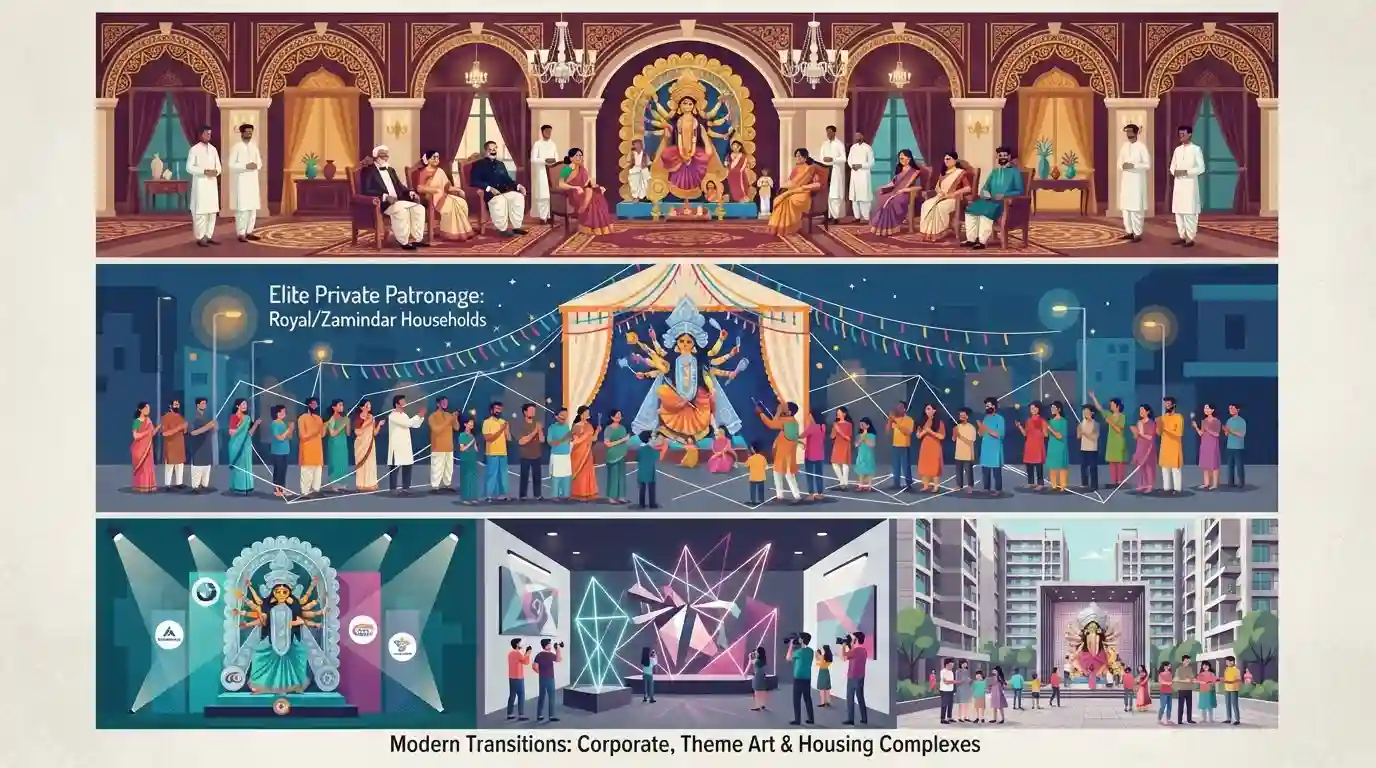
An analysis of the historical evolution of Bengal's Durga Puja, tracing its path from elite private patronage in royal/zamindar households to democratic public barowari festivals, and finally modern transitions involving corporate sponsorships, theme-based art, and private housing complex celebrations.
Key Points
- Durga Puja in Bengal has evolved from private zamindari patronage (Barabari/household pujas) to community-driven public celebrations (Barowari), and more recently, back toward corporate-sponsored and private gated celebrations (housing complexes/apartments).
- The festival serves as a major driver of West Bengal's creative economy, tourism, and intangible cultural heritage, highlighted by its inscription on the UNESCO Representative List of the Intangible Cultural Heritage of Humanity in 2021.
- The shift mirrors broader socio-economic changes in Bengal, transitioning from feudal agrarian elite sponsorship to urban democratic public participation, and now to neo-liberal commercialization and apartment-culture communities.
Important Terms
UNESCO

The United Nations specialized agency that promotes international collaboration in education, arts, sciences, and culture, and designates sites and traditions of global significance.
UPSC context
WBCS Paper I (History & Culture): Crucial for questions on international cultural recognition, India's intangible heritage listings, and West Bengal's global heritage status.
Static Concepts Connected
What are the historical origins and milestones of Barowari and Sarbojanin Durga Pujas in Bengal?
- Guptipara 1790: Guptipara origins: The first community Barowari puja was organized by twelve friends in Guptipara, Hooghly, in 1790 as an alternative to feudal household worship.
- Bhawanipur 1910: Bhawanipur milestone: The Bhawanipur Sanatan Dharmatsahini Sabha organized an inclusive public 'Sarbojanin' puja in Kolkata in 1910, institutionalizing democratic urban participation.
- UNESCO ICH List: UNESCO recognition: In December 2021, Durga Puja in West Bengal was inscribed on the UNESCO Representative List of the Intangible Cultural Heritage of Humanity.
Cross-Topic Patterns
Barowari Pujas and 19th-Century Public Nationalism
The evolution of Barowari festivals highlights the rise of urban public civic culture under colonial rule, paralleling the growth of early nationalist associations and public sabhas in 19th-century Bengal.
ICH Status and West Bengal's Creative Economy
UNESCO's ICH inscription transformed a local socio-religious festival into a major driver of cultural diplomacy, state tourism, and creative industries economics in West Bengal.

Durga Puja's historical evolution (Guptipara 1790, Bhawanipur 1910) and UNESCO ICH listing will appear in matching or chronological prelims questions.
Linked PYQs · 1
Linked PYQs · 1
- 2024WBCS_PRELIMSGS1
East Kolkata Wetland has been declared as
